St Mary the Virgin’s Church, Cavendish: A Medieval Church of England Parish Church
Site at a Glance
- Rating
- 4.1
- Popularity
- Very Low
- Country
- United Kingdom
- Primary era
- Medieval
- External website
- Open
- Eras represented
- Medieval, Early Modern
- Civilizations
- English
- Site type
- Religious
- Remains
- Church
On this page11 sections
History
St Mary the Virgin’s Church is a Church of England parish church in Cavendish, United Kingdom, whose present building was constructed mainly between about 1300 and 1485. Dedicated to St Mary, it belongs to the Diocese of St Edmundsbury and Ipswich, within the Suffolk Archdeaconry and Clare Deanery. The parish is part of the Stour Valley Team Ministry, alongside the parishes of Clare, Poslingford, Stoke-by-Clare, Wixoe, and Hundon. A Grade I listed building, it is recognized as having exceptional architectural or historic interest.
Medieval origins and construction
A church at Cavendish is recorded in the Domesday Book, the great survey of English landholding and resources commissioned by William the Conqueror in the late eleventh century. The oldest parts of the present building belong to about 1300. Its medieval development continued over nearly two centuries, producing the principal structure that stands today.
The south-aisle walls were rebuilt to their present height in 1350, when new windows were inserted. The chancel was made possible by a bequest from Sir John Cavendish in the 1380s. Sir John left the money as recompense after his son, also named John Cavendish, was held responsible for the death of Wat Tyler during the Peasants’ Revolt.
The Cavendish family and the Peasants’ Revolt
The connection between the church and the events of 1381 is especially direct. The Peasants’ Revolt was a major English uprising driven by resistance to taxation, social inequality, and aspects of royal administration. Wat Tyler was one of its principal leaders.
After Wat Tyler’s death, John Cavendish sought sanctuary at the church by grasping the handle of its door. He was taken to the market place at Bury St Edmunds, where a mob led by Jack Straw, one of the revolt’s prominent figures, beheaded him on 15 June 1381. John Cavendish was buried at Bury St Edmunds. The later bequest by his father helped provide the church with its chancel.
Later religious and civic history
Until the late 1530s, a chantry altar probably stood within the church, possibly in connection with a guild. A chantry was an endowed foundation supporting prayers or services for the dead. The altar area was later replaced by a tomb chest for Sir George Colt, who died in 1570.
In the early twenty-first century, the interior was adapted as a clean, bright, comfortable, and functional Anglican worship space. The church’s architectural and historical value has also shaped its modern interpretation. Simon Jenkins awarded it one star in England’s Thousand Best Churches.
Remains
Medieval fabric and exterior
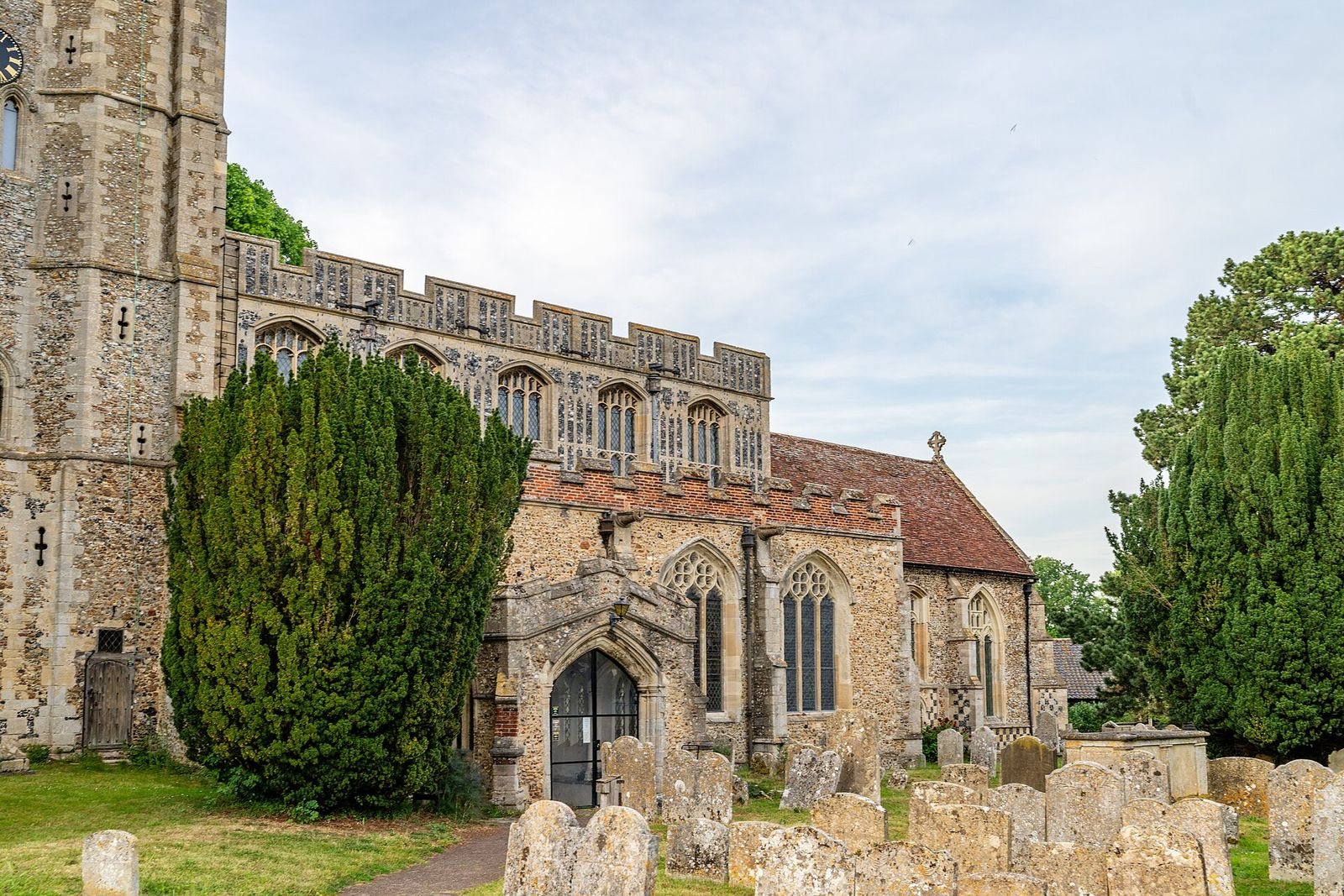
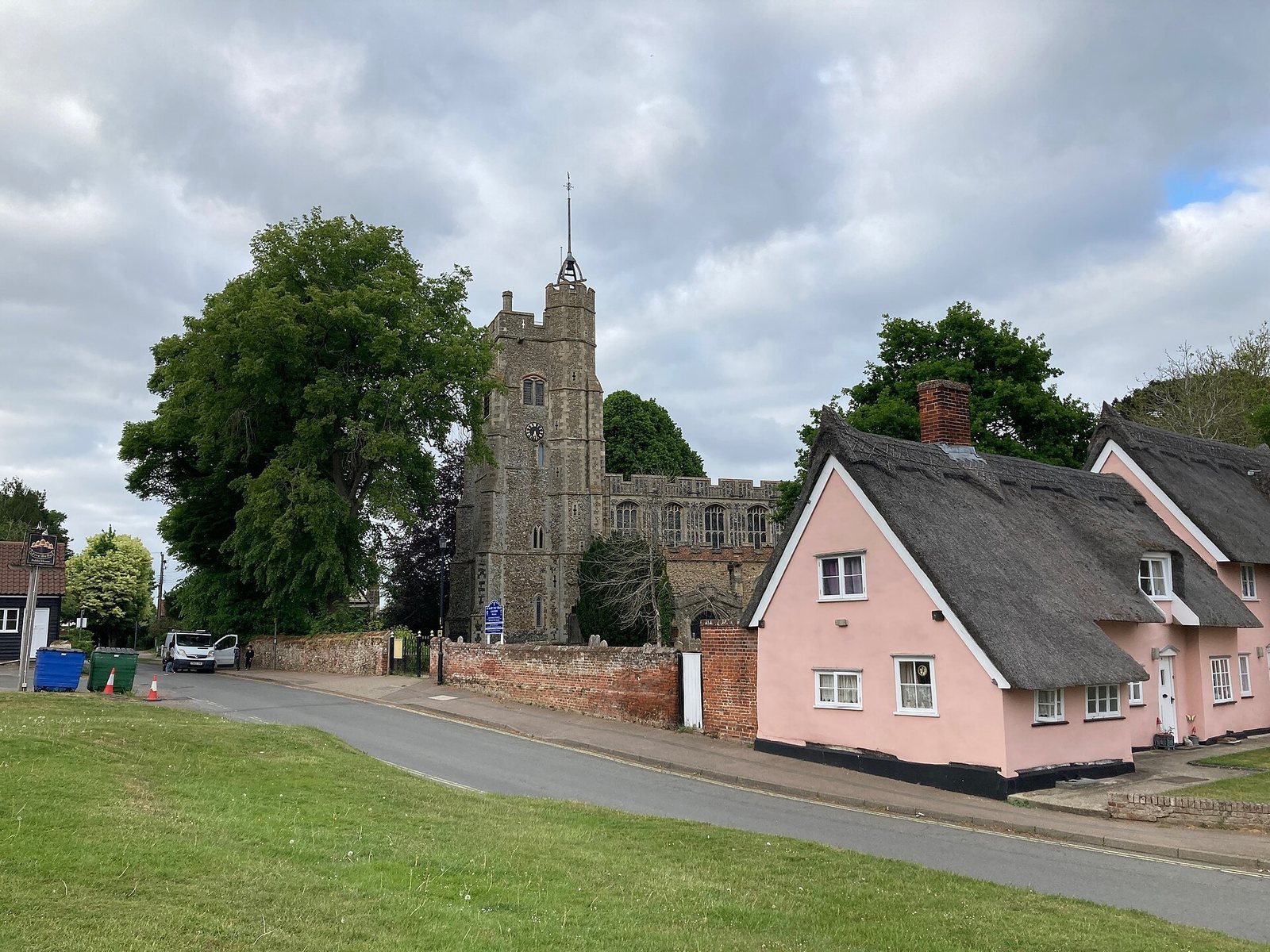
The church’s oldest surviving fabric includes the fourteenth-century tower, the porch, and the lower sections of the aisle walls. The south aisle reached its present wall height in 1350, when new windows were added. The exterior is faced with dressed flint, and a stair turret rises above the parapet. The fourteenth-century tower is surmounted by a lantern, giving the building a distinctive upper termination.
Chancel, nave, and aisles
The chancel forms the eastern part of the church and contains the principal altar. Its construction was supported by Sir John Cavendish’s bequest in the 1380s. The nave, the main body of the church, was probably the work of Reginald Ely, a medieval master mason and architect also associated with the design of King’s College Chapel in Cambridge. The aisles run alongside the nave as longitudinal subdivisions of the building.
Interior furnishings and memorials
Reredos and squint
A sixteenth-century Flemish reredos, an ornamental panel behind an altar, shows the Crucifixion. It stands in the north aisle within a frame designed by Sir Ninian Comper, a British church architect and designer known for Gothic Revival ecclesiastical interiors. A squint, or opening allowing a view toward the high altar, provided sight of the altar from the former chantry-altar area.
Colt tomb chest and later memorials
The tomb chest for Sir George Colt stands at the east end of the south aisle. Beside it, a canopied niche contains a modern image of the Madonna and Child. A large roundel memorial in the south aisle commemorates Sue Ryder and Leonard Cheshire, British organizers associated with major humanitarian and war-relief work after 1945.
Organ
The church contains a two-manual pipe organ made in 1884 by Henry Jones and Sons. It remains part of the building’s furnishings and supports its continuing use as an Anglican parish church.