Movilla Abbey: An Early Irish Monastic Foundation in Northern Ireland
Site at a Glance
- Popularity
- High
- Country
- United Kingdom
- Primary era
- Medieval
- Eras represented
- Medieval, Early Modern, Modern
- Civilizations
- British, English, Norman
- Site type
- Religious
- Remains
- Church
On this page13 sections
History
Movilla Abbey is an early Irish monastic site in Newtownards, County Down, Northern Ireland, above Strangford Lough. St Finnian founded it around 540 with the support of a king of Dál Fiatach, a ruling dynasty in the early Irish kingdom of Ulaid. The name derives from the Irish magh bile, meaning “plain of the notable tree,” and is linked to a sacred tree worshipped there before the monastery was established.
Foundation and early prominence
Finnian expanded the monastery’s school, called Druim Fionn. By the seventh century, Movilla had become one of Ireland’s leading centres of Celtic Christianity, the early medieval Christian traditions of Ireland and Britain. Its community devoted itself to worship, prayer, learning, missionary work, and trade. Finnian brought a complete Latin Vulgate Bible from Rome; at the time, it was said to be the only complete Bible in Ireland.
Columba, a pupil of Finnian, studied at Movilla and became a deacon there. Tradition credits him with performing early miracles at the monastery, including turning water into wine for the Eucharist, the Christian rite commemorating the Last Supper. He returned in the 550s to visit Finnian.
A later legend says that Columba secretly copied the monastery’s Scriptures. The copied text was eventually identified in tradition as the Cathach, a Psalter, or manuscript of the Psalms. Finnian brought the dispute to Diarmait mac Cerbaill, a king traditionally counted among the High Kings, rulers regarded as pre-eminent among Irish kings. The tale says that Diarmait ruled the copy belonged to Finnian, after which Columba returned it unwillingly and stirred an Uí Néill revolt. The resulting Battle of the Book was said to have caused about 3,000 deaths. The story, sometimes treated as an early copyright dispute, is regarded as a 16th-century invention.
Religious life and scholarship
In the seventh century, Pope Honorius I urged Irish churchmen to adopt the Roman method of calculating Easter, which differed from the Irish practice, and warned against Pelagianism, a teaching condemned by church authorities. Cronan of Movilla, whom Bede names Cromanus, may have received the letter. In the early eighth century, Colman, son of Murchu and bishop at Movilla, composed a hymn to St Michael. Its opening expresses hope in the Trinity and invokes the archangel.
Decline and Augustinian reform
Danish raids in 823 and 825 began Movilla’s decline. The abbey was united with Bangor Abbey in 910. In 1135, St Malachy of Armagh established an Augustinian community there. Augustinian canons were clergy who lived together under a rule based on the teachings of St Augustine, but this revival did not restore Movilla’s former standing.
By 1306, the abbey’s church property was valued at only two and a half marks, a medieval unit of account. Its poverty gave the Anglo-Normans little reason to take it over, and Irish abbots continued to serve there.
Dissolution and later use
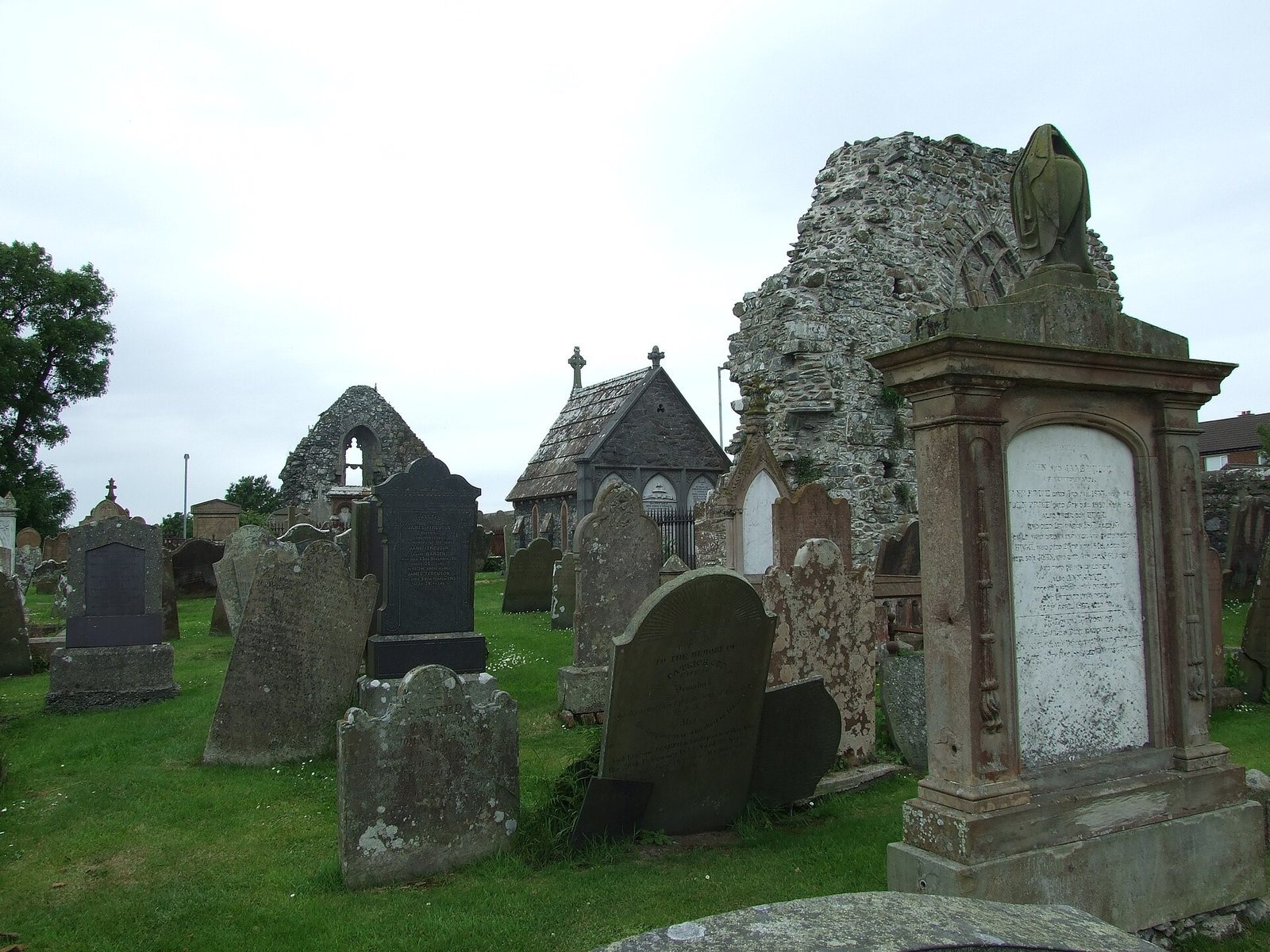
Henry VIII dissolved the abbey in 1542, as part of the closure and confiscation of religious houses in his reign. In 1572, Brian McPhelim O’Neill, a Gaelic lord of Clandeboye, burned Movilla and other religious houses in Ards to prevent English forces from using them as military garrisons. The grounds began to serve as a cemetery in the 17th century. Movilla Abbey, identified as a church of Augustinian canons, is now a State Care Historic Monument, a protected historic site in state care.
Remains
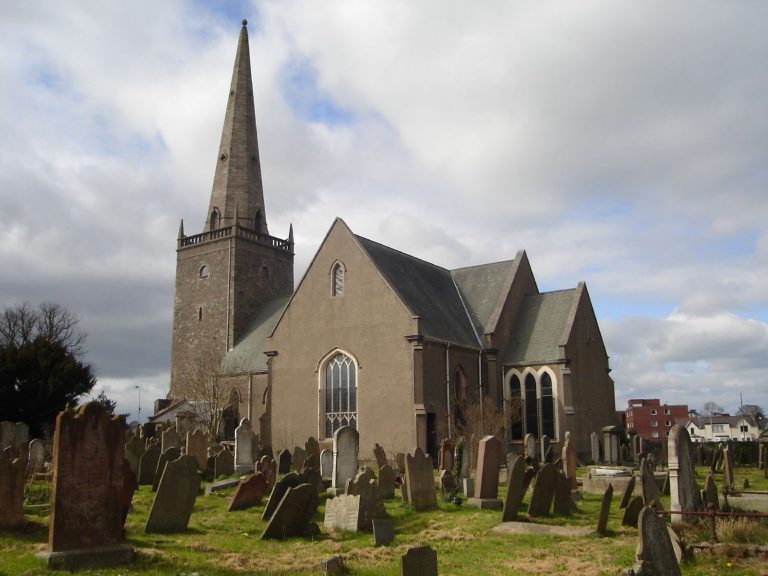
The standing ruins belong to a 15th-century Augustinian church, represented by two gables about 150 feet apart. The church’s interior measures 107 by 21 feet. The cemetery and excavated parts of the monastic site also preserve evidence of carved memorials, burial practices, and craft production.
The Augustinian church
The east wall’s former three-light window has two lights largely blocked, while the remaining light has a rounded Romanesque arch, a form associated with rounded arches. Two small carved heads sit near the top of the arch. The west wall has two window lights with trefoil heads, a three-lobed shape. Their horizontal bars, called transoms, retain traces of tracery, ornamental stonework dividing a window opening.
Cemetery features
Carved grave slabs
Seven tapered sandstone grave slabs are set into the north wall of the church ruins. Described as Anglo-Norman in origin, they date broadly from the 10th to 13th centuries and bear large crosses carved in relief, each with a different design. Slabs associated with men depict swords, while those linked with women show sickles and willow motifs. One carries the inscription “Or Do Dertrend,” translated as “a prayer for Dertriu.” The name is thought to refer to a 10th-century abbot of Movilla.
Stone coffer
A large stone coffer was found in the cemetery in the 19th century during excavation for a family burial vault. It lay on the slate bedrock, eight to ten feet below ground. The oblong trough measures 3 feet 8 inches long, 2 feet 8 inches wide, and 1 foot 10 inches high. Its interior is 26 by 14 inches and about 15 inches deep. Shallow panels decorate its exterior, and a ledge just below the top edge may have supported a stone lid.
Interpretations of the coffer include an early baptismal font hurriedly buried as Danish raiders approached, a lidded chest for church valuables, and the base of a carved cross. W. J. Patterson rejected the cross-base explanation, arguing that a shaft fitting the socket would have been too heavy for the base.
Later tombs and mausoleum
Among the cemetery’s memorials, the Corry family tomb dates from the early 17th century and is designed as a small temple in the Doric order, a classical architectural style. The Parr Mausoleum, built in 1860, uses the Gothic Revival style, which draws on medieval Gothic architecture.
Commonwealth war graves
The cemetery remains in use and contains 21 Commonwealth burials from the First World War and 24 from the Second World War. Seven of the Second World War burials are unidentified.
Excavated craft remains
Excavation of part of the monastic site near Movilla Road in 1980–81 uncovered industrial debris and objects associated with bronze and glass production. These finds provide evidence of the technical and artistic work carried out by early Christian craftsmen at Movilla.