Church of San Román: A Mudéjar Church and Museum in Toledo


Site at a Glance
- Rating
- 4.6
- Popularity
- Low
- Country
- Spain
- Primary era
- Medieval
- External website
- Open
- Eras represented
- Medieval, Early Modern
- Civilizations
- Crown of Castile, Spanish, Visigothic
- Site type
- Religious
- Remains
- Church
On this page10 sections
History
Church of San Román is a thirteenth-century Christian church in Toledo, Spain, built in the Mudéjar style, a medieval Iberian tradition that adapted Islamic architectural and decorative forms for Christian buildings. It stands on a site associated with a Visigothic basilica and probably with an earlier Roman structure. The building remains connected with Catholic worship and houses the Museum of the Councils and Visigothic Culture.
Earlier foundations and medieval consecration
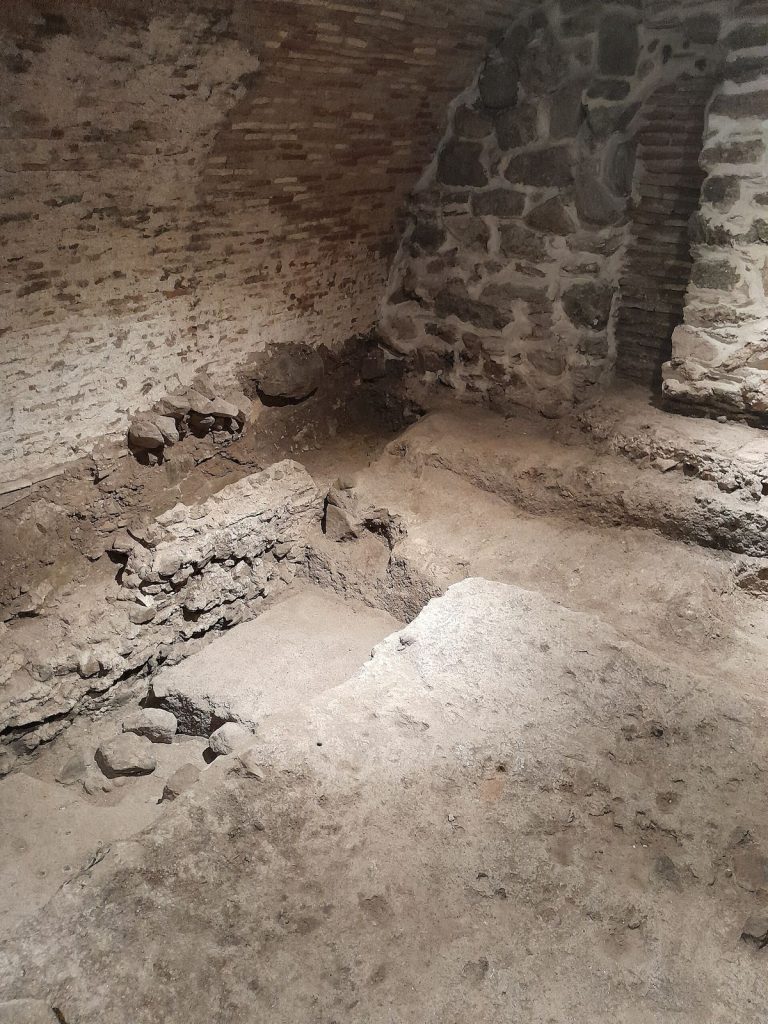
The parish of San Román is documented from the twelfth century. A crypt beneath the main chapel supports the presence of an earlier Visigothic phase, and it may later have been reused as a mosque. The church itself was consecrated in 1221 by Rodrigo Ximénez de Rada, the medieval archbishop of Toledo.
Tradition associates the church with a political event from the previous century. According to the longstanding account, Alfonso VIII of Castile was crowned king there on 26 August 1166 by Esteban Illán, a Castilian knight and nobleman. During the thirteenth century, the church received a new apse and its substantial Mudéjar tower. The tower later served as a model for other towers in Toledo.
Renaissance alteration and later rediscovery
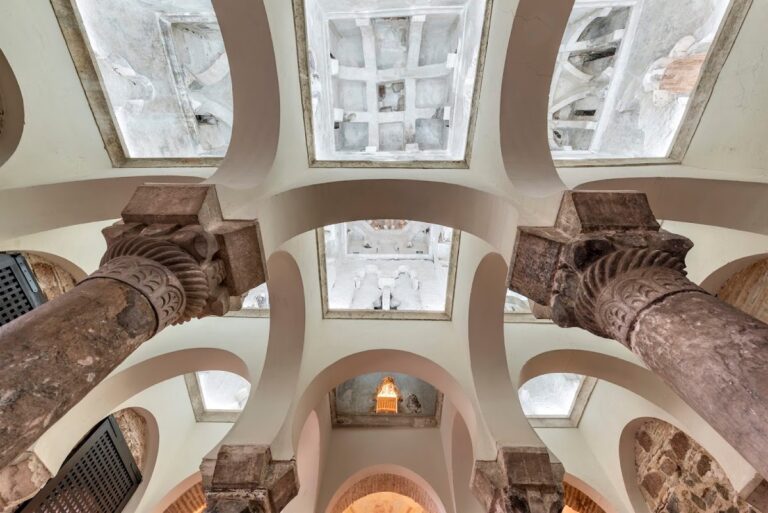
In the sixteenth century, Alonso de Covarrubias designed the apse and its Plateresque coffered dome for the main chapel. Plateresque was a Spanish Renaissance style noted for elaborate surface ornament and coffered architectural forms.
The church’s medieval mural paintings were subsequently covered with lime plaster. They came back to view during the first third of the twentieth century, and conservation work in the 1940s recovered the paintings where possible. The building was declared a national historical-artistic monument in 1931 and is protected under heritage legislation. It also forms part of the Historic City of Toledo, a designated cultural-heritage area.
Remains
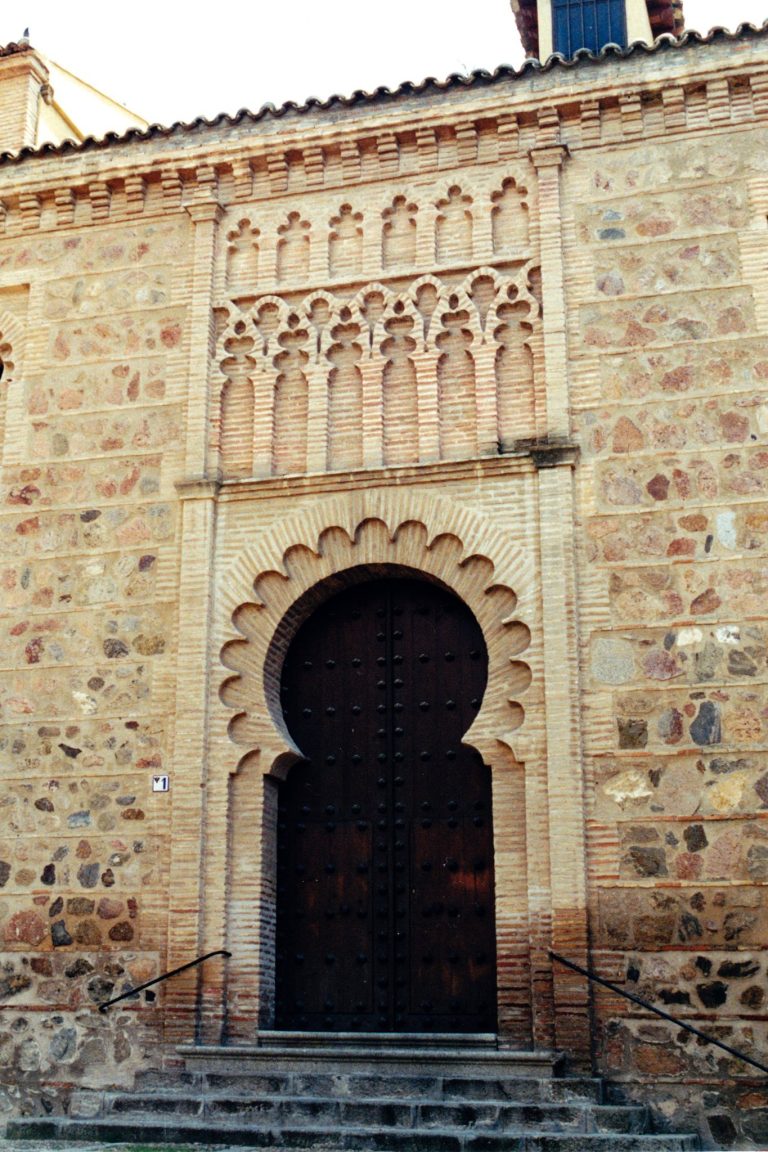
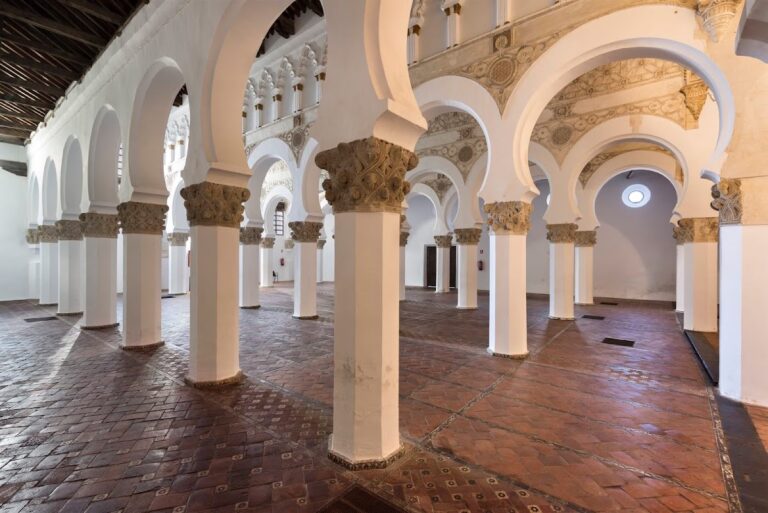
Church of San Román occupies one of Toledo’s highest locations, on the second of the city’s twelve hills. Its basilical plan has three naves divided by horseshoe arches framed by alfiz mouldings, rectangular surrounds placed around arches. The supports combine pillars with attached Roman and Visigothic columns, including reused Visigothic capitals decorated with Corinthian foliage. Above the church rises a robust Toledan Mudéjar tower whose two upper levels form a double belfry, with openings grouped in pairs and threes.
Medieval painted decoration
The interior walls and arches retain a fragmentary cycle of mural paintings dating approximately to the time of the 1221 consecration. They constitute the southernmost surviving ensemble of Romanesque paintings in Spain. Their imagery combines monumental Romanesque Christian figures, influenced by manuscript illumination and Byzantine art, with Mudéjar decoration. Arabic-script inscriptions praising the Virgin Mary frame some of the scenes.
Evangelists and saints
On the arch facing the Epistle nave and dividing it from the apsidal chapel, three seated human-animal figures at desks represent Matthew, Mark, and Luke. John appears on the adjoining wall, completing the tetramorph, the symbolic representation of the four evangelists through human or animal forms. The same wall and the intrados, or inner curve of the arch, contain saints including Eugenius, bishop of Toledo, and Isidore of Seville. Archbishops, Saints Stephen and Lawrence, and angels appear elsewhere in the painted decoration.
Last Judgment imagery
The southern wall preserves the figure of John and, beyond a heavily damaged section, a scene of the Resurrection of the Flesh at the Last Judgment. Trumpeting angels accompany the dead as they rise from their tombs and lift heavy stone slabs. The figures in the final part of the wall survive in a poorly preserved state.
Western wall and Paradise imagery
A horseshoe arch was opened in the western wall after the paintings had been completed, cutting through part of the painted surface. The damaged area probably depicted Paradise from the Fall onward. Fragments beside the tree and near the foot of the Epistle nave suggest the presence of Eve and a beardless image of God.
Central nave registers
At the foot of the central nave, the paintings are arranged in three registers. Isaiah and Jeremiah stand on either side of the upper register, which includes a rectangular window and two polylobed windows with elaborate Mudéjar decoration. Below them, twelve enthroned figures hold books against a branching leafy background. They may represent the apostles sheltered by the Tree of Paradise. A lower band contains twelve figures in white garments that may represent the elect in an apocalyptic vision. Other saints and prophets fill the arches and their undersides, while a Pantocrator, an image of Christ as almighty ruler, appears above the northern door. Some details belong to the Gothic period.
Main chapel and museum collection
The main chapel contains the sixteenth-century apse designed by Alonso de Covarrubias, together with its Plateresque coffered dome. The church also contains the Museum of the Councils and Visigothic Culture, whose displays include Visigothic-period art and replicas of objects from the Guarrazar Treasure. The museum’s name refers to the Councils of Toledo, ecclesiastical assemblies held in the city during late antiquity and the Visigothic period.