Church of San Andrés: A Historic Parish Church in Tenerife
Site at a Glance
- Rating
- 4.5
- Popularity
- Very Low
- Country
- Spain
- Primary era
- Early Modern
- External website
- Open
- Eras represented
- Early Modern, Modern
- Civilizations
- Crown of Castile, Spanish
- Site type
- Religious
- Remains
- Church
On this page14 sections
History
The Church of San Andrés is a Roman Catholic parish church in San Andrés, Santa Cruz de Tenerife, Spain, built by the Christian settlers of Tenerife in the period following the island’s conquest. Its origins probably date to around 1510 or earlier, making it one of the earliest Christian temples established on Tenerife. Today it belongs to the Diocese of San Cristóbal de La Laguna and serves San Andrés, Valleseco, San José de El Suculum, and Igueste de San Andrés.
Early chapel and the Salazar settlement
Lope de Salazar, the founder and first resident of the settlement, established an early chapel dedicated to Saint Andrew the Apostle and Saint Lucy of Syracuse. The chapel is dated either to about 1505–1510 or to around 1510 and earlier. By 1520 it was known as Our Lady of Salazar, and by about 1562 it had an altar. The building served the religious needs of the growing settlement in the Valley of Salazar.
The chapel was called the Chapel of San Andrés by 1619, when a baptism took place there. Regular religious use by the inhabitants of the valley is recorded from 1684. The original building was rebuilt as a full church between 1662 and 1680. A traditional belief holds that the present church occupies the foundations of the first chapel, although this has been questioned because a document indicates that the earlier structure had become dangerous by about 1624. Its position above a ravine appears to have required the chapel to be moved.
Parish foundation and devotional life
On 13 February 1747, Bishop Juan Francisco Guillén elevated the church to parish status. It became the first subsidiary parish of the Church of the Immaculate Conception in Santa Cruz, following a request from residents of San Andrés, Igueste, and Bufadero. The rector of the Church of the Immaculate Conception, Ignacio Logman, approved the request with the assent of Bishop Guillén.
Saint Andrew, one of the twelve apostles of Jesus and traditionally represented with an X-shaped cross, is the patron saint of San Andrés and is popularly regarded as the patron of the Anaga region, the mountainous area in northeastern Tenerife. Saint Lucy of Syracuse and Our Lady of Mount Carmel have also played important parts in local devotion. On 29 July 2012, the Bishop of Tenerife formally declared Our Lady of Mount Carmel co-patron of San Andrés.
The church’s religious life has included processions, confraternities, and pilgrimages. In 1659, the image of Saint Andrew was carried to San Cristóbal de La Laguna in a rogation, a penitential procession seeking divine help, to ask for an end to drought in the Valley of San Andrés. In 1863, the feast of Saint Andrew was held twice because the previous year’s celebration had been postponed until May amid fears that pilgrims might spread yellow fever from Santa Cruz de Tenerife. After a cholera pandemic ended, residents of San Andrés made a thanksgiving pilgrimage to the Royal Sanctuary of the Holy Christ of La Laguna in 1894.
The image of Our Lady of the Rosary was formerly carried through the village each 7 October while the faithful recited the Rosary, a practice that continued until the late 1990s. The maritime procession of Our Lady of Mount Carmel was established in 1951 and travels from San Andrés to Igueste de San Andrés in remembrance of those who died at sea. In January 1965, the image of Our Lady of Candelaria, patroness of the Canary Islands, stayed in the church for two nights during a tour of Tenerife’s villages.
The church remains associated with confraternities, Catholic lay associations organized around devotion and worship, dedicated to Our Lady of Mount Carmel, Saint Rita of Cascia, and Our Lady of Sorrows. Its annual religious calendar includes Holy Week and Corpus Christi processions, the feasts of Our Lady of Mount Carmel and Saint Andrew, and other processions connected with its images.
Restoration and continuing use
A major restoration in the late 1970s replaced the roof and uncovered the stone arch and red volcanic tuff that had been covered. The church closed on 12 November 2014 for another restoration. This work repaired the roof, secured detached parts of the bell gable, renewed the low-voltage electrical system, and added fire protection suited to the building’s heritage value. The church reopened on 28 November 2016 after two years of work.
Remains
Layout and exterior
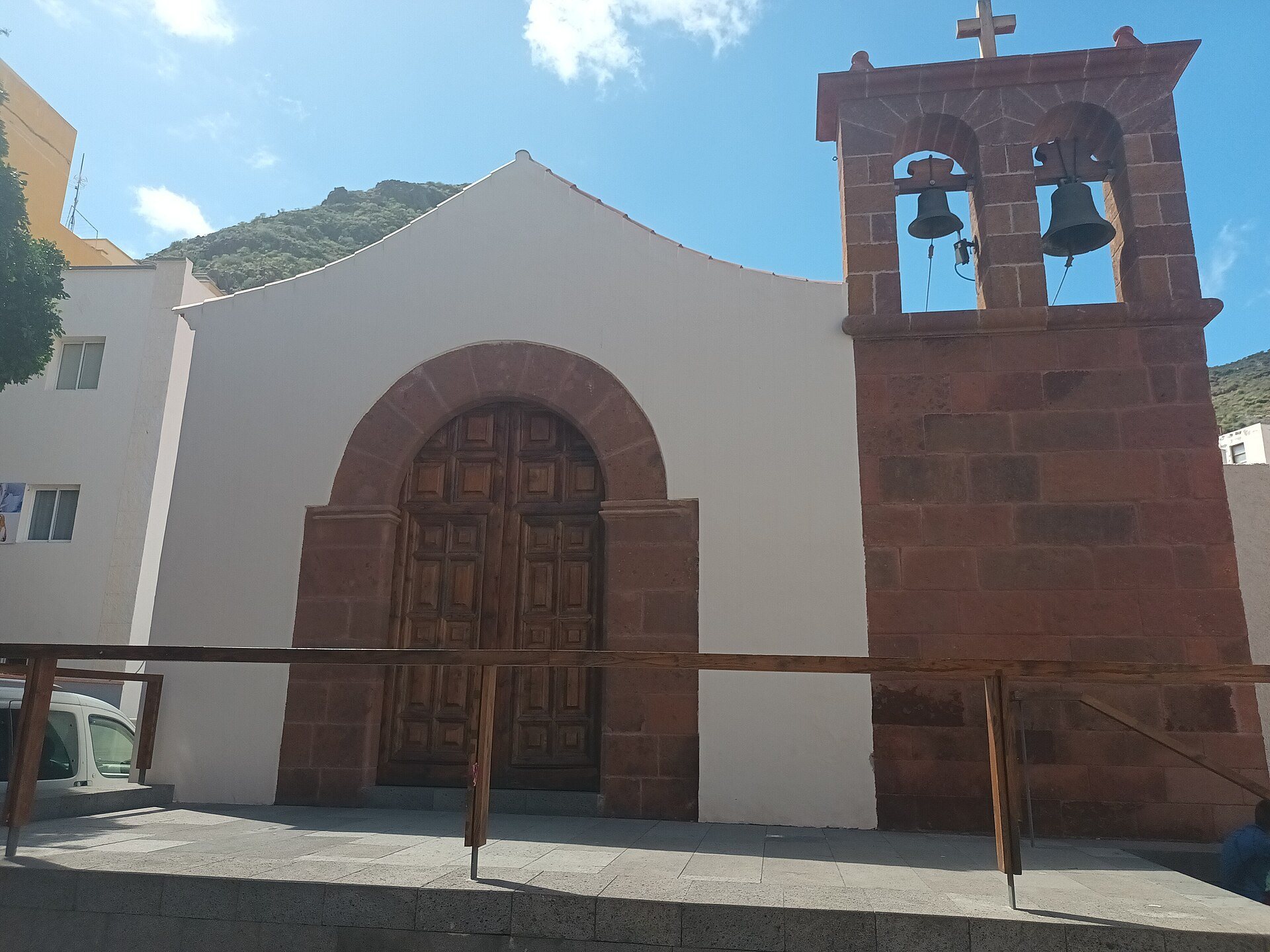
The church occupies the centre of the historic settlement beside Church Square. It is a whitewashed example of popular Canarian architecture, with a tiled roof, a floor area of approximately 259.24 square metres, and a long east-west plan. The main entrance faces east and is reached by a staircase because the church floor stands above street level. A secondary doorway opens on one side. The building is long and narrow, with a single nave, meaning one principal internal worship space.
A side bell gable, the projecting structure that holds the bells, rises above the building and carries two bells of unequal size with a cross at its summit. Both the gable and the entrance arch are made from red volcanic tuff taken from the Valley of San Andrés. The larger bell bears the words “AVE MARIA”; its date and original provenance are unknown, although its purchase on 20 December 1849 is recorded. The smaller bell is British and bears the inscription “S.S. WESTBURN 1893 SUDERLAND.” The steamship Westburn was captured during the First World War and later sunk by German forces near San Andrés.
Interior spaces and principal furnishings
Main chapel and altar
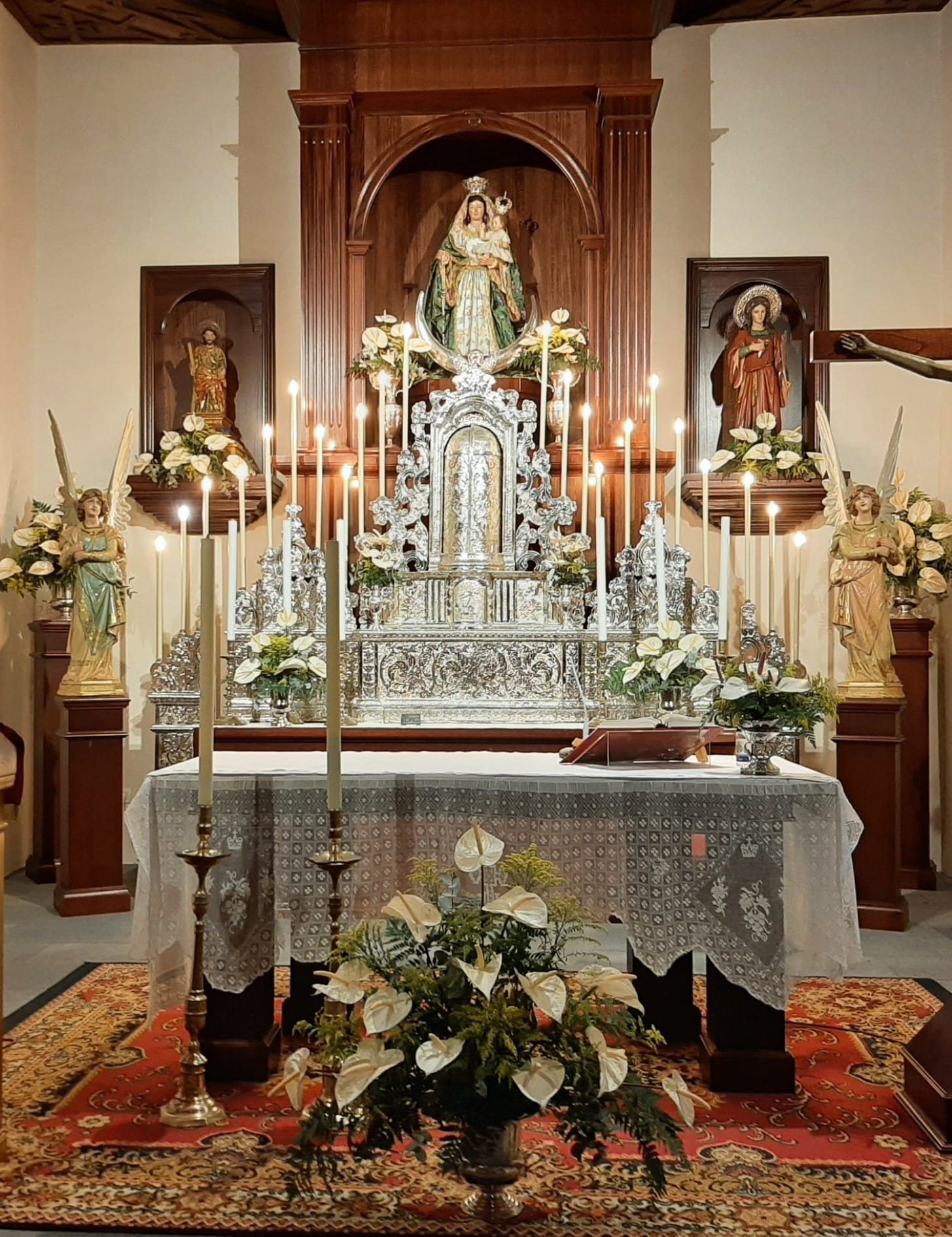
The wooden ceiling of the nave is made from barbusano, a laurel-family hardwood native to the Canary Islands and Madeira. Niches in the walls hold religious images and paintings. A stone arch separates the nave from the main chapel, which stands two steps higher. Two windows are set in the chapel’s side walls. Behind the altar is a silver-and-nickel tabernacle, the fixed receptacle for the consecrated Eucharist, made by the La Laguna silversmith Rafael Trujillo Forte in the late nineteenth century.
The main altarpiece contains the eighteenth-century dressed image of Our Lady of the Rosary. She holds the Christ Child on her left arm and a rosary in her right hand, while a silver crescent moon rests at her feet. Beneath the crescent is the silver tabernacle with the monstrance, the vessel used to display the consecrated Eucharist during adoration or procession. Niches beside the central image contain Saint Andrew and Saint Lucy of Syracuse. The Saint Lucy image is a twentieth-century serial work from the Olot workshops, Spanish manufacturers known for devotional sculptures. She carries a martyr’s palm and a cup containing her eyes, her traditional attributes.
Christ of the Cegato
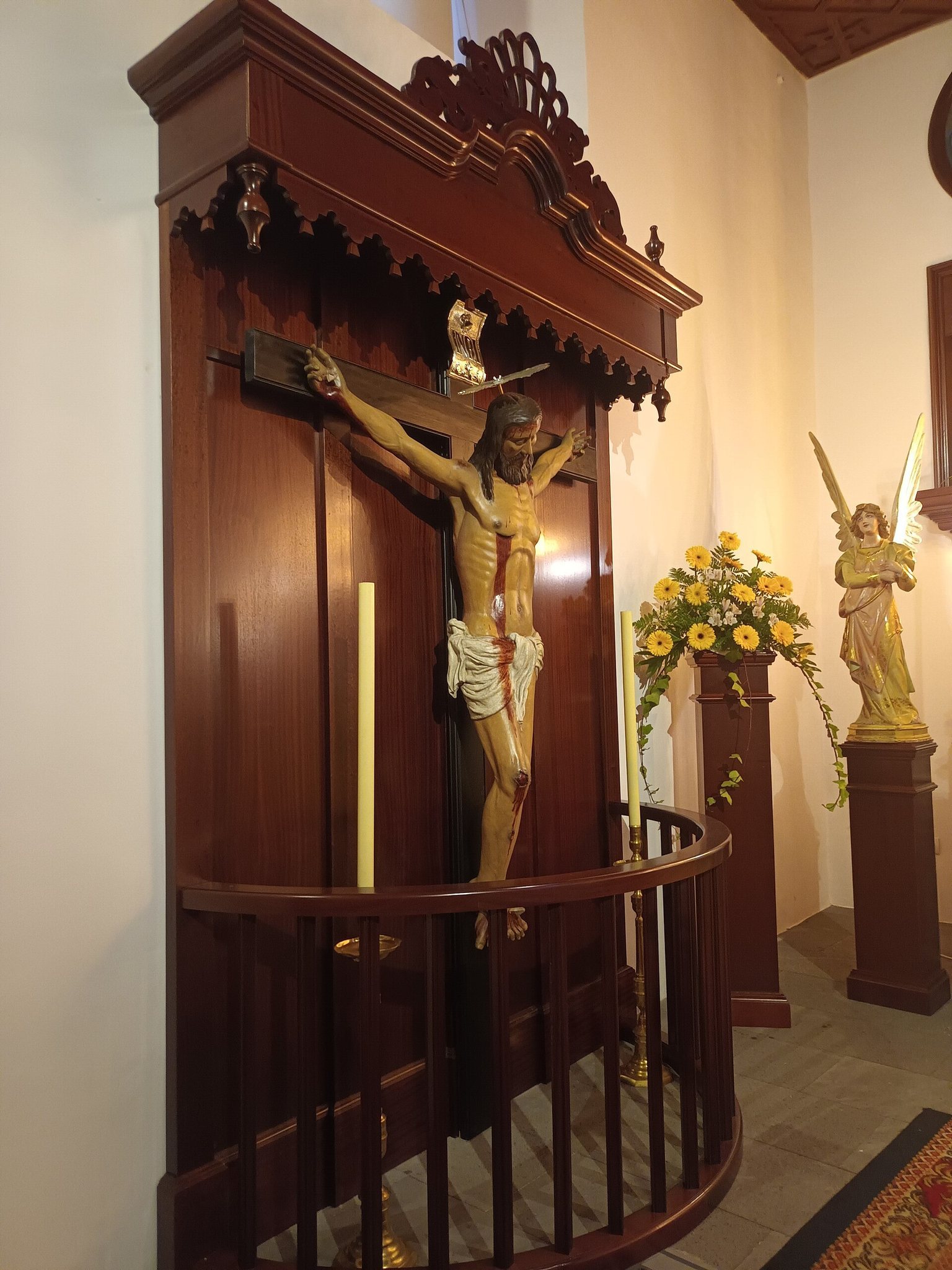
A small wooden canopy-style altarpiece beside the main altar houses the Christ of the Cegato, a popular nineteenth-century devotional image. The slightly smaller-than-life-size crucified figure is carved from orange wood and was completed in 1882 by Francisco Marrero Gabrili, a local parishioner who was blind. The sculpture replaced a smaller articulated seventeenth-century crucifix known as the Dead Lord. It was first kept in the baptismal chapel, moved to the main altar in the 1970s, and now stands beside the main altar.
Baptismal chapel and exhibition room
A baptismal chapel connects with the nave and leads to an exhibition room created in the former parish-office area during the 2014–2016 restoration. The room contains the church’s small museum of sacred art. The chapel preserves an old fixed baptismal font made from two types of basalt, with a reddish base and a greyish basin, as well as other religious images.
Images and side niches
Saint Andrew and Our Lady of Mount Carmel
The seventeenth-century image of Saint Andrew is a small rustic wooden work associated with popular workshops. It carries the saint’s X-shaped cross and Gospel book. After its restoration in 2007, it was normally displayed without the embroidered and jewel-studded clothing formerly used for it, although those garments are worn when the image is placed on its processional throne for the feast of Saint Andrew.
Our Lady of Mount Carmel stands in a side niche as a mid-twentieth-century dressed mannequin image. It replaced a larger and heavier full-body statue used when the maritime procession began in 1951. The present image holds a scapular in her right hand and the Christ Child in her left.
Other Marian and saintly images
The dressed image popularly called Our Lady of “Las Marías” actually represents the Immaculate Conception. It is an anonymous nineteenth-century work of the Canarian school. The eighteenth-century image of Our Lady of Sorrows occupies the leftmost niche nearest the entrance. It shows the Virgin as a mature woman looking upward with joined hands and a dagger piercing her heart. Opposite her stands the seventeenth-century gilded and polychrome wooden image of Saint Joseph of Nazareth, who looks toward the Christ Child in his arms. At Christmas, this image is moved to the main altar for the Nativity display.
Other images housed in the church include Our Lady of Fatima, brought from Portugal; a small Our Lady of Candelaria; Saint John the Baptist; the Dead Lord; Our Lady of the Miraculous Medal; Saint Anthony of Padua; Saint Rita of Cascia, brought from Italy; the Sacred Heart of Jesus; and Saint Cecilia of Rome. Twentieth-century images from the Olot workshops include Saint John the Evangelist, Christ Bound to the Column or Christ of the Mountain, Saint Mary Magdalene, the Christ of the Good Death, and Jesus the Nazarene or Christ of Great Power.
Paintings, altarpieces, and votive objects
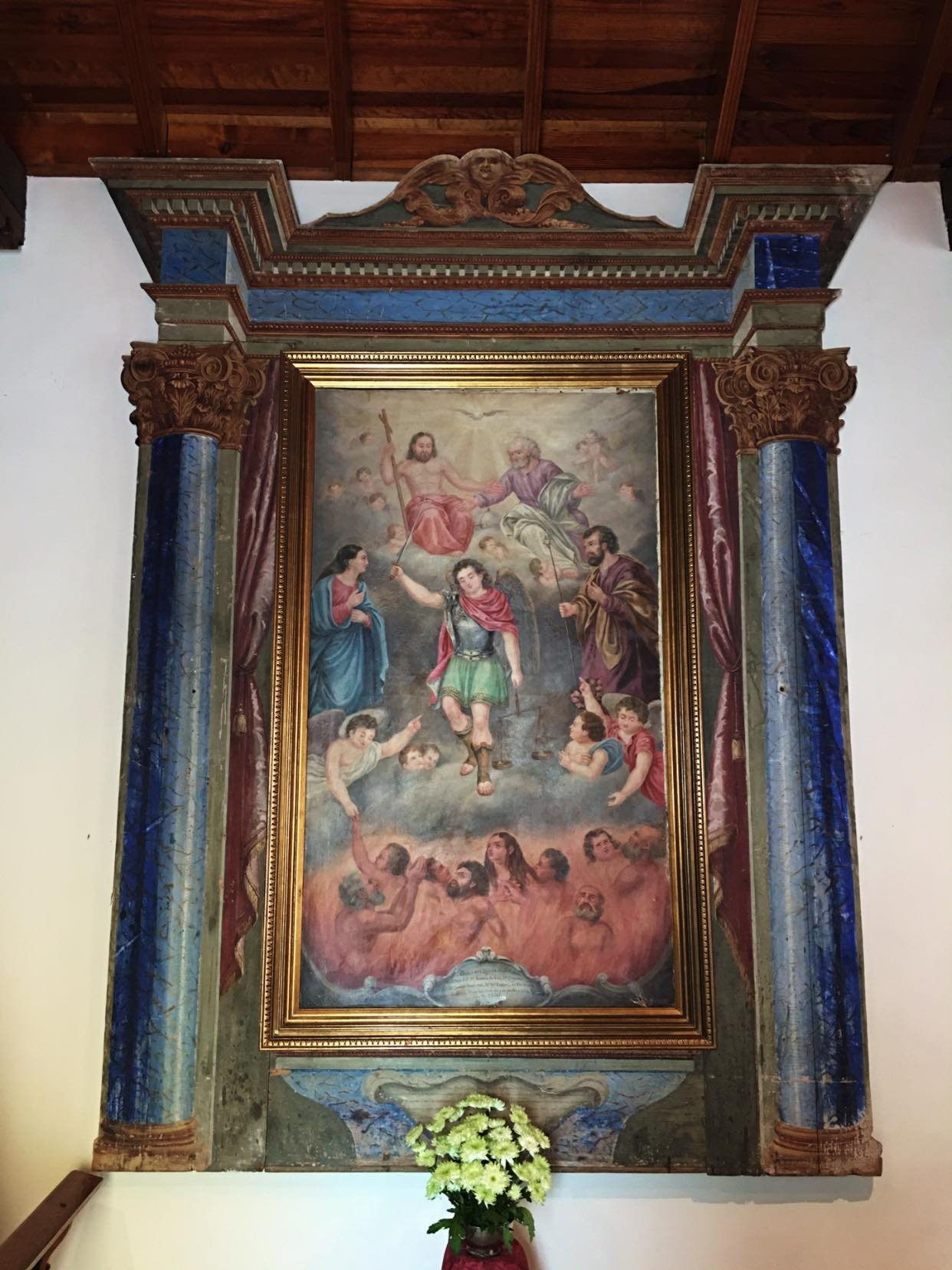
The church contains an oil copy of Murillo’s Immaculate Conception, a painting of the Descent from the Cross, and the Souls altarpiece. The latter dates from 1850 and was paid for by donations from inhabitants of San Andrés and Igueste. It depicts the archangel Michael descending from heaven with a balance, the suffering souls in Purgatory below, and the Holy Trinity above. In Catholic art, these souls represent the dead believed to be undergoing purification before entering Heaven. Flowers and candles are placed before the altarpiece, especially on All Souls’ Day.
The church also preserves a substantial collection of votive offerings, including jewellery dedicated especially to Saint Andrew and mantles worn by the image during its festivals. Together with the paintings, altarpieces, bells, and sculptures, these objects preserve the material expression of the parish’s long devotional history.