Augustinian Monastery in Zaječov: A Gothic and Baroque Religious Complex

Site at a Glance
- Rating
- 4.5
- Popularity
- Very Low
- Country
- Czechia
- Primary era
- Medieval
- Eras represented
- Medieval, Early Modern
- Civilizations
- Holy Roman Empire, Kingdom of Bohemia
- Site type
- Religious
- Remains
- Monastery
On this page10 sections
History
Foundation and Medieval Development
The Augustinian monastery in Zaječov, Czechia, was founded in 1262 by Oldřich Zajíc of Valdek as thanksgiving for Přemysl Otakar II’s victory over the Hungarian king Béla IV at the Battle of Kressenbrunn. Established at a locality then known as Ostrov, it was the first Augustinian monastery in Bohemia. Augustinian hermits, members of a Catholic order following the Rule of Saint Augustine, were installed there in 1263. Construction continued until the end of the fourteenth century, and the complex belonged to the Augustinian religious order.
A foundation tradition says that Oldřich, while resting at Valdek, saw two men in a vision who led him to a wooded valley. There he saw the Virgin Mary, who instructed him to build a monastery in her honor. Oldřich later told the story to King Přemysl Otakar II and sought permission to establish a church and monastery at the place shown to him.
Saint Benigna and the Hussite Wars
In 1327, the monastery received the relics of Saint Benigna, a Christian martyr who had died in 449. The community subsequently adopted her name, and the monastery became an important pilgrimage destination. Annual pilgrimages continued until the Hussite Wars, fifteenth-century religious and political conflicts in the Bohemian lands associated with the followers of Jan Hus.
The complex was repeatedly devastated during the Hussite Wars. Restoration of the church and convent probably began after 1496 and continued into the 1520s. A reduced community remained in the altered monastery until 1552, when the last monks moved to Prague. The property then passed first to the Zajíc family and later to the Lobkowicz family. Their property was confiscated in 1594 and transferred to the royal treasury, while the monastery suffered further substantial damage in 1620.
Baroque Rebuilding and Dissolution
The Augustinians regained the monastery in 1676. A major Baroque rebuilding followed under plans by the Italian architect Dominik Canevalle and his son, with work continuing into the first third of the eighteenth century. The church was rebuilt first, followed by the chapel and monastic choir, the construction of a new tower, and the reconstruction of the eastern and southern convent wings. The western wing remained unfinished. The church again became an important pilgrimage site because of the reputation of a miraculous statuette of Saint Benigna.
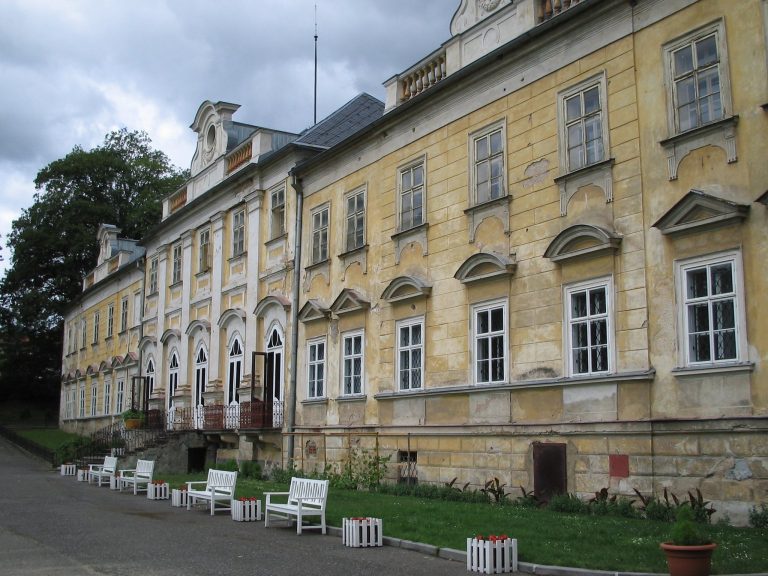
The monastery was dissolved in 1785 during the Josephine reforms, the late-eighteenth-century religious and administrative measures of Emperor Joseph II that suppressed or reorganized some monastic institutions. Joseph II made an exception in 1789 on the condition that the local Augustinians take pastoral care of the surrounding area. The convent building was adapted for use as a parish house and school. Prussian troops damaged the complex in 1866, after which restoration of the church and convent buildings began.
Twentieth-Century Suppression and Return
In April 1950, the monastery was forcibly dissolved during Action K, a communist state operation against Czechoslovak male religious communities. Its religious members were interned in labor camps. On 1 September 1950, the 52nd Auxiliary Technical Battalion was established in the Svatá Dobrotivá district of Zaječov, and the monastery complex subsequently deteriorated.
After 1990, the monastery was returned to the Augustinians. It has since undergone gradual repairs, and Augustinians from the Prague monastery at the Church of Saint Thomas hold regular worship services in the church. The complex is listed as a cultural monument of the Czech Republic.
Remains
Church and Convent Layout
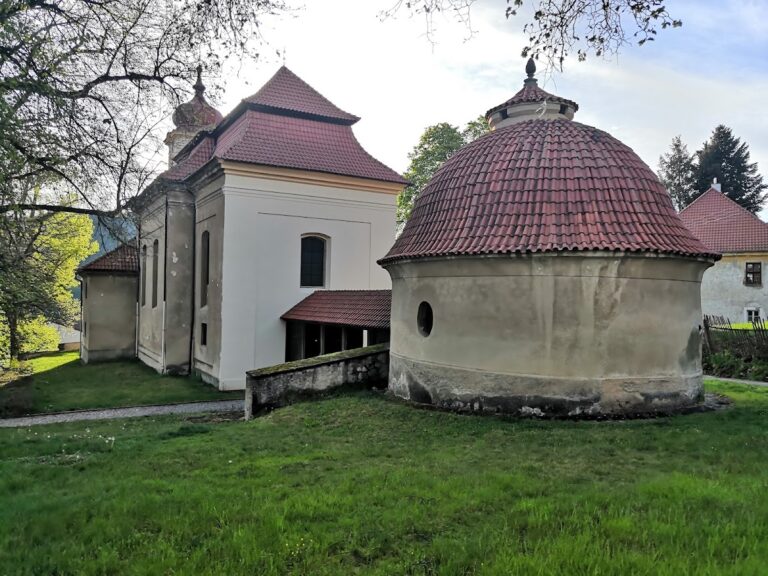
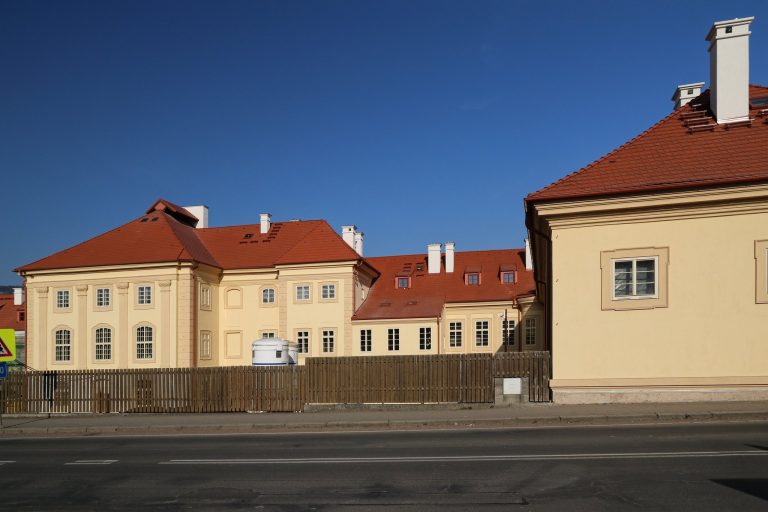
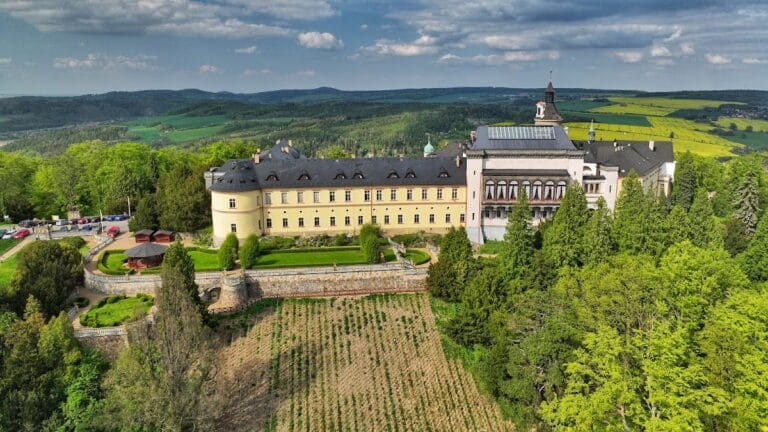
The complex is organized around the three-aisled Church of the Annunciation of the Virgin Mary and the adjoining convent. The church retains a basic Gothic structure, modified during the Baroque rebuilding. Its presbytery, the part surrounding the main altar, connects with the two-storey eastern and southern convent wings. On the western side, a boundary wall encloses the complex and includes a gate.
Chapels and Tower
Sacristy and Side Chapel
Between the church presbytery and the northern facade of the convent is a sacristy, a room used to prepare and store items for worship. It is connected with the Chapel of Saint Augustine and Saint Nicholas of Tolentino. A tower rises above the sacristy, forming part of the later architectural development of the complex.
Chapel of Saint Benigna
A small Chapel of Saint Benigna stood between the chapel complex and the termination of the church. Its dedication reflects the role of Saint Benigna’s relics and statuette in the monastery’s pilgrimage tradition.