Church of Saint Ignatius of Loyola in Prague: A Jesuit Church and College
Site at a Glance
- Popularity
- High
- Country
- Czechia
- Primary era
- Early Modern
- Eras represented
- Early Modern, Modern
- Civilizations
- Austria-Hungary, Habsburg, Habsburg Austria, Holy Roman Empire, Kingdom of Bohemia
- Site type
- Religious
- Remains
- Church
On this page26 sections
History
The Church of Saint Ignatius of Loyola in Prague is a Roman Catholic Jesuit church in Czechia, begun in 1665 in the early Baroque style, a European art and architectural style. Its construction followed an earlier phase associated with the Chapel of Corpus Christi. The church and an adjoining Jesuit college were planned together, and the church’s design followed that of Il Gesù, an influential Jesuit church in Rome.
Foundation and construction
Carlo Lurago designed the church, and builder Martin Reiner took charge of the work in 1671. The principal construction phase continued until 1678, while work on the exterior and interior carried on in later stages through 1699. The adjoining college occupied land that had held 23 houses and 13 gardens. The complex was the third-largest Jesuit complex in Europe.
Aristocrats active after the 1620 Battle of White Mountain in Bohemia financed the church and college. Marie Maxmiliána, widow of Adam of Sternberg, gave the Jesuits 44,000 florins and an annual payment of 9,000 florins. Archbishop of Prague Jan Bedřich of Valdštejn consecrated the church on 31 July 1678. It was dedicated to Ignatius of Loyola, founder and patron of the Jesuit order, formally known as the Society of Jesus.
From Jesuit church to parish
After the Jesuit order was suppressed in 1773, the church was taken from the Jesuits and used as a parish church. It was returned to the order in 1866, a change that displeased Czechs, and the Jesuits repaired the building. The former college buildings later took on hospital uses.
Twentieth-century changes and present role
In 1950, Communist judicial authorities interned the Jesuits, who could not return to their posts until 1991. That year, the church became part of the parish of St Stephen. Since 1990, the parish has been under Jesuit pastoral care, with most parish activity taking place at the church or the adjacent Jesuit residence. The church is now owned by the City of Prague. It is a Roman Catholic subsidiary church of St Stephen’s parish, within the Prague Archdiocese and the First Prague Vicariate, a diocesan administrative district, and the Czech province of the Jesuits, a regional division of the order.
The organ was dismantled in 1988 to permit necessary work on the choir loft. Following consultations and tests from the 1990s onward, the Kánský-Brachtl workshop built a new instrument using the original pipes; its reconstruction was completed in 2013.
Remains
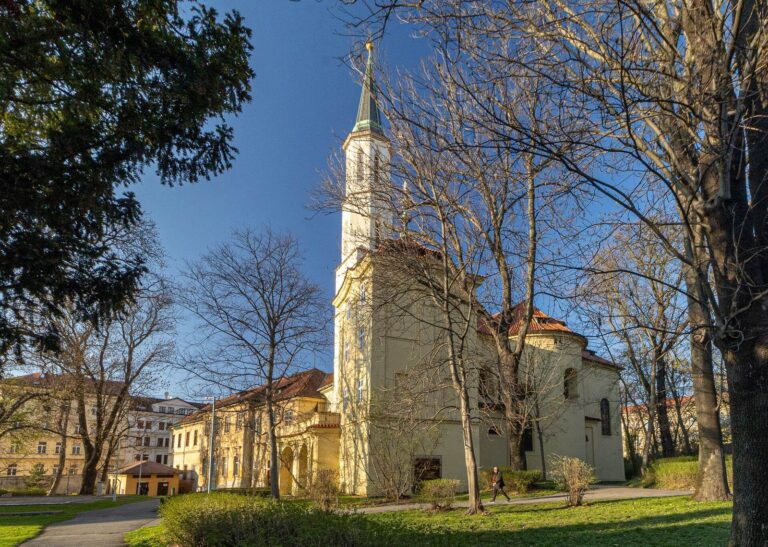
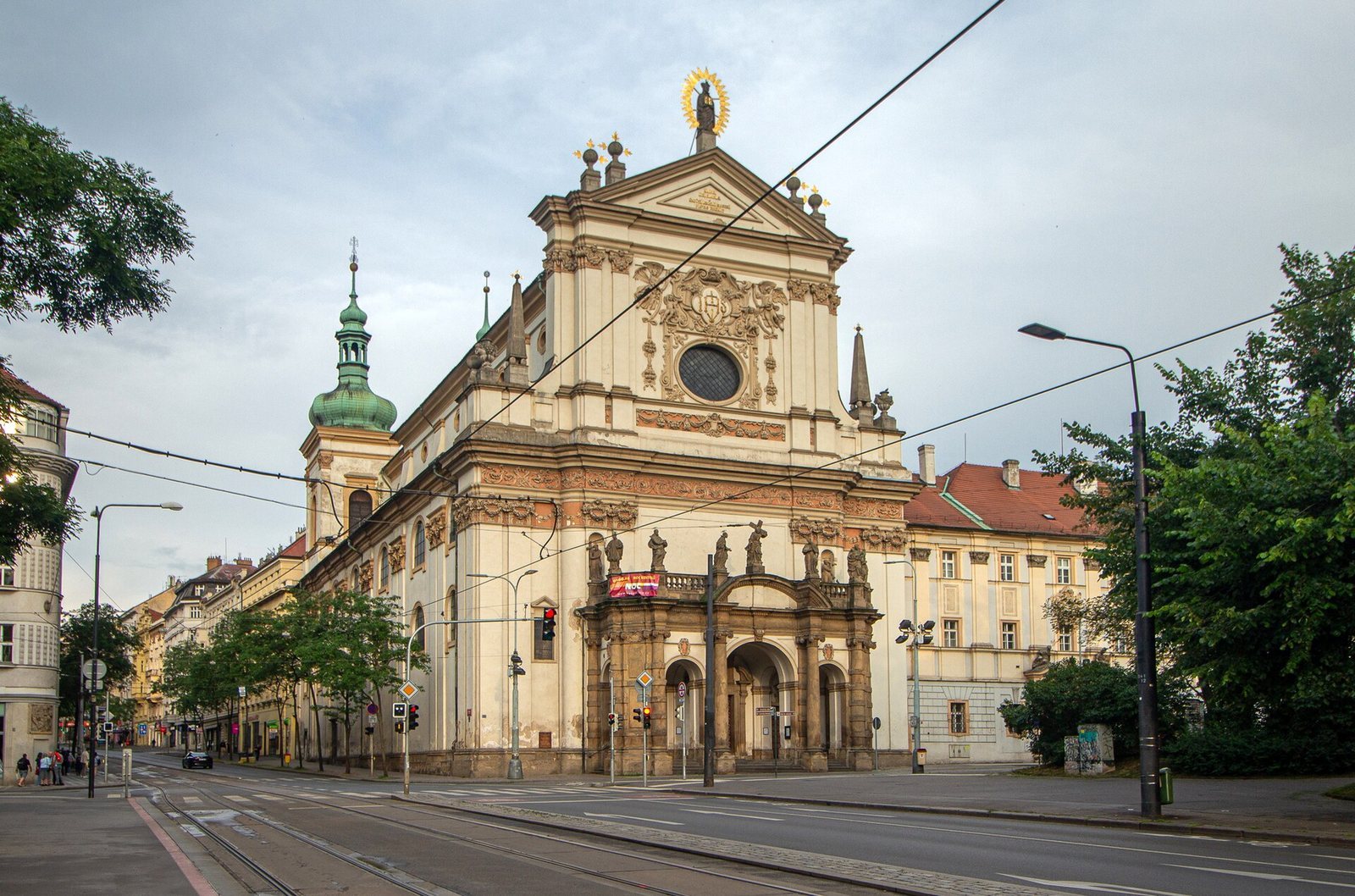
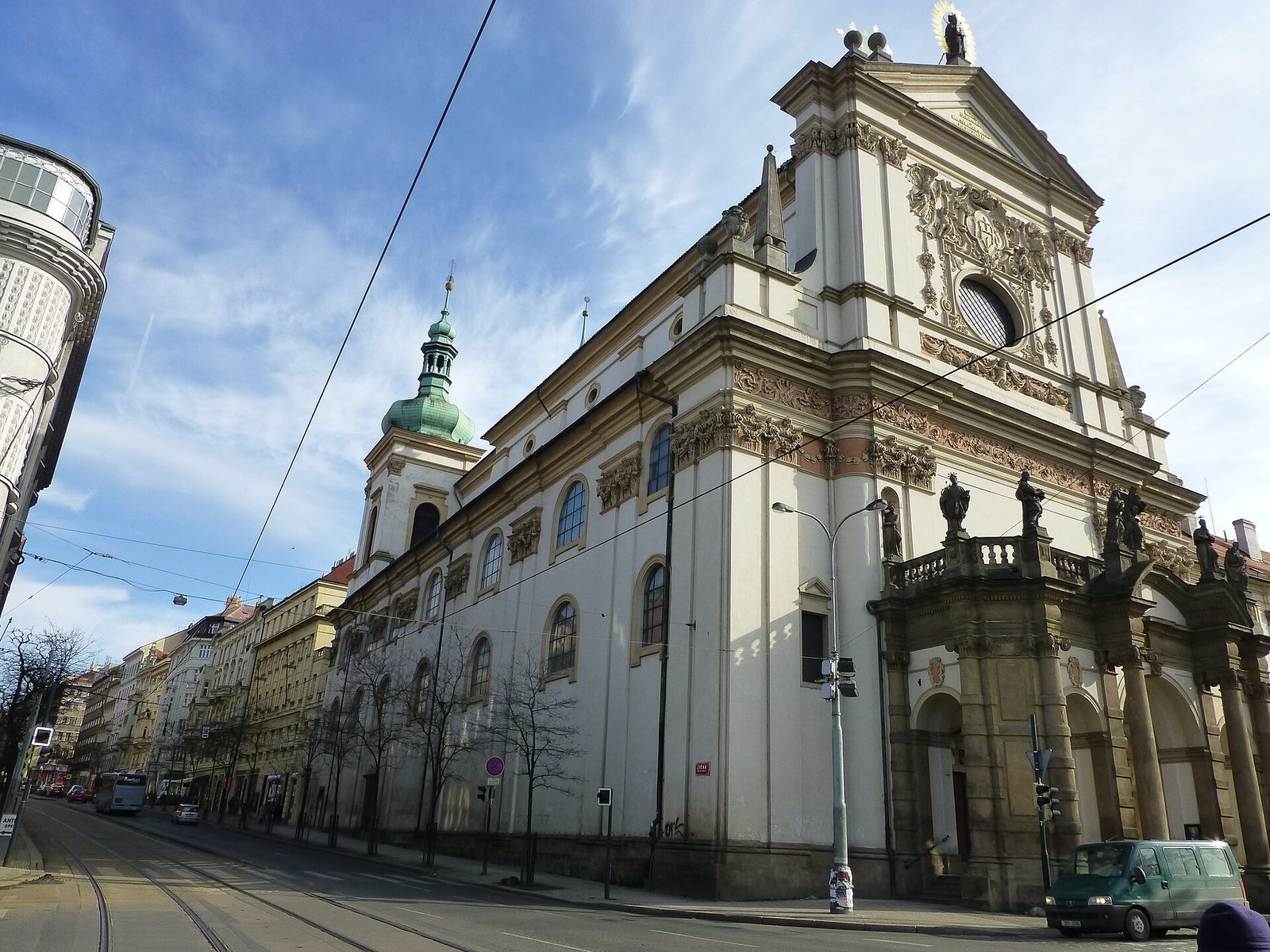
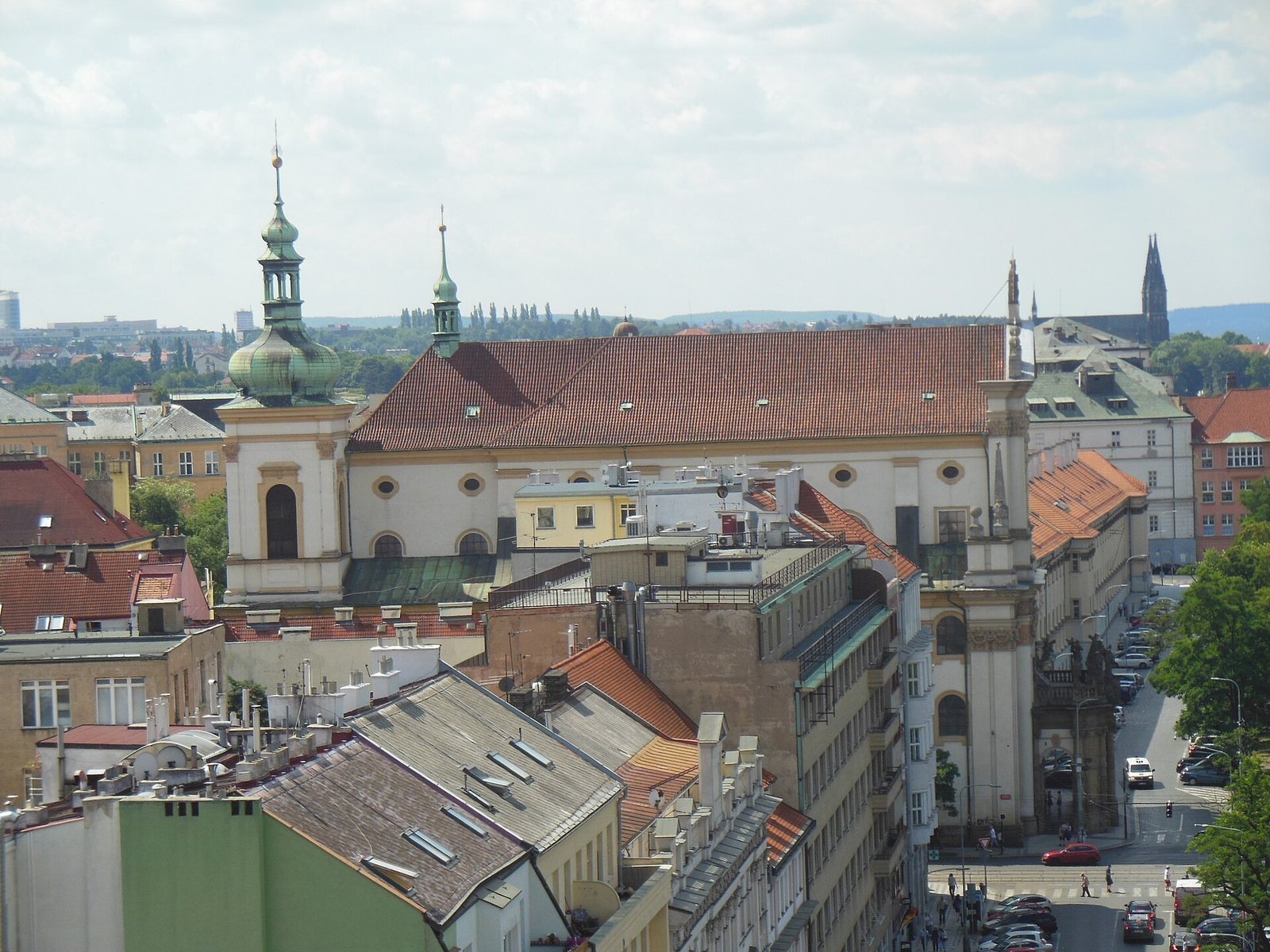
The early Baroque building is a three-aisled basilica, meaning a church with a central nave and side aisles. Narrow side chapels line the interior and connect through passageways. Above the chapels is a gallery, while the eastern end is marked by a tower. A massive façade faces west, and a stone entrance porch stands before it.
Exterior and tower
Western façade and entrance porch
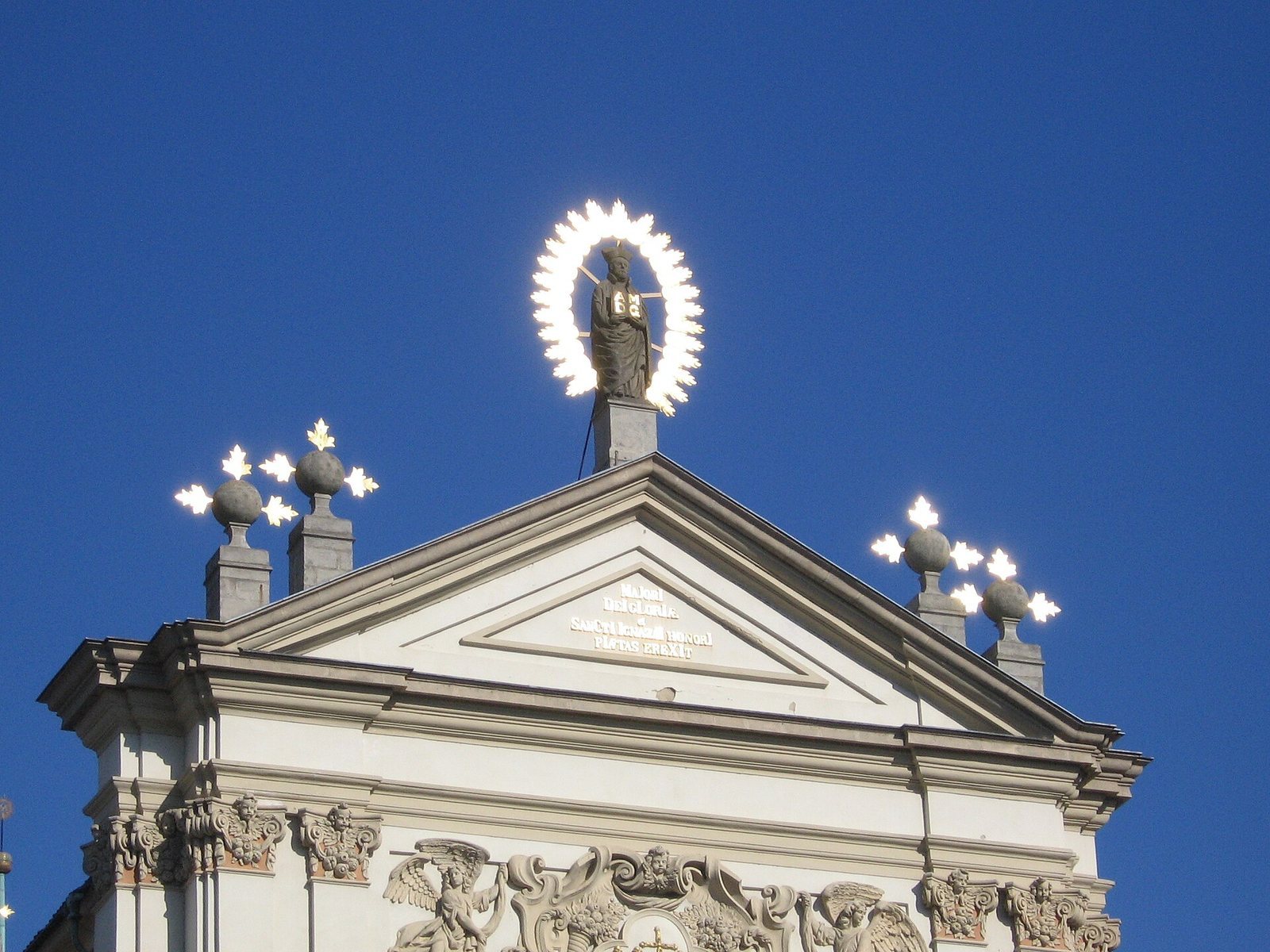
The western façade is crowned by a triangular tympanum, the enclosed field within a pediment, and a statue of Ignatius installed at its summit in 1671. The figure is surrounded by a full-body halo and bears the gilded initials AMDG, abbreviating the Jesuit motto Ad maiorem Dei gloriam, or “For the greater glory of God.” A Latin inscription in the tympanum contains a chronogram, an inscription whose letters also indicate a date, giving 1671. The statue’s halo prompted a dispute with the Dominicans, who argued that this honor belonged only to Christ and noted that the Savior figure on the porch was smaller. They appealed to the pope in Rome and lost.
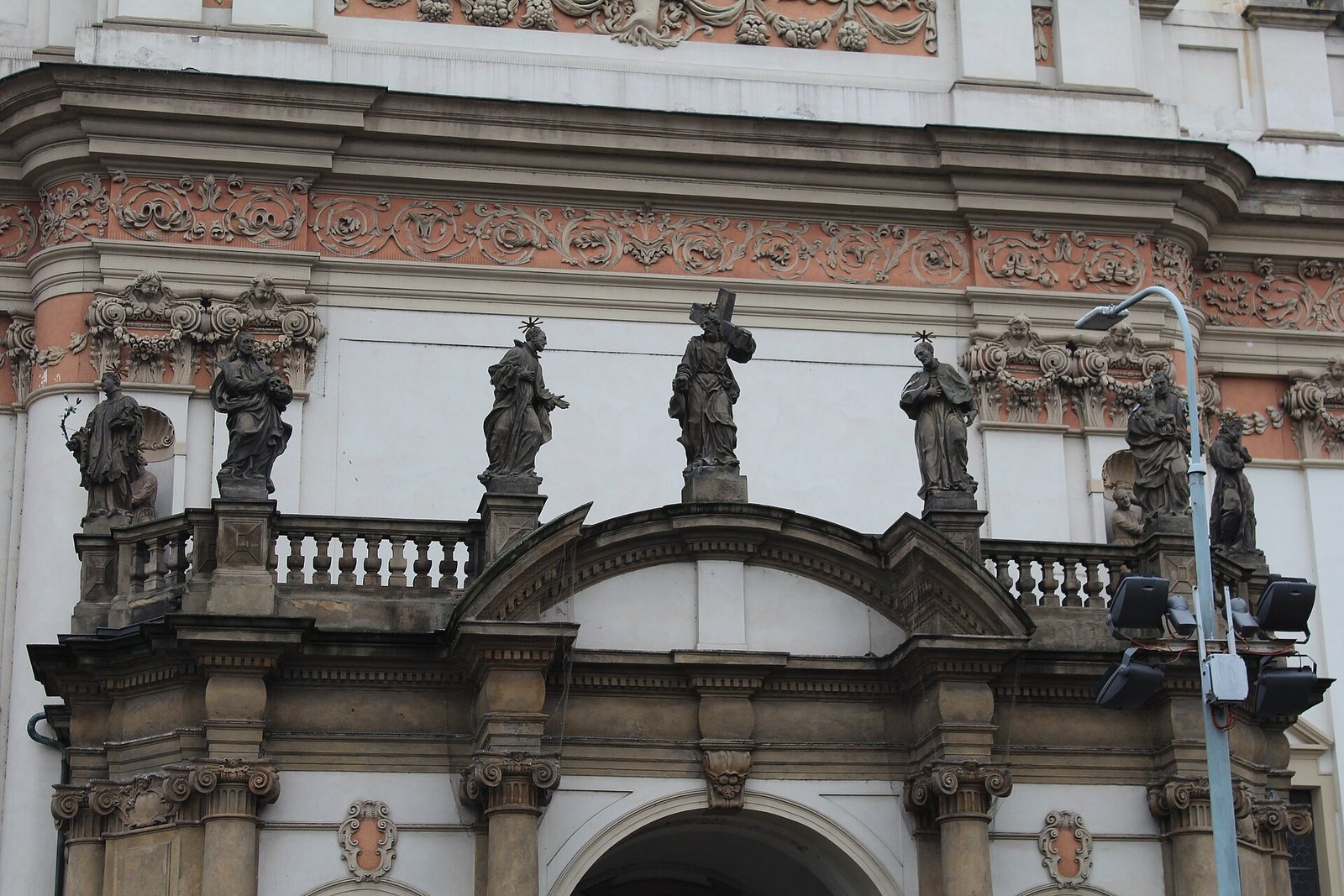
A stone entrance porch and stairs were added in 1699 to a design by Pavel Ignác Bayer. Eight statues of Jesuit saints surround a statue of Christ the Savior, with the sculptures produced by Matěj Václav Jäckel’s workshop. Jan Jiří Heinsch is credited with decorative painting on the exterior, and Jäckel with its sculptural work.
Eastern tower
A faceted tower topped by a dome rises over the church’s eastern end. Its completion is dated to 1687, and it is also associated with Bayer’s work on the building in the late seventeenth century.
Nave, sanctuary, and altars
Nave and vault
Large semicircular windows light the nave, or central aisle, above two levels of side chapels. A barrel vault, an arched ceiling, extends overhead and is divided by transverse arches into three sections. The sanctuary narrows slightly in relation to the nave. Tommaso Soldati’s richly modeled stucco, or ornamental plasterwork, covers the walls and vaults; this work dates to 1697–99.
Six busts of Bohemian patrons occupy curved recesses in the vault. Beneath the arches are figures of the Jesuit patrons Ignatius of Loyola, Francis Borgia, Aloysius Gonzaga, Stanislaus Kostka, and Paul Miki with a companion, accompanied by angels. Early Baroque frescoes, or paintings made on wet plaster, appear with inscriptions, scripture quotations, and prayers. Donors’ coats of arms near the sanctuary represent the Sternberg, Hohenzollern, Věžník, and Stařínský families.
High altar
The high altar’s architectural structure, made from red artificial marble, dates to 1768–73. Its painting, Jan Jiří Heinsch’s Saint Ignatius of Loyola Enters Heavenly Glory, was completed in 1688. White statues of Saints Peter and Paul, made from stuccoed stone, stand at the sides and are the work of Jäckel.
Side chapels
Chapel of the Bohemian Patrons
The Martinic family commissioned this chapel. Its 1719 altar is dedicated to St John of Nepomuk and includes a painting by Emanuel Dítě the Younger. Other works include a copy of an image of Our Lady of Montserrat, Heinsch’s 1692 painting of the transfer of St Wenceslas’s body, and a statue of St Wenceslas by Jan Jiří Bendl.
Chapel of St Francis Borgia
On the south side of the sanctuary, this chapel contains Ignác Raab’s painting of St Francis Borgia kneeling before the consecrated Eucharist, known in Catholic practice as the Blessed Sacrament.
Chapel of St Barbara
Raab’s altarpiece shows St Barbara between statues of St Catherine and St Lucy. The chapel also holds the tombstone of Fridrich Leopold Věžník, who died on 6 April 1663. It was moved here from the former cemetery beside the Chapel of Corpus Christi.
Chapel of Our Lady of Piekary
The chapel contains an image of Our Lady of Piekary, patroness of Upper Silesia, acquired in 1680. A workshop led by František Ignác Weiss made the niche statues of Saints John the Baptist, Joseph, Joachim, and Zechariah in 1743–45. The Lobkowicz family’s fish emblem is positioned above the chapel. On the vault, a Marian monogram sits between two frescoes with quotations from the Marian litanies. Refuge of Sinners depicts exiles, while Consoler of the Afflicted shows a prison.
Chapel of the Dead
Also called the Chapel of All Faithful Souls, this chapel was built in 1685. Its altar is dedicated to the Crucifixion. A painting attributed to Heinsch and dated to about 1690 shows Christ on the cross with souls in purgatory, the state of purification after death in Catholic teaching. An eighteenth-century statue of Christ lies in a Holy Sepulchre set into the altar table, and a painting of the Last Judgment, dated 1685, covers the vault.
Chapel of St Liborius
Raab painted the image of St Liborius for this chapel. Statues of Blessed Spinola and St Peter Canisius by Eduard Veselý, dated 1878, flank the painting. Other niches contain figures of St Stanislaus Kostka and St John Francis Regis, made around 1760–70 by a follower of I. F. Platzer, as well as eighteenth-century statues of St Anne with the Virgin and Child and St Elizabeth with the young John the Baptist.
Chapel of St Aloysius Gonzaga
Richard J. Prachner made the chapel’s richly sculpted, gilded altarpiece around 1770 in Rococo, a later, ornate style that developed from Baroque. A small painting of St Aloysius by Raab appears above a copy of the pilgrimage image of Our Lady of Good Counsel from Genazzano. The image’s halo and inscription ribbon date to 1882. Jäckel’s workshop supplied the niche statues of Saints Jude Thaddeus and Andrew in 1699. A hanging painting by Heinsch, dated 1687, depicts Ignatius before the Holy Trinity.
Chapel of St Francis Xavier
Raab’s altarpiece depicts the death of St Francis Xavier. White-painted statues by Jäckel show Paul Miki and three fellow Japanese Jesuit martyrs, while niche figures by the same sculptor represent Saints Peter and Paul. A hanging painting by Jan Umlauf, dated 1872, shows St Peter Faber among angels.
Other devotional features
Pulpit
The Rococo pulpit, made around 1770 by Richard Jiří Prachner’s workshop and other craftsmen, has a body finished in artificial marble and a shell at its base. Four allegorical figures representing Christian virtues decorate its front, and a statue of Christ the Good Shepherd stands on the canopy.
Lourdes grotto
A grotto contains a sculpted composition of the Virgin Mary appearing to Bernadette Soubirous. Heřman Kotrba modeled it in 1948.
Organ and later additions
Organ
The organ case dates to about 1680. Its three-part Baroque façade, made in 1699 by Jäckel’s workshop, includes small statues of angels holding musical instruments. Emanuel Štěpán Petr installed an instrument in 1911, identified as opus 200; it was later replaced by a new instrument that reused the original pipes. The present three-keyboard organ has 50 stops, each a set of pipes producing a particular tone or timbre, and 3,100 pipes ranging from 15 millimeters to 6 meters long.
Patronage and sacristy
A fish emblem above the Chapel of Our Lady of Piekary identifies the Lobkowicz family’s association with it, while the Martinic family commissioned the Chapel of the Bohemian Patrons. A new sacristy was built in 1717.