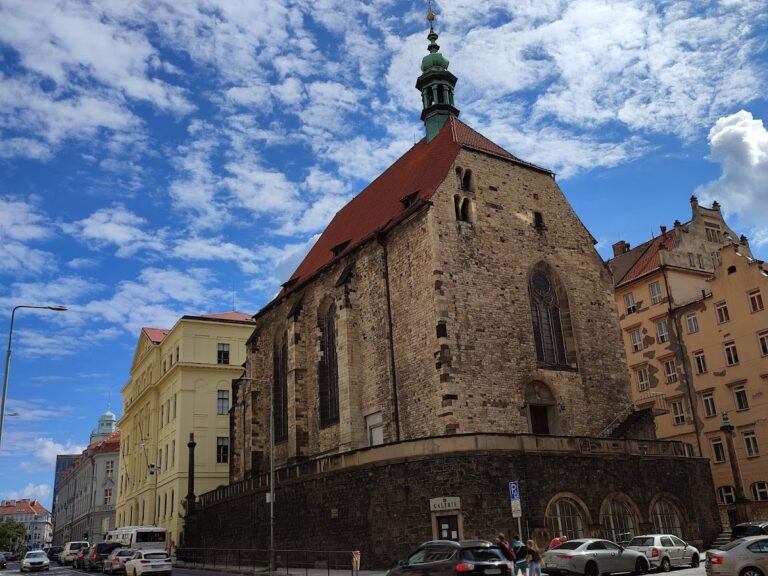
Church of Saint Catherine: A Baroque Church in Prague’s New Town


Site at a Glance
- Rating
- 4.8
- Popularity
- Low
- Country
- Czechia
- Primary era
- Early Modern
- External website
- Open
- Eras represented
- Medieval, Early Modern
- Civilizations
- Holy Roman Empire, Kingdom of Bohemia
- Site type
- Religious
- Remains
- Church
On this page11 sections
History
The Church of Saint Catherine is a Baroque church in Czechia, founded in 1355 by Charles IV, King of Bohemia and Holy Roman Emperor, as part of an Augustinian nuns’ monastery in Prague’s newly established New Town. Its dedication to Saint Catherine of Alexandria was traditionally connected with thanksgiving for Charles IV’s first battle, fought near San Felice sul Panaro in Italy on 25 November 1332, the saint’s feast day.
Foundation and Hussite destruction
The monastery church was consecrated on 29 November 1367. On 25 May 1420, Taborites, the radical militant wing of the Hussite reform movement in late medieval Bohemia, attacked the monastery. They expelled the Augustinian nuns and destroyed the church and convent buildings. The church and convent were rebuilt between 1518 and 1522.
Monastic transformation and Baroque rebuilding
In 1565, Augustinian monks took over the monastery and church from the nuns. The former Gothic monastery buildings were rebuilt in the Baroque style between 1718 and 1730. The church itself underwent an extensive rebuilding between 1737 and 1741.
The work was long attributed to Franz Maximilian Kaňka, a Bohemian architect associated with Baroque architecture. More recent attribution identifies the church as one of the major works of Kilián Ignác Dientzenhofer, who is also associated with its plans alongside Kaňka. Dientzenhofer shaped both the building and its internal arrangement and furnishings.
Secular institutions and renewed religious use
During the reforms of Joseph II, the eighteenth-century Habsburg emperor whose policies dissolved many monasteries and reassigned their buildings, the monastery was dissolved in the 1780s. From 1787, the complex served as a military training institution. From 1822, it housed a psychiatric institution, directed between 1837 and 1851 by the psychiatrist Josef Gottfried von Riedel.
The church was reconsecrated in 1841 and continued to host services until 1950. After the Second World War, the former monastery complex housed the Neurological Clinic of the First Faculty of Medicine at Charles University from May 1945, and the buildings were restored during this period.
After 1950, the National Museum in Prague used the church as a storage depot and lapidarium, a collection or storage place for architectural and sculptural stone monuments. The church later came under the administration of the Knights of the Cross with the Red Star, a Catholic order founded in Bohemia. At the beginning of the twenty-first century, it was restored and made available to the order.
Prague municipal authorities later placed the church at the disposal of the Orthodox Church in the Czech Lands and Slovakia. The first Orthodox service, combined with the consecration of the altar, took place on 24 December 2012. Miroslav Šantin served as priest in 2014, and Father Milan Horváth replaced him in 2015 and was still serving in 2024. The church is a protected component of the former Augustinian convent complex and is recorded as a cultural monument. It is regularly used by the Orthodox Church and forms part of the Prague Diocese.
Remains
Building and interior
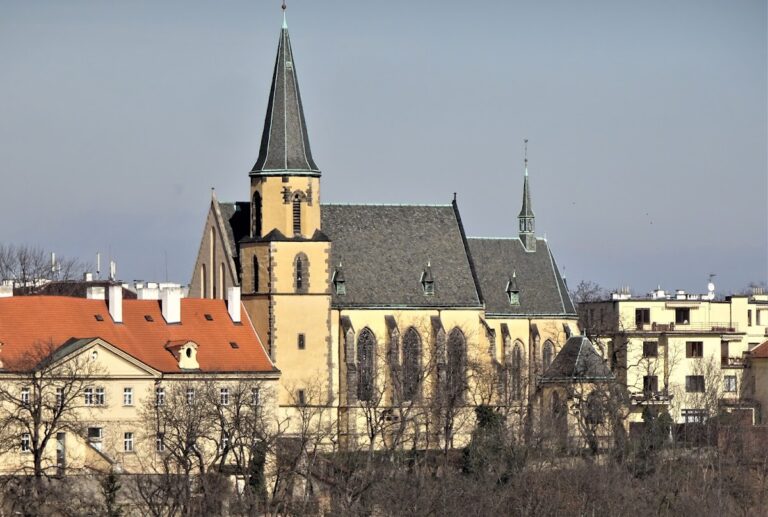
The church stands in Kateřina Garden within the General University Hospital complex, approximately midway between Charles Square and I. P. Pavlova Square, in the area bounded by Kateřina, Viničná, and Ke Karlovu streets. The present structure is a Baroque reconstruction of the original Gothic church. It is a vaulted hall church with a transept, the part that crosses the main axis of the nave to form a crosswise arm.
Gothic tower
The tall, slender tower incorporated into the facade is the only surviving original part of the Gothic church. It rises 51.3 metres and has octagonal upper stories. Its unusual height and form have given it the informal nickname “Prague Minaret.” The tower survived the Hussite attack after an attempt to demolish it failed when falling masonry killed some of the attackers. A statue of Saint Catherine stands on the tower, and an entrance plaque or sign bears an inscription.
Baroque decoration
Frescoes by Václav Vavřinec Reiner decorate the vaults with scenes from the life of Saint Catherine. They are exceptionally well preserved. Numerous sculptures were made by the Prague sculptor František Ignác Weiss. Because few artists contributed to the decoration and later additions are largely absent, the interior retains a unified High Baroque character and is an unusually pure example of that style in Prague.
Memorials and stone sculpture
Tombstones
The church contains grouped tombstones commemorating the children of Jan I of Lobkowicz. Further tombstones commemorate Theobald František von Dewaldt and probably Zikmund Fellner von Feldegg. Additional tombstones are located in the entrance area.
Former lapidarium collection
During its period as a National Museum depot and lapidarium, the church housed large stone figures from Charles Bridge, including originals and casts. Among them was the equestrian statue of Saint Wenceslas by Johann Georg Bendl, which stood in Wenceslas Square until 1913.
Nearby sites