Dalhem Church: A Medieval Church on Gotland


Site at a Glance
- Rating
- 4.6
- Popularity
- Very Low
- Country
- Sweden
- Primary era
- Medieval
- External website
- Open
- Eras represented
- Medieval
- Civilizations
- Unclassified
- Site type
- Religious
- Remains
- Church
On this page13 sections
History
Dalhem Church is a medieval church in Dalhem, Sweden, on the island of Gotland. It belongs to the Church of Sweden and lies within the Diocese of Visby. The present building developed through medieval construction phases led by Cistercian monks from nearby Roma Abbey, followed by a major renovation between 1899 and 1914 that reshaped its appearance and later interpretation.
Early churches and medieval construction
The earliest church on the site was a stave church, a medieval timber building constructed around load-bearing vertical posts. It was later replaced by a small stone church, probably Romanesque, meaning that it belonged to the architectural style that preceded Gothic architecture in much of medieval Europe. This earlier church apparently had an apse, a rounded end to the choir. Its foundations were discovered during the renovation of 1899, and a tombstone from the building was later set into the wall beside the northern portal.
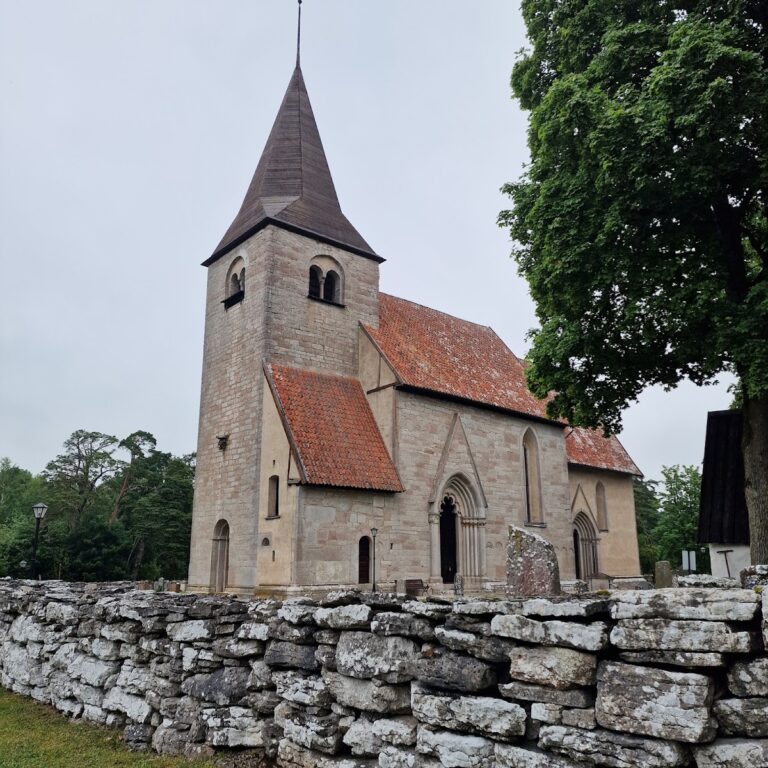
The present church took shape in several medieval stages. The choir, nave, and sacristy, a room for clergy vestments and liturgical objects, date from the first half of the thirteenth century. The tower, main portal, and large western window were added in the fourteenth century. These later works are attributed to the unidentified medieval master conventionally called Egypticus, who is also associated with churches at Gothem, Öja, and Stånga.
The 1899–1914 renovation
A far-reaching renovation began in 1899 under the Swedish architect and artist Axel Haig, also known as Axel Herman Hägg, and continued for fifteen years until 1914. Haig raised funds internationally, and the work altered both the exterior and interior in an effort to give the church a more strongly medieval appearance. The exterior limestone, formerly covered with whitewash, was exposed, while the interior received additional windows in a medieval style and extensive painted decoration by Haig.
The result was initially regarded as remarkable, and Dalhem Church came to be called the “national shrine of Gotland.” Later assessments have described the work as a harsh and loose reconstruction of the Middle Ages. The church therefore remains an example of the conservation ideas prevalent during the period, when restoring a historic building could involve extensive visual recreation rather than only the preservation of surviving fabric.
Later preservation
A minor renovation took place in 1969. Afterward, the decision was made to preserve the church in the condition created by Haig’s 1899–1914 renovation. That decision retained both the medieval fabric and the strongly interventionist character of the early twentieth-century restoration as parts of the building’s modern history.
Remains
Plan and exterior
Nave, choir, and sacristy
The church consists of a tower, a three-aisled nave, a choir, and a sacristy. Four substantial central piers divide the nave into nine vault bays, each a section of the vaulted ceiling between supporting elements. A fragment of the earlier Romanesque church survives in a niche intended to hold the bread and wine used in the Eucharist, the central Christian rite involving consecrated bread and wine in remembrance of Jesus Christ.
Tower and western window
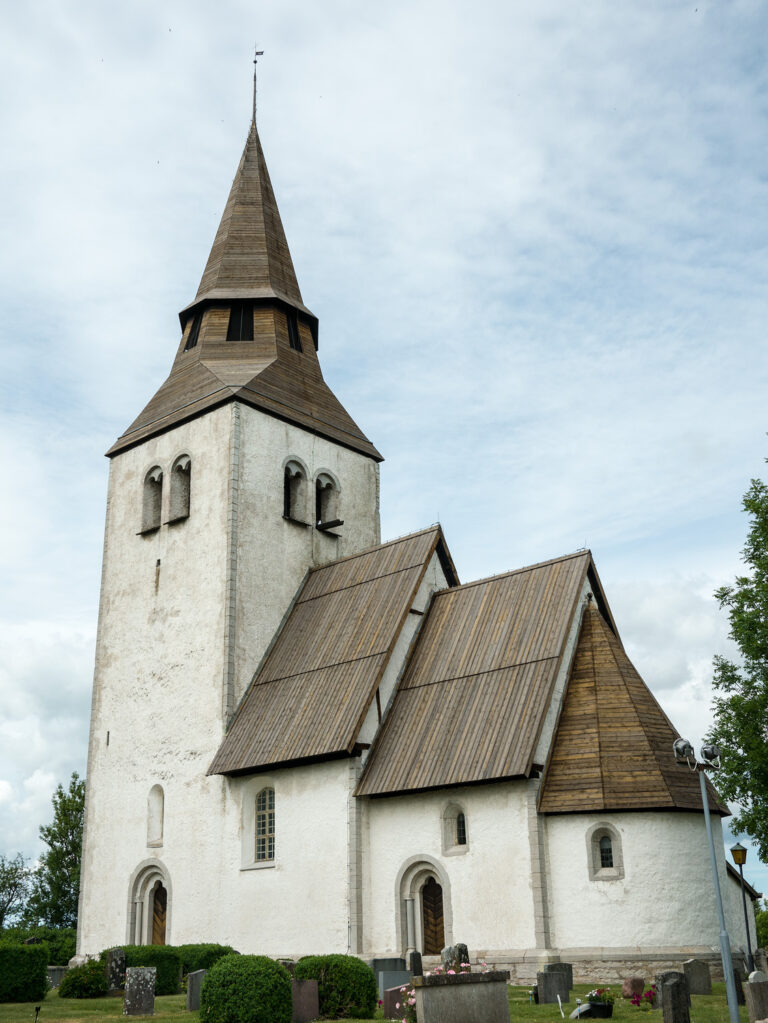
The tower rises more than 50 metres, or about 160 feet. Its galleries show the influence of art from the Rhine Valley, and it is crowned by a Rhenish helm, a steep, multi-sided medieval spire form associated with that region. The large window in the western façade dates from the fourteenth century. During the major renovation, the exterior whitewash was removed to expose the limestone beneath it.
South portal and northern wall
The fourteenth-century main portal on the south façade carries carved stone sculpture with motifs unusual in Gotland. Its capital band, a sculpted ornamental band associated with the capitals of columns or piers, includes figures of a dragon, a centaur, and a sphinx. The portal and tower are attributed to Egypticus, the conventional art-historical name for an otherwise unidentified medieval master linked with several Gotland churches. Beside the northern portal, a tombstone from the earlier stone church is immured in the wall.
Interior decoration and furnishings
Stained glass and wall paintings
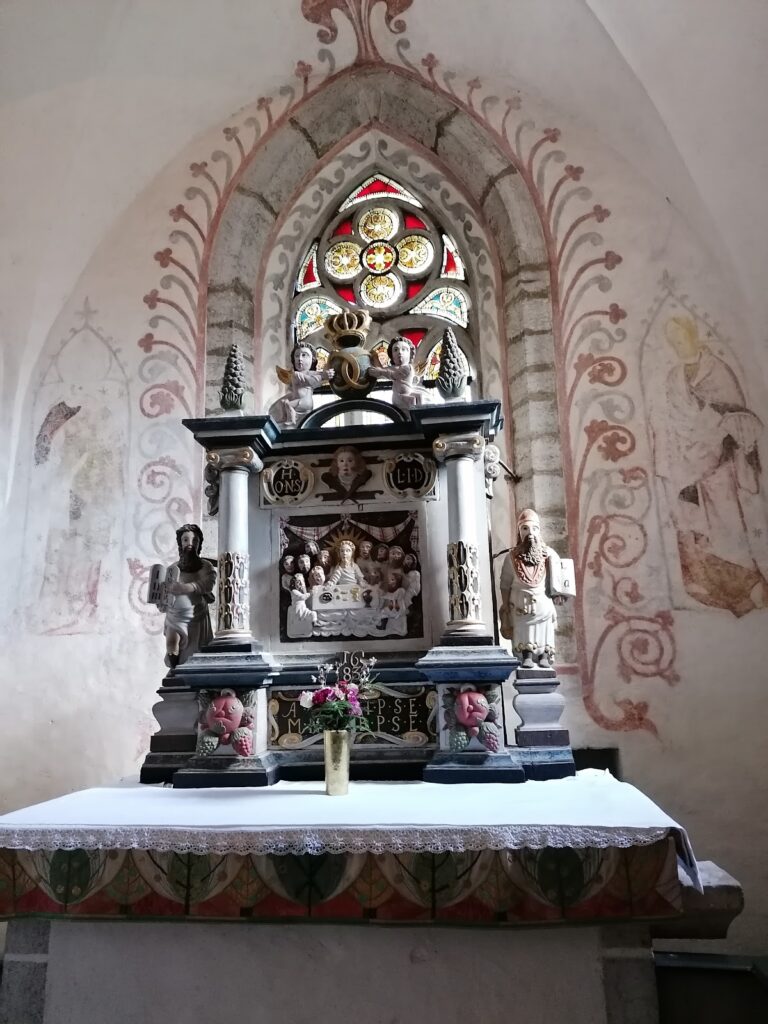
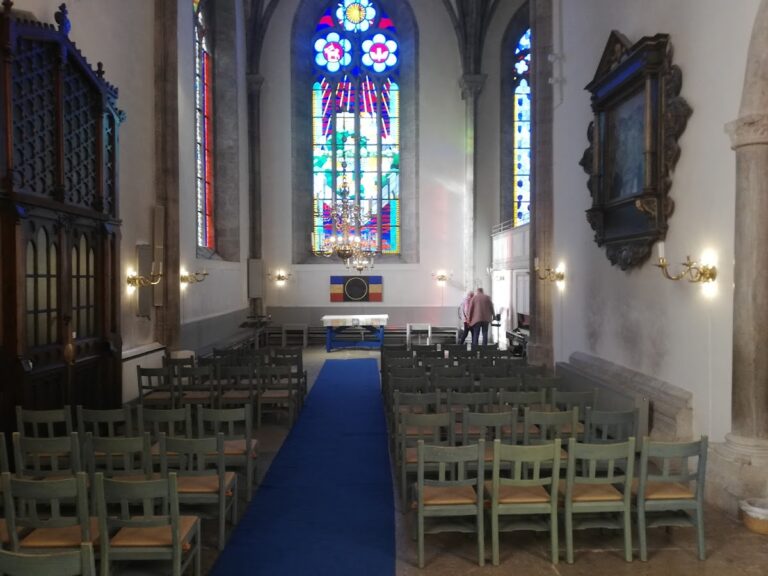
Dalhem Church contains Gotland’s oldest preserved stained-glass windows, made by a German artisan. The glazing in the choir is regarded as among the island’s most important medieval stained-glass work. Further windows in a medieval style were installed during Haig’s renovation. Several medieval wall paintings also survive, including scenes of the Crucifixion and the archangel Michael, a Christian protector and leader of the heavenly hosts. Haig’s numerous renovation paintings dominate the interior visually.
Older furnishings and later fittings
The church contains a fourteenth-century processional cross, a twelfth-century baptismal font, and an oak pulpit dated 1637. The organ was built in 1875 by Åkerman & Lund. The church bell was cast in 1599 by the Lübeck bell founder Matthias Benningk. These objects form part of an interior whose furnishings largely derive from the major renovation.
Grave slabs
Five old grave slabs are displayed beside the church beneath a roofed pergola. Three are trapezoidal in shape, and the oldest dates from the end of the twelfth century.