Choragic Monument of Lysicrates: A Memorial to an Athenian Chorus Victory
Site at a Glance
- Popularity
- High
- Country
- Greece
- Primary era
- Classical
- Eras represented
- Classical, Early Modern
- Civilizations
- Ancient Greek, Ottoman
- Site type
- Civic
- Remains
- Monument
On this page16 sections
History
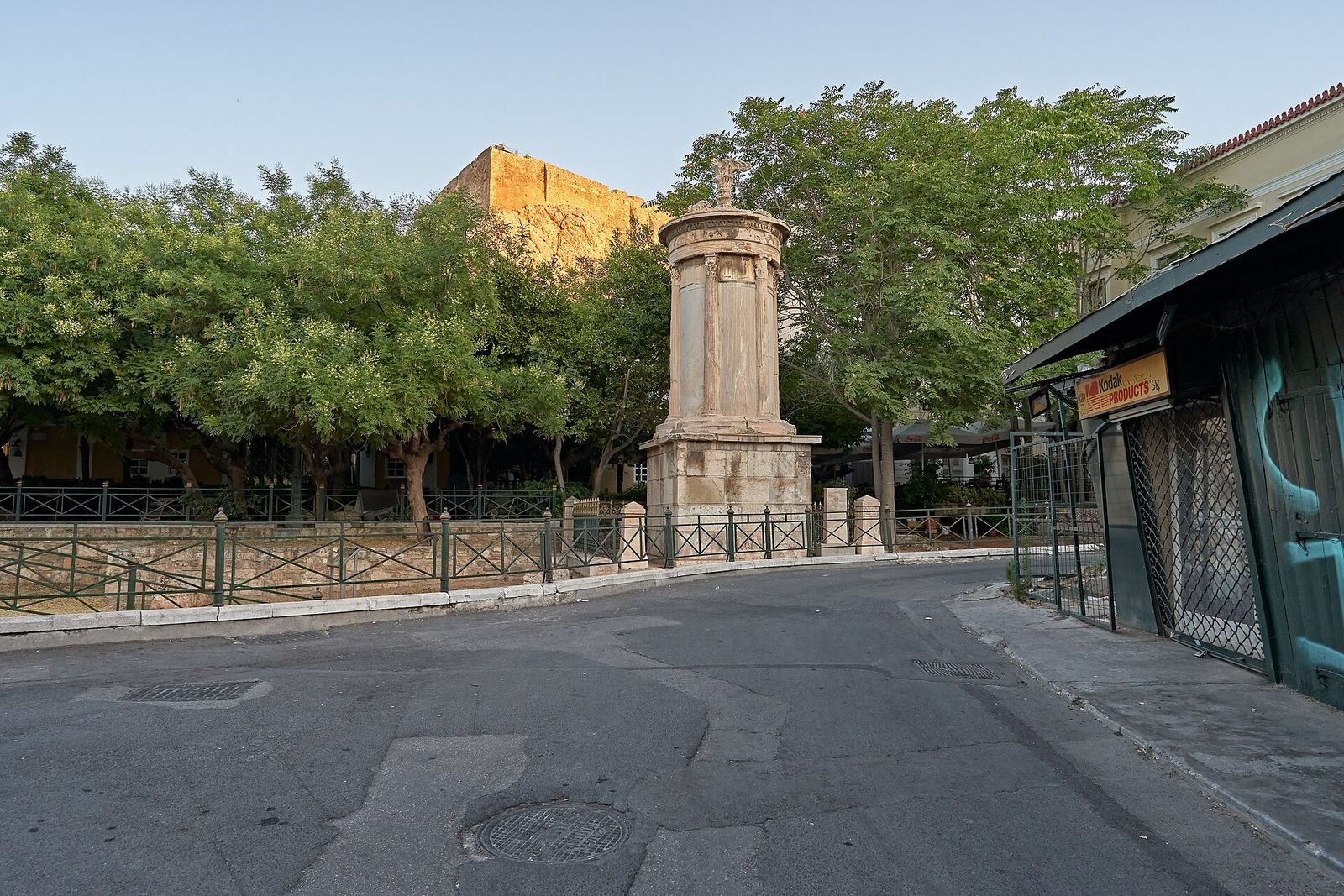
The Choragic Monument of Lysicrates stands in Athens, Greece. Lysicrates, a wealthy choregos, erected it in 335/334 BCE after the chorus he sponsored won the boys’ dithyramb contest at the City Dionysia, Athens’ major festival honoring Dionysus. A choregos financed and supervised a chorus for public performances and competitions, while a dithyramb was a choral form associated with the god. Monuments of this kind displayed the bronze tripod awarded to a winning sponsor.
The monastery and rediscovery
Capuchin monks, members of a branch of the Franciscan order, established a monastery beside the monument in 1658 and acquired the ancient structure in 1669. They partly enclosed it within the monastery and used it as a library. Its original purpose had faded from memory, and it became popularly known as the Lantern of Demosthenes or the Lantern of Diogenes.
In 1676, the French antiquarian and traveller Jacob Spon read the inscription and recognized the monument’s connection to a chorus victory. James Stuart and Nicholas Revett published its first measured drawings in their Antiquities of Athens in 1762. Their work, followed by later engravings, helped bring the monument’s design to architects and builders.
Architectural influence and attempted removal
The monument’s form inspired at least 18 structures erected in Britain during the eighteenth and nineteenth centuries. Examples include the Dugald Stewart and Burns monuments in Edinburgh, buildings at Shugborough in Staffordshire, and St John the Evangelist church in Chichester. Versions also appeared in Sydney’s Royal Botanic Gardens and at Melbourne’s Shrine of Remembrance.
In the United States, William Strickland drew on the monument for the cupolas of Philadelphia’s Merchants’ Exchange and the Tennessee State Capitol. Its design also influenced the Soldiers’ and Sailors’ Monument in New York and the Portland Breakwater Light in Maine. Napoleon commissioned a terracotta replica by Jacques-Guillaume Legrand for the gardens at Saint-Cloud. Shown in the Louvre courtyard in 1802 before being installed at Saint-Cloud, the replica was destroyed by Prussian forces during the Siege of Paris in 1870.
From about 1800, the British diplomat Lord Elgin arranged for casts to be made and unsuccessfully sought to remove the original. In 1829, the monks offered the monument to an English traveller, but it was too difficult to dismantle and transport. A cast of its frieze, made by the French archaeologist Louis-François-Sébastien Fauvel, was lost when his house burned in 1825.
War damage and restoration
In 1821, during the Greek War of Independence, the revolt through which Greece won independence from Ottoman rule, the adjoining monastery was attacked and burned. The fire damaged the monument. The monastery was later demolished, leaving the structure exposed to weather, neglect, and damage from passers-by.
Emergency repairs were completed in 1824 using money released by Fauvel. After Greek independence in 1830, the land and monument were placed in the care of the French Legation, France’s diplomatic mission in Greece. Greek national and municipal authorities, the archdiocese, and local residents repeatedly challenged French possession.
Restoration proceeded in several stages. Architect Jules Goury paid for work in 1832, and the French Commission for Historic Monuments supported repairs in 1845. In 1867, French diplomat Arthur de Gobineau initiated another campaign under architect François Boulanger; work included excavation around the base and clearing the monastery ruins. Further restoration took place from 1876 to 1887 under French auspices, supervised by Boulanger and E. Loviot.
Archaeological work and recent damage
Excavations took place in 1920-1921 and again in 1982-1983. The later work contributed to changes in the arrangement of the surrounding square. In 2016, political words were spray-painted on the monument.
Remains
Setting and overall form
The monument remains at its original location in a small garden in Lysicrates Square, beside Tripodon Street near the Acropolis. The street follows the line of the ancient Street of the Tripods, which led toward the Theater of Dionysus. A high square base supports a hollow, round structure resembling a small temple. The complete monument, including its central roof ornament, is about 11 metres high.
Podium and circular structure
Podium
The square podium measures about 3 metres across and 3.9 metres high. Four narrow steps lead to its smooth wall, built from blocks and capped by a projecting slab. Contrasting stone and marble appear in the podium and its projecting courses. Across the monument, the materials include Piraeus stone, limestone, Hymettian marble, Pentelic marble, and volcanic tuff, with varied finishes on different surfaces.
Cylindrical body and columns
The hollow cylinder is about 4.77 metres high and 2.8 metres in diameter. Its white Pentelic marble wall is encircled by six engaged columns, meaning columns attached to a wall rather than freestanding. Each is about 3.5 metres high, and the visible shaft has 13 flutes. The columns sit within the wall so their inner faces do not project into the interior.
The elongated Corinthian capitals, or column tops decorated with acanthus leaves, have two rows of foliage and open volutes (scroll-shaped forms). A groove around the neck of each capital may have held a bronze ring. The sculptor is unknown; the work has been tentatively associated with Leochares or another artist connected with the school of Scopas.
Carved bands and roof
Upper structure and reliefs
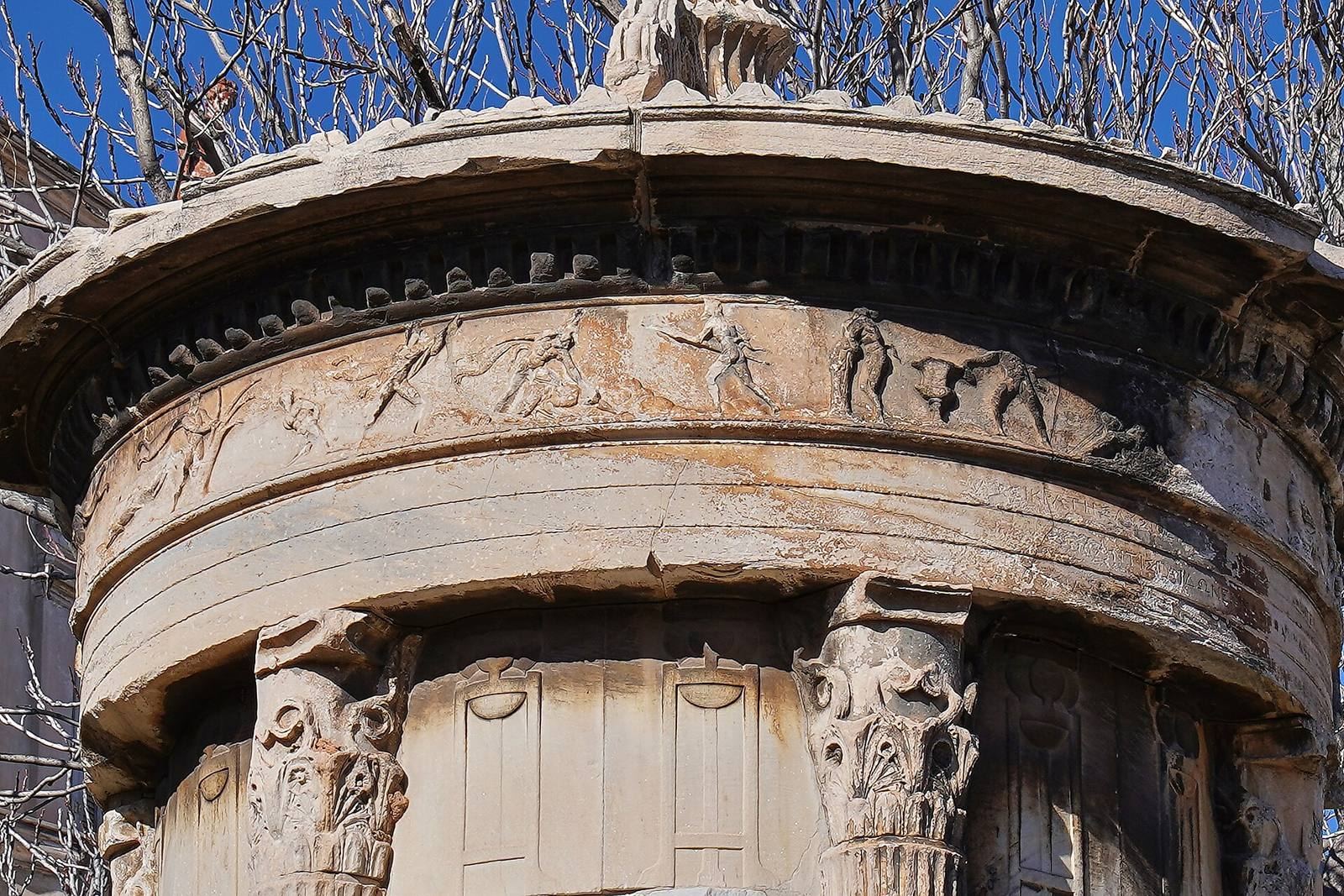
The columns carry a horizontal upper structure with a three-part Ionic architrave, the lowest band, above which runs a continuous sculpted frieze. A cornice crowns the structure and includes dentils, small toothlike blocks. The frieze depicts Dionysus and the Tyrrhenian pirates: satyrs punish the pirates as they are transformed into dolphins, while Dionysus appears with a panther. The story is also told in the Homeric Hymn to Dionysus.
Between the capitals, 12 panels show tripods, arranged in pairs in each space between columns. A separate sequence of reliefs also depicts tripods. These carved images form part of the decoration around the monument’s cylindrical body.
Roof and tripod ornament
The roof was carved from a single hollowed block of bluish Hymettian marble. Moulded decoration covers its underside, while scale-like patterns cover its curved surface. Stylized floral ornaments, called anthemia, rise along two sides and meet at an acanthus finial. The finial supported Lysicrates’ bronze tripod, which is no longer preserved; small statuettes of a satyr and a dolphin also supported it.
Inscription and archaeological evidence
Dedicatory inscription
An inscription on the architrave names Lysicrates as the son of Lysitheides and a member of Kikynna, an ancient Athenian civic district. It identifies the tribe of Acamantis as victorious in the boys’ contest, Theon as the flute-player, Lysiades of Athens as chorus director, and Euainetos as archon, a senior magistrate.
Alterations and excavated finds
When the Capuchins adapted the monument for monastery use, they moved one upright wall slab to make an entrance. Excavations in the surrounding area revealed the bases of three other choragic monuments. Finds included sculpture fragments, inscriptions, vessels, and Roman and medieval coins. The square’s layout was altered, and part of its railing was removed.