Château Saint-Germain: A Valley Fortification in France


Site at a Glance
- Rating
- 4.9
- Popularity
- Very Low
- Country
- France
- Primary era
- Medieval
- External website
- Open
- Eras represented
- Medieval, Early Modern
- Civilizations
- French
- Site type
- Military
- Remains
- Castle
On this page10 sections
History
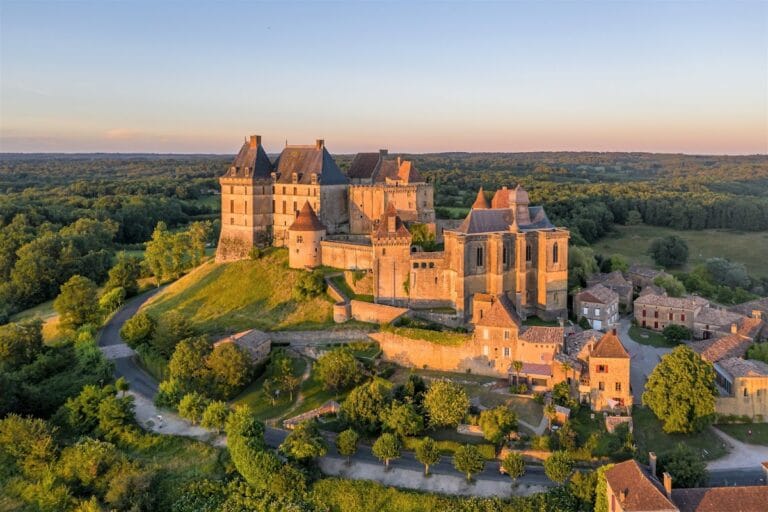
Château Saint-Germain is a fifteenth-century castle in France, at Gaugeac in the Dordogne, built as an advanced fortification of Château de Biron. Its position controlled an important route into the Dropt valley, where a narrow passage descended from the north of the plateau formerly occupied by Château de Bonneville. From this point, the castle could monitor movement through wooded and scrub-covered plateaus that Château de Biron could not directly control.
Saint-Germain and Biron
Much of the castle’s earlier history was lost when the archives of Biron were deliberately burned during the French Revolution. Surviving evidence still preserves details about Saint-Germain’s lords and a parish dedicated to Saint Germain, from which the castle took its name. During the reign of Saint Louis, the lord of Saint-Germain was regarded as the oldest vassal of the lord of Biron. Saint Louis was Louis IX, king of France from 1226 to 1270, while a vassal was a dependent lord who owed loyalty and service to a feudal overlord.
In 1124, the lord of Saint-Germain is recorded as having joined Guillaume de Biron on a crusade. The two men were said to have departed from Cadouin Abbey. The lord of Saint-Germain also held a ceremonial role at the first entry of the Lady of Biron into the castle courtyard. Kneeling and unarmed, he held her bridle, sought her acceptance of his homage, and swore an oath of fealty. After returning to his manor, he received her horse, harness, and the dress she had worn for the ceremony. This was an expression of the close feudal relationship between Saint-Germain and Biron.
A Judicial Duel in 1310
In 1310, Hugues de Saint-Germain killed his sister with a dagger. After Aimeric de Biron reprimanded him, Hugues accepted a judicial duel at Molières. The encounter took place on horseback and in armor on the Tuesday after the feast of Saint James, in the presence of the English seneschal, a senior administrative and judicial official. Hugues was defeated and killed, and his property was confiscated for the Duke of Guyenne because of his capital crime. The seneschal congratulated Aimeric de Biron and reimbursed him for the expenses of the encounter.
War, Alteration, and Protection
Château Saint-Germain later took part in the French Wars of Religion, a series of sixteenth-century civil and religious conflicts fought chiefly between Catholic and Protestant forces. Its garrison changed between Catholic and Protestant control as the surrounding region shifted during the fighting.
The surviving castle is dated to the fifteenth century. It was also said to be due to celebrate its nine-hundredth anniversary in 2024, a claim that reflects an earlier foundation tradition or historical reckoning not otherwise established here. The castle entered the register of French historic monuments on 28 December 1984. Its façades and roofs received protection, while three fireplaces on the first floor were given classified status. The property remains privately owned. In modern times, the castle has also served as a setting for action scenes in several swashbuckling films, including a sequence from La Fille de d’Artagnan featuring Philippe Noiret and Sophie Marceau.
Remains
Main Fortification
Residential Building
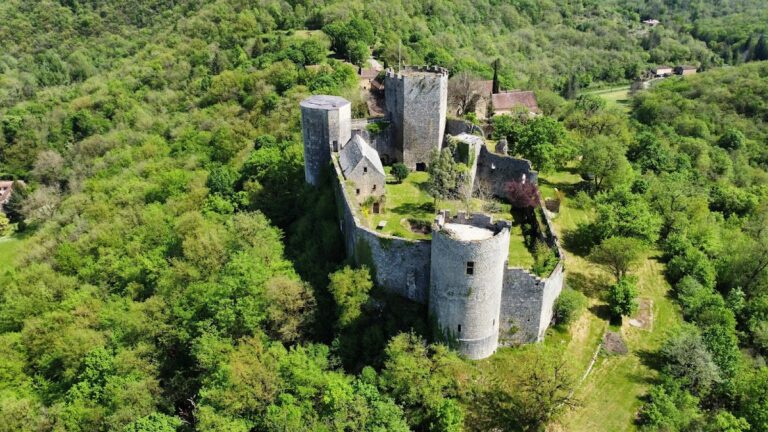
The principal residential building faces the valley and forms the main body of the castle. It is flanked by two round towers, although one is substantially more important than the other because of its defensive function. Large windows were opened on the valley side at the first-floor level to light the principal rooms. On the second floor, monumental fireplaces survive beside intact mullioned windows, which are divided into separate lights by vertical stone members.
Defensive Tower
The principal tower retains an intact watch post and commands the point where the road from Bonneville reached the main road between Monpazier and Villeréal. Its principal gun loophole, a narrow protected opening for firearms, controlled this junction. The tower’s position therefore formed the castle’s clearest surviving connection with its role in supervising movement through the valley.
Seventeenth-Century Changes
The castle probably underwent its first major architectural modification during the seventeenth century, when the upper crowns of both round towers were removed. Tradition attributes the work to the lord of Biron. According to the story, he ordered the crowns destroyed by cannon fire after the castellan boasted that he could see his suzerain in the dining room and his wife in the bedroom through the high dormer windows. The account preserves a later explanation for a visible change to the towers, while the precise circumstances remain part of tradition.
Later Buildings and Chapel
Additional buildings were attached to the principal residential block at different periods. The door and window of the hexagonal tower, together with its spiral staircase, retain their original condition. Two more towers were built later, and one contains the castle chapel. In the early twentieth century, the son of the philosopher Maine de Biran was married there.