Château du Puy: An Eighteenth-Century Château in Tercillat, France
Site at a Glance
- Rating
- 4.8
- Popularity
- Low
- Country
- France
- Primary era
- Early Modern
- External website
- Open
- Eras represented
- Medieval, Early Modern
- Civilizations
- Unclassified
- Site type
- Domestic
- Remains
- Castle
On this page8 sections
History
Château du Puy is an eighteenth-century château in Tercillat, France, rebuilt in 1789 in the architectural and historical setting of the late ancien régime. Its stone rubble and limestone came from the former feudal castle of Tercillat, an earlier Templar commandery, meaning an estate that combined religious, residential, and economic functions for the medieval Order of the Temple. The present building therefore preserves material links to the earlier stronghold and to the long history of the Le Puy estate.
Medieval origins and the Le Puy fief
The estate of Le Puy, known as Podio in a Latin parchment, appears in a lawsuit dated 4 May 1237 between P. de Mornac and P., son of Clément. In 1282, Gilles Ajasson, lord of Le Puy, sold the estate to Roger de Brosse, lord of Sainte-Sévère. At the end of the fourteenth century, Louis II de Brosse gave it to the knight Jehan Le Groing, lord of La Motte-au-Groing. Le Groing later sold the estate to Pierre Guionnet, and Pierre II de Brosse confirmed that transaction on 24 January 1395.
A fief was land held through a feudal relationship. Its successive holders acknowledged the authority of higher-ranking lords through homage, the formal act by which a vassal recognized that authority in return for possession of the land. In 1509, Marguerite, wife of Loys de la Vigne, lord of Maransanges, held the Le Puy fief. It soon passed to Claude Bochier, lord of Maison-Neuve and Lage-Saint-Paul, who retained it at least until 1578.
Seigneurial ownership before the Revolution
Jean de Noblet reunited Le Puy with the lordship of Tercillat. After his death, the château and fief were separated from Tercillat and passed first to his son, Gilbert de Noblet, and then to Gilbert’s daughter, Marie-Agnès de Noblet. While widowed from Sylvain de Durat, lord of La Cellette, she rendered feudal homage for the fief in 1733. Her detailed acknowledgment of 1736 described a seigneurial residence with two dwelling blocks enclosing a courtyard, a gateway, and a dovecote at the entrance. A dovecote housed domestic pigeons and could also express the status and rights of a landholder.
After Marie-Agnès de Noblet died around 1745, the fief passed to Sylvie-Claire de la Chapelle, wife of Claude de Vauchaussade, lord of Brousse. Their farmer, Jean-Baptiste Porcher, rendered homage by proxy in 1749 to Germain de Flexelles, lord of Sainte-Sévère. A few months later, Claude de Vauchaussade sold the estate to Claude-Bertrand de Beaumont, lord of Tercillat, who rendered homage for it in 1750. The Le Puy lordship consequently remained tied to the owners of the Tercillat land.
Rebuilding and later ownership
The former feudal castle of Tercillat was destroyed during the French Revolution. In 1789, the present residence was built from materials taken from that earlier structure. The lands of Tercillat, Le Puy, and the Pontet and Bois Huguet farmsteads had formed one of the oldest and most important fiefs associated with the lords of Sainte-Sévère and Déols Abbey, a medieval religious institution near Châteauroux in the historic province of Berry. During the Revolution, these lands became part of the Creuse.
The lordship remained associated with Tercillat and passed in 1816 to the Beaufranchet family and their descendants, the barons of Wildemberg. Claude Amable de Beaufranchet lived at the château that year. Around 1894, when the property belonged to d’Abadie and de Wildemberg, the building was considered unfinished, with its roof structure resting at ground-floor level.
Charles Rousseaux acquired the château and its dependencies from Baron Bernard de Wildemberg in 1976, through Maître Louis, a notary in Sainte-Sévère. The property was later restored and arranged for presentation by the five grandchildren of the Countess of Maussion de Candé. Since 1989, the château and its collection of 3,000 costumes have been available to the public and to schools by reservation for cultural days, while heritage-day visits and other activities have also taken place there.
Remains
The eighteenth-century residence
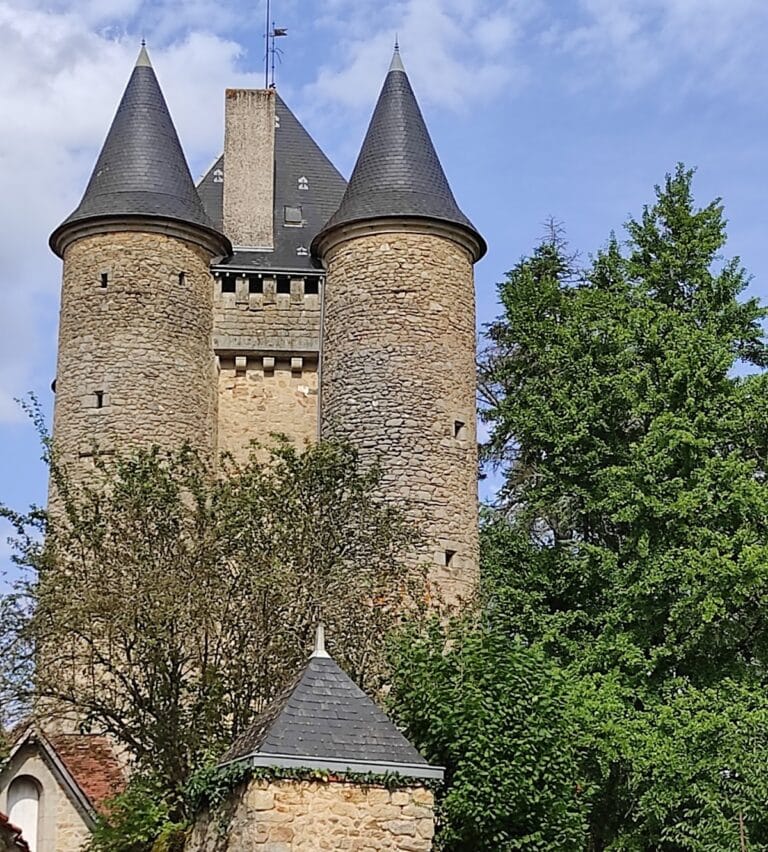
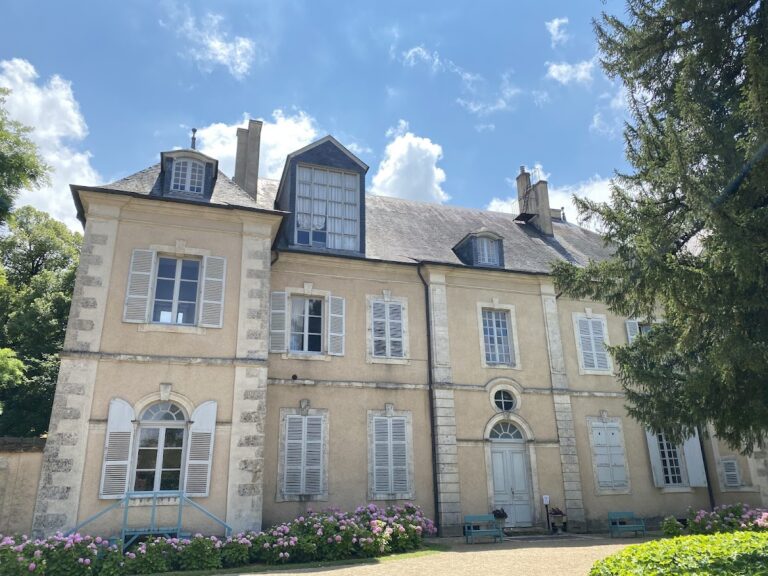
Château du Puy is a large square residence situated about one kilometre northwest of Tercillat. The building raised in 1789 uses limestone rubble and other materials from the former castle of Tercillat. At least one reused stone bears a Templar cross. Elements from the earlier castle, including Templar heads, a staircase, and fireplaces, are embedded in or installed within the present residence. The restored eighteenth-century carriage gates retain parqueted woodwork.
Earlier buildings and estate structures
The architectural complex includes a seventeenth-century residence and a medieval farmyard, together with a medieval dovecote, a farm, and a bakery oven. Its service area contains an eighteenth-century masonry stove, a fixed stove or range built from materials such as brick or stone. Other surviving features include a clock from the Revolutionary period, a sheepfold containing historical tools, and vaulted cellars. Performance rooms and the collection of 3,000 costumes form part of the château’s arranged interior presentation.
Grounds and agricultural landscape
The dependencies and grounds extend across twelve hectares. They include forests, classified streams, ponds, wooded and sloping ground, a natural-stone quarry, a vegetable garden, and a deer park. The medieval farmyard, dovecote, seventeenth-century residence, and deer park belong to the visitable architectural and landscaped complex, linking the main residence with the estate’s agricultural buildings and managed grounds.
Nearby sites