Château de Jouillat: A Medieval Defensive Keep in France

Site at a Glance
- Rating
- 4.4
- Popularity
- Very Low
- Country
- France
- Primary era
- Medieval
- External website
- Open
- Eras represented
- Medieval, Early Modern, Modern
- Civilizations
- French
- Site type
- Military
- Remains
- Castle
On this page8 sections
History
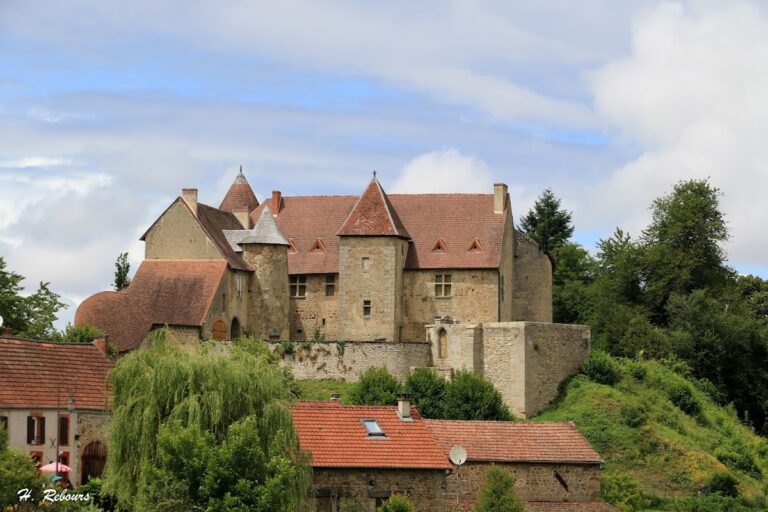
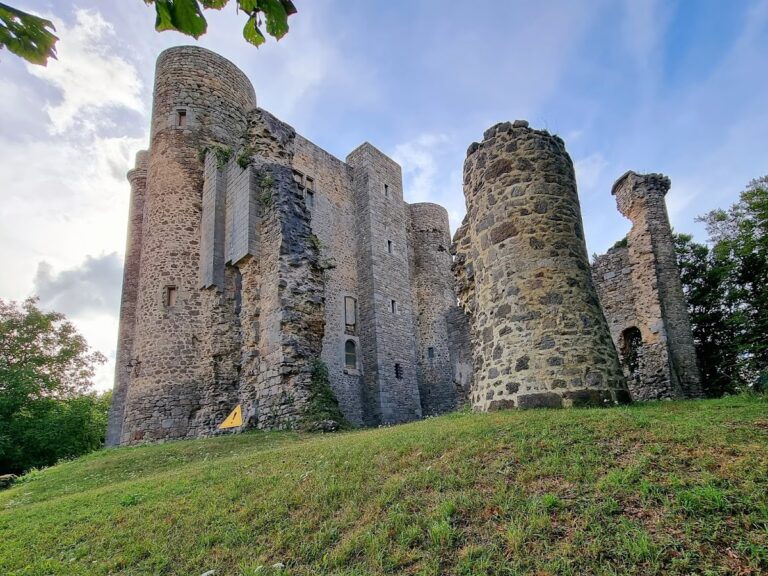
Château de Jouillat is a fourteenth-century fortified tower in Jouillat, France, built as a military defensive structure rather than a seigneurial residence. Traditionally understood to have protected two castles, it was later abandoned, stripped of stone for local house building, and eventually transformed into a residence during the nineteenth century.
Medieval origins and the Chamborant lords
The earliest known owners were the lords of Chamborant. In 1490, Imbert de Chamborant brought a legal action against Baron Pierre de Brion. A judgment issued in 1497 allowed Pierre de Chamborant to acquire the lands of Jouillat, described as including the “castle and manor,” together with the villages of Soullat and Peschedouères. Imbert died at the end of the proceedings, and his nephew then inherited. The property may previously have been granted to an ancestor of Pierre de Brion by Marguerite de Malval, wife of Pierre II de Brosse.
In 1587, Marguerite de Chamborant and her husband, Etienne Faure, purchased the castle jointly for 750 écus. In 1616, Guillaume d’Aubusson inherited it under a will dated 20 June 1616. He was married to Louise de la Trémoille and was a grandson of Marguerite de Chamborant.
Seventeenth- and eighteenth-century ownership
Louis de Boéry was associated with the property in 1658. He had married Marie Dissandes in 1651 and also purchased Boisfranc. The castle was seized in 1696. On 21 March 1700, Marguerite de la Seiglière, widow of Denys Gedoin, bought it at auction for 30,500 livres. The notarial deed referred to “towers” rather than a castle.
In 1714, the property passed to Denys Michel de Montboisier-Beaufort-Canillac, Marguerite de la Seiglière’s grandson. He served as a Black Musketeer under Louis XIV and Louis XV. Documents concerning repairs to the roof and the renovation of outbuildings, mills, barns, and other buildings indicate that the form of the château seen today was probably created between 1714 and 1733.
François de Madot purchased the property late in 1733. He was Bishop and Count of Chalon-sur-Saône and a confidant of Madame de Maintenon. In 1739, the château passed to his nephew Sylvain Louis Antoine de Madot, treasurer of the king at Moulins. Henry de Madot inherited it in 1753, followed by his wife, Marie-Marguerite de Préaulx, in 1764. The property then passed to their daughter Marie Josèphe de Madot in 1783 and to her husband, Jean-Baptiste Le Groing, in 1784.
Revolutionary and nineteenth-century succession
Anne Marie Lejeune, widow of Jean Antoine Garaud, appears in the ownership sequence in 1785. In 1796, the property was associated with her son Philippe Thomas Garaud, whose sister was Geneviève. Around 1793, Anne Marie Lejeune and Philippe Thomas Garaud sought removal from the list of suspects as emigrants, people treated during the Revolution as having left France in opposition to the new regime.
Marguerite Alexandrine Godeau d’Abloux, widow of Philippe Thomas Garaud, received the property on 29 September 1816. An act of 23 December 1824 recorded Claire and Agatha Garaud’s abandonment of succession rights in favor of Marie Alexandrine Godeau d’Abloux’s children, Claire, Eugène, and Agatha. Pierre and François Lamoureux, together with Jean and another Jean Dufour, were associated with the property in 1826.
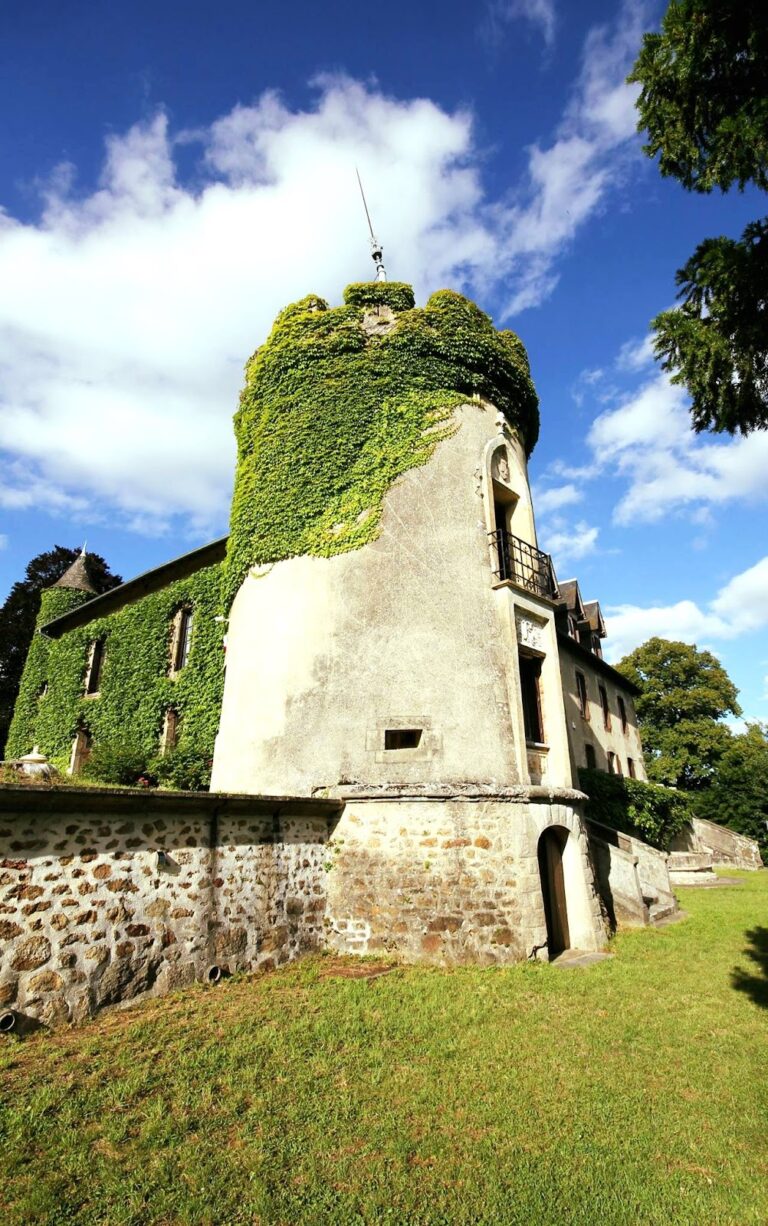
Jean-Baptiste Desheraud, a tobacco merchant and tobacconist, was recorded as owner in 1833. After his death in 1877, ownership passed to his sister and sole heir, Thérèse Desheraud, widow of Antoine Pierre Simonnet, in 1877 and 1878. During the nineteenth century, the former defensive tower was adapted as a residence. Its internal platforms were divided into living rooms, and the fireplaces were reconstructed in a nineteenth-century style.
Later owners and heritage protection
Joseph Louis Léopold Chassinat, a prefectural councillor at Guéret, acquired the château on 13 August 1886. After his death in 1890, it passed by succession to his father, Joseph Raoul Chassinat, a physician in Toulouse and former Russian vice-consul, and to his brother Joseph Edmond Lucien Chassinat, an assistant forest inspector living in Toulouse.
Pierre Dufour, a cultivator and property owner from the village of Jouillat, acquired the château on 5 August 1891. In 1930, it passed by donation, succession, or partition to Alexis Mazaud Dufour, a naval doctor who later practised as a physician at Guéret. Jean Félix Chevereau, husband of Adèle Parrain, was recorded as owner in 1945, and their son Jacques Chevereau was associated with the property in 1993. A donation and partition in April 1996 transferred it to Christophe, Stéphane, Raphaële, and Mathias Chevereau.
Château de Jouillat has been registered as a historic monument in France since 15 June 1926. This status places the building within the national system for protecting monuments of historical or architectural importance.
Remains
The fortified keep
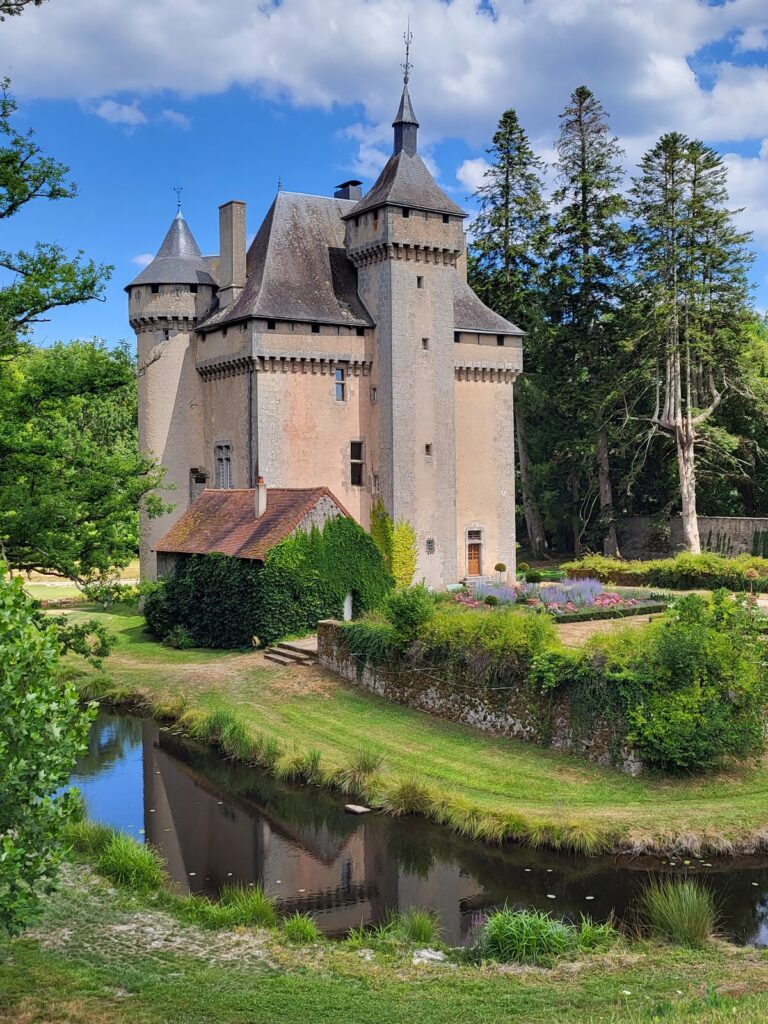
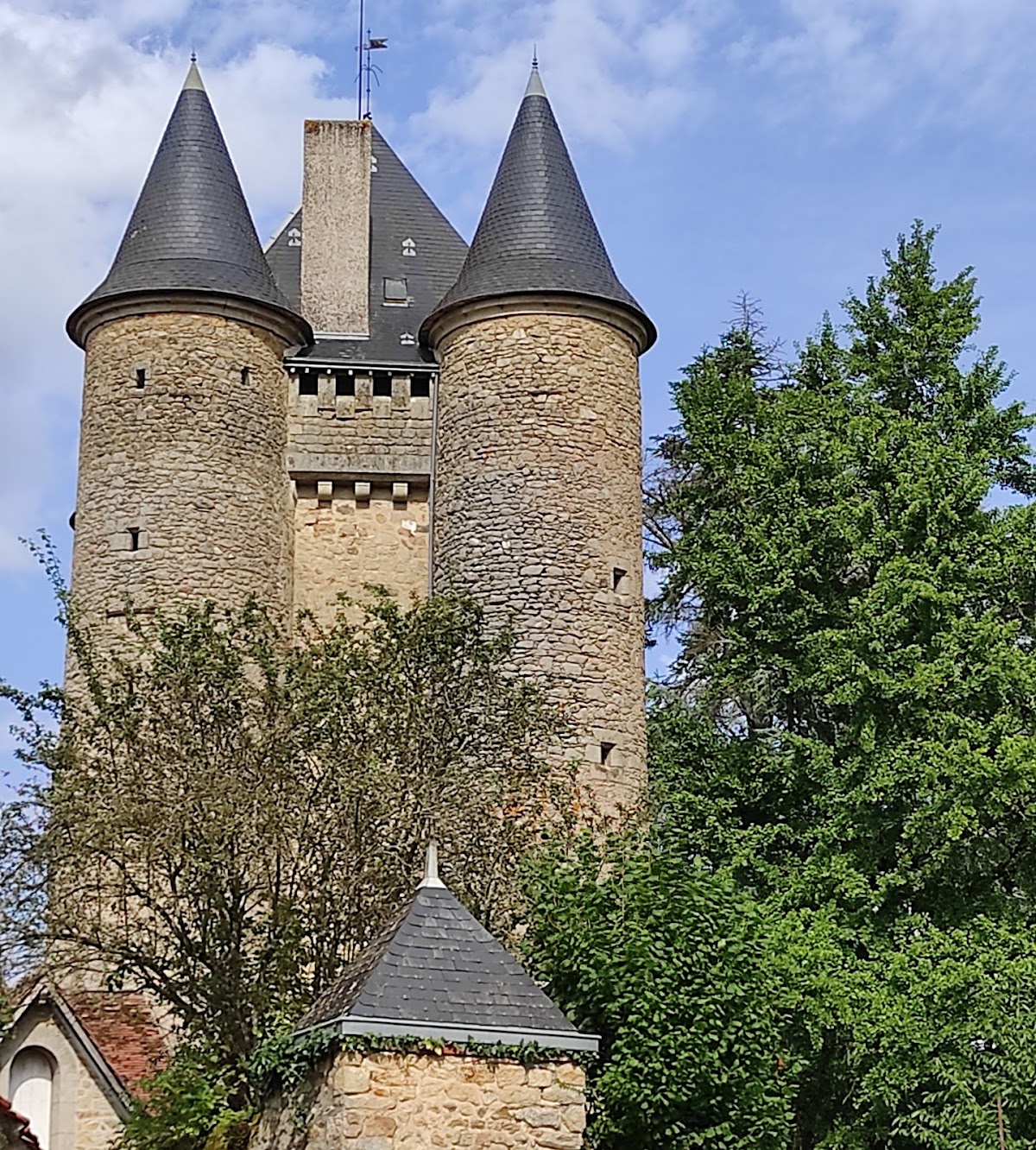
The château survives as a single keep, the principal fortified tower of a medieval castle, set on a large rectangular base. Four round towers immediately protect its corners. At the top, crenellated machicolations, projecting defensive galleries with openings directed toward attackers below, stand beneath a wall-walk, the passage running along the top of a fortified wall or parapet.
An inverted spiral staircase preserves evidence of the building’s original defensive purpose. The three internal levels were later subdivided into living rooms during the nineteenth-century residential conversion. The fireplaces belong to that later adaptation and were rebuilt in an anachronistic nineteenth-century style.
The entrance portal
Since the late nineteenth century, two statues have stood on the piers of the entrance portal. Transferred from Château de Bretouilly in the same commune, they each portray a lion devouring a human figure.