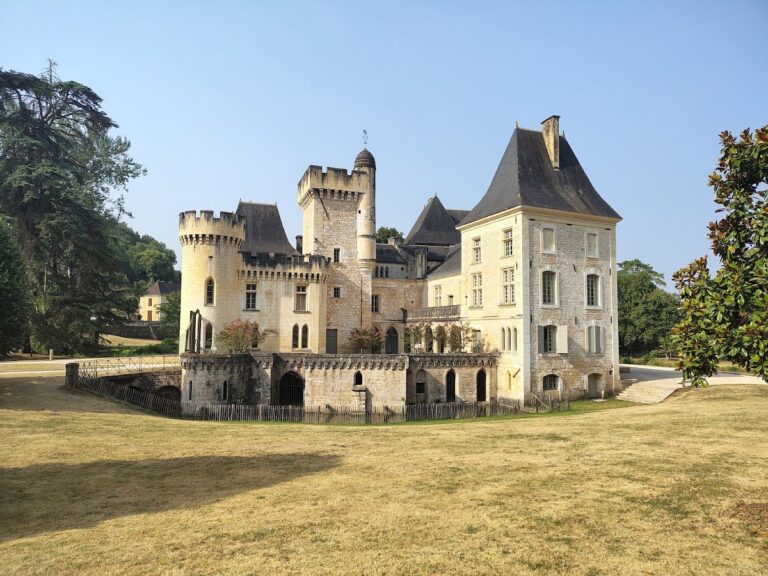
Château du Paluel: A Fifteenth-Century Fortified Residence in France


Site at a Glance
- Rating
- 4.6
- Popularity
- Low
- Country
- France
- Primary era
- Medieval
- External website
- Open
- Eras represented
- Medieval, Modern
- Civilizations
- Duchy of Aquitaine, French
- Site type
- Military
- Remains
- Castle
On this page11 sections
History
Château du Paluel is a fifteenth-century fortified residence in France, at Saint-Vincent-le-Paluel in the Périgord Noir of southeastern Dordogne. Built on a promontory above the Énéa stream, about two kilometres downstream from the village, it replaced an earlier structure and became a long-lived seigneurial residence.
Fifteenth-century origins
In the middle of the fifteenth century, a bastard of the Gimel family inherited the lordship of Paluel. He and his descendants began building the château that survives in substantially ruined form today. The new castle occupied the site of an earlier structure, linking its fortified residence to an older phase of occupation.
Changes of ownership
Paluel passed to the Durfort family in 1600. Antoine d’Aymeric purchased it in 1701, when the château had already been abandoned for nearly a century. His descendants still held the property at the beginning of the nineteenth century. The residence remained inhabited until the twentieth century, despite its earlier period of abandonment.
At the beginning of the twentieth century, Prince Louis de Croÿ acquired Paluel together with the completely ruined Château de Commarque. Stone from Commarque was used in the renovation of Paluel. The restoration also added a wing with a Neo-Gothic or Renaissance appearance, altering the historic complex while returning it to use. On 5 November 1927, the château was placed on the supplementary inventory of historic monuments.
War, destruction, and later ownership
Several scenes of the silent film Le Capitaine Fracasse, starring Pierre Blanchar, were filmed at the château in 1928. During the 1930s, Prince de Croÿ allowed La Cagoule, a clandestine far-right organization active in France during that decade, to store a large weapons cache in the underground spaces. In 1942, after German forces occupied the former Free Zone, he reported the arsenal to the judge in Sarlat because he feared that it would be discovered. The weapons were transferred to the courthouse and eventually used by the Resistance, the network that opposed German occupation and the collaborationist authorities during the Second World War.
The château remained in good condition until the end of the Second World War. In June 1944, German SS forces burned it after encountering and killing an armed young Resistance fighter below the château. A commemorative stele was later erected at the foot of the site. The building was not repaired afterward and became a ruin overgrown with vegetation. The 1999 storm further weakened the structure.
After the destruction, ownership passed to Professor Jean Lassner, a physician recognized as a pioneer of anaesthesia. Following his death in July 2007, his four children put the estate on the market. In 2010, the new British owner, Kevin Cartledge, cleared the château and its surroundings, making the remains more visible and potentially suitable for restoration. Unable to meet his debts, he saw the property auctioned in September 2017.
On 21 September 2017, the château was awarded at auction in Bergerac to Étienne Cluzel, a Dordogne restaurateur, for 853,000 euros. A Luxembourg company made a 10-percent overbid during the subsequent legal period, but the Bergerac enforcement judge ruled the overbid inadmissible on 21 December 2017. Cluzel began safeguarding parts of the château and considered reconstructing its largely collapsed keep. The property remains privately owned and is historically characterized as a ruin.
Paluel continued to attract film productions after the war. It served as a location for Le Tatoué in 1968, with Louis de Funès and Jean Gabin, and for two scenes of the American film Ever After: A Cinderella Story in 1998. The latter scenes were filmed in the great hall and the main residential building.
Remains
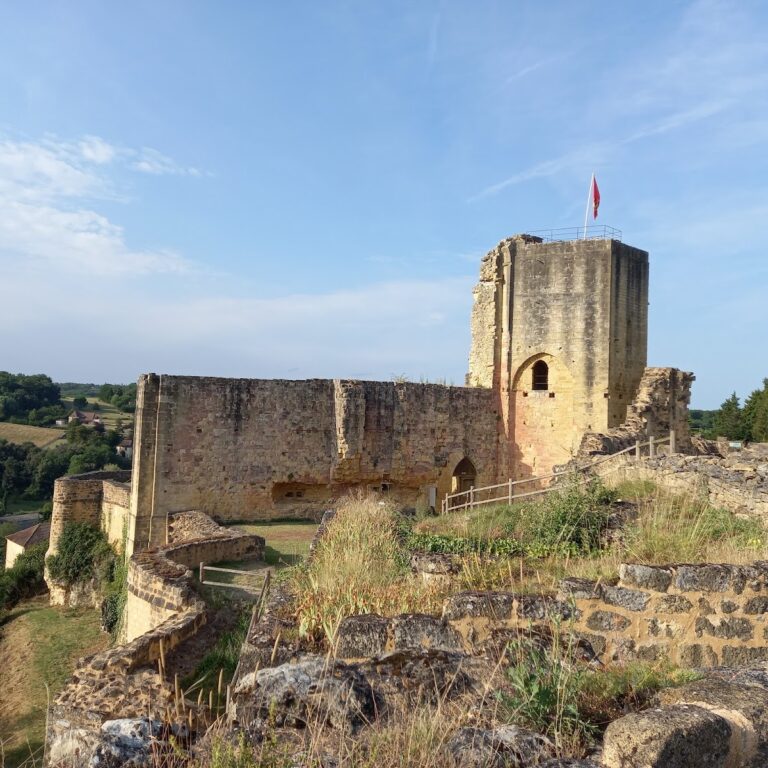
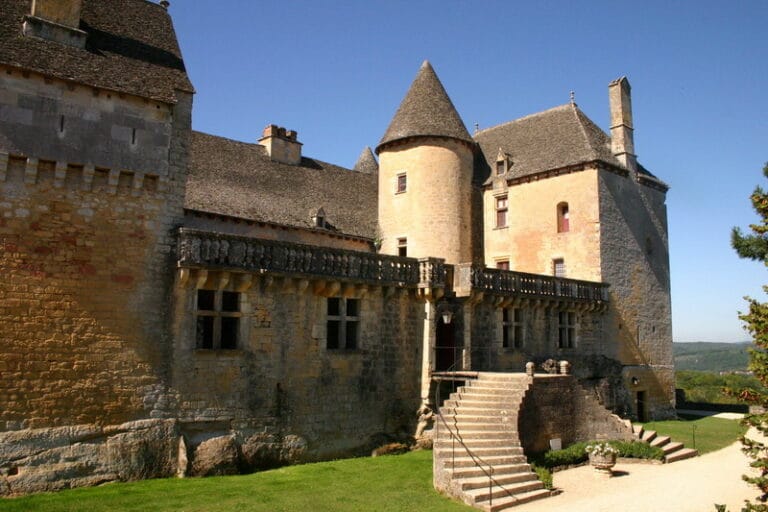
The surviving château occupies a promontory above the Énéa stream. Its principal layout is formed by a main residential body flanked by two corner towers, with a central stair tower between them. A narrow passage behind this building connects the complex to a rectangular keep. Curtain walls, meaning enclosing defensive walls joining towers or other strongpoints, surround the château.
Residential complex and keep
Main residential body
The main residential body belongs to the fifteenth-century castle and is arranged between two corner towers and a central stair tower. Machicolations crown the towers and the residential building. These projecting defensive structures contain openings through which defenders could drop or pour material onto attackers. The early-twentieth-century restoration added a wing with a Neo-Gothic or Renaissance appearance. The château is now substantially ruined, and the main residential areas survive in a heavily damaged condition.
Medieval keep
Behind the main building, a narrow passage leads to a rectangular keep dated to the twelfth century. A keep is the principal fortified tower of a medieval castle, often serving as both stronghold and residence. The fifteenth-century castle was built on the site of an earlier structure, while this surviving keep represents an older architectural element within the complex. Its largely collapsed condition became a focus of later plans to safeguard and possibly reconstruct parts of the château.
Defensive features and associated remains
Towers, machicolations, and curtain walls
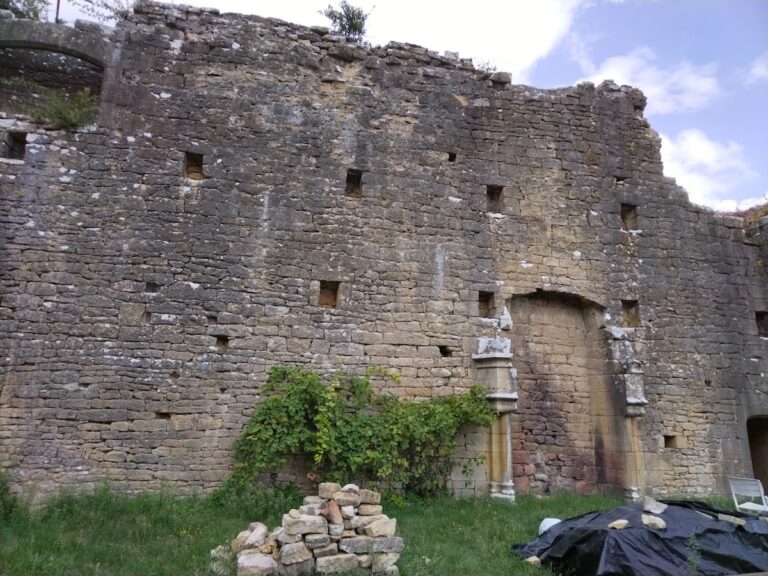
The two corner towers and the main residential body retain their relationship within the defensive enceinte, or enclosed fortified area. Their upper levels are marked by machicolations, while the keep retains wooden machicolations with daub infill. The surrounding curtain walls define the château’s defensive enclosure and connect its principal strongpoints.
Well and commemorative stele
A well lies within the site. In 1980, the body of a Bordeaux drug trafficker was found at its bottom, adding a later episode to the physical history associated with the ruin. At the foot of the château, a stele commemorates the armed young Resistance fighter killed there in June 1944, when German SS forces burned the building.
The ruined appearance was altered temporarily during the filming of Le Tatoué. False windows and doors were installed in openings in the facade so that the building would appear less damaged, although almost nothing remained behind that facade at the time.
Nearby sites