Château de Campagnac: A Multi-Period Castle in France


Site at a Glance
- Rating
- 4.1
- Popularity
- Very Low
- Country
- France
- Primary era
- Medieval
- Eras represented
- Medieval, Early Modern, Modern
- Civilizations
- French
- Site type
- Military
- Remains
- Castle
On this page8 sections
History
Château de Campagnac is a multi-period castle in France, at Campagnac near Sarlat-la-Canéda, whose construction developed across the fourteenth, sixteenth, and nineteenth centuries. A member of the Plamon family, a bourgeois family of Sarlat that had supplied many of the town’s consuls since the fourteenth century, began the building. The château later became involved in the military and religious conflicts that shaped the history of Périgord.
Campagnac in the Hundred Years’ War
The château stood at Campagnac-l’Évêque, a settlement in the parish of Saint-Martin within the Diocese of Sarlat. The settlement was known by that name at least from 1657 until 1792. In that year, the creation of the civil register attached the parish to the commune of Sarlat.
Campagnac lay in a region contested during the Hundred Years’ War, the prolonged conflict between the French and English crowns that lasted mainly from the fourteenth to the fifteenth century. On 8 July 1347, English captains seized Puymartin and La Vaissière near Salignac. They later withdrew those places after receiving payment, but their actions led Sarlat’s council to dismantle or disable the defenses of Puymartin, La Vaissière, La Rode, Campagnac, and other nearby sites, preventing English troops from using them.
In 1348, an English force from the garrisons of Bergerac, Le Bugue, and Tayac captured Campagnac, Temniac, and Saint-Quentin, placing Sarlat under threat. The seneschal of Périgord, a royal official with administrative, judicial, and military authority, joined the lord of Ribérac and inhabitants of Sarlat in forcing the English to withdraw.
Further conflict followed in 1360, when Gilbert de Domme, the French king’s seneschal of Périgord and lord of Vitrac, sought control of the area between the Dordogne and Vézère rivers. After Sarlat opposed his plans, he allied with the English and used the church at Campagnac and the fort of Vitrac as bases for raids that reached the town’s gates. Bishop Hélie de Salignac of Sarlat negotiated an agreement in July 1360. On 9 December 1361, Sarlat’s consuls paid Gilbert de Domme 500 gold florins to secure peace. The Treaty of Brétigny, finalized on 24 October 1360, had placed Périgord under English suzerainty, but Edward III ordered English troops to withdraw from the region in 1361.
After the Plamon family, ownership passed to the Roux de Campagnac family and then to the Abzac de Campagnac family during the fourteenth century.
Religious wars and the seventeenth century
During the Wars of Religion, the sixteenth-century conflicts between Catholic and Protestant forces in France, Protestants occupied the château. In 1589, their control of Campagnac and several other fortified places left Sarlat effectively besieged.
In 1592, the lord of Pelvézy and his brothers captured the château of Campagnac del Bos. Jean Roux, lord of Campagnac, was killed while defending it. The event forms part of the château’s history as a fortified residence repeatedly drawn into the struggles around Sarlat.
Revolutionary sale and nineteenth-century expansion
During the French Revolution, part of the château was sold as national property, an asset placed under public ownership and then commonly sold to private buyers. The sale took place on 22 Floréal of Year II for 10,000 francs to Salives, a resident of Campagnac. The Record family of Sarlat purchased the other part.
Baron Pierre Stanislas Alexandre de Dampierre, a diplomatic attaché based in Paris, bought the château in 1830 and expanded the estate. He sold it in 1891 for 90,000 francs to Gabrielle Victoire van Marcke de Lummen, the wife of the painter Louis Watelin. The couple undertook work costing 50,000 francs and lived at the château from 1896.
Twentieth-century decline and protection
The property was sold to Monsieur Arnould in 1956. After his death, his widow leased half of it to a religious institution, which used the château as a home for orphaned boys. The institution housed 80 children during the 1960s, but closed in 1975 as the number of children rapidly declined.
In 1980, the commune bought the property for 1.8 million francs after local concern about the possible establishment of a Buddhist community and Tibetan monks. Louis Delmon, then mayor, intended to convert the château into a centre for community associations. The building was subsequently abandoned and deteriorated into ruins, while the surrounding 40 hectares became hiking paths. Mayor Jean-Jacques de Peretti later sought a private partner for the property’s future.
The stair tower was registered as a historic monument on 5 March 1998. Registration is a French heritage-protection measure that recognizes and legally protects buildings or sites of architectural or historical importance. A decree of 17 September 2025 replaced that protection with registration of the entire château, its gateway, pavilions, and the remains of a fishpond.
Remains
Castle and surrounding estate
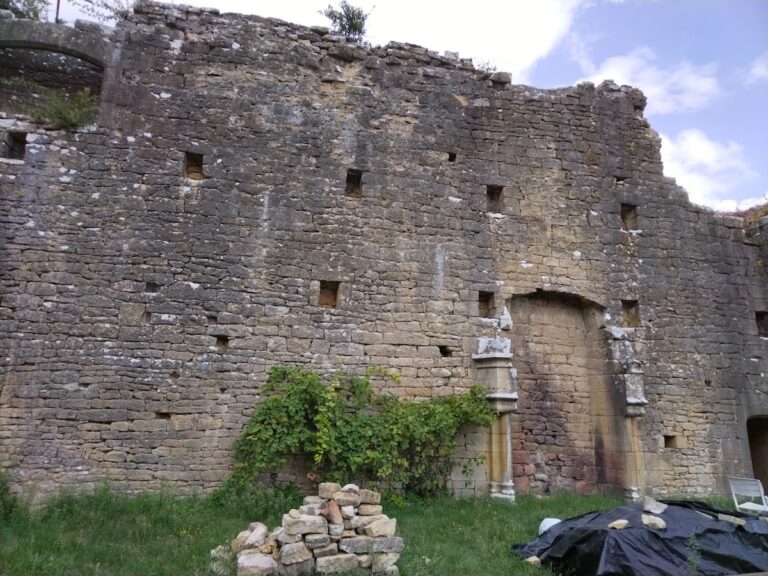
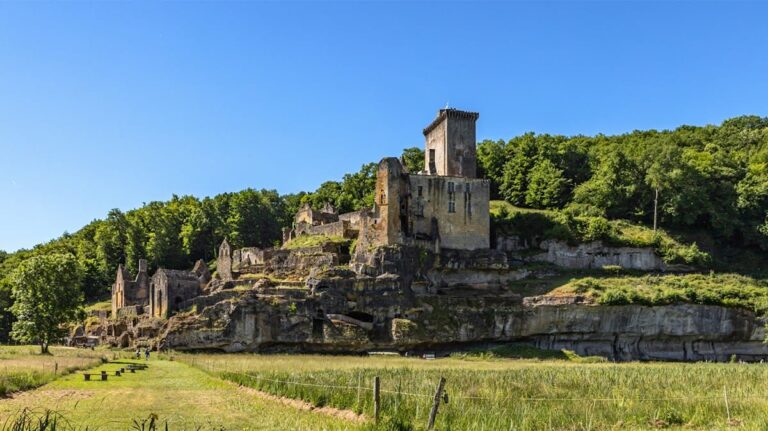
Château de Campagnac is a multi-period building whose surviving form reflects construction and alteration in the fourteenth, sixteenth, and nineteenth centuries. The complex consists of the château together with its gateway, pavilions, and the remains of a fishpond. These elements form the principal physical components of the protected site.
The stair tower contains a staircase covered by a barrel vault, a curved ceiling formed as a continuous half-cylinder. The staircase turns around a central core, giving the tower a distinct internal arrangement within the wider building. This stair tower was the part of the château first registered as a historic monument, before protection was extended to the full complex.
Condition and landscape
Since the property’s abandonment after the commune acquired it in 1980, the château has deteriorated into ruins. Approximately 40 hectares surround the building, and this estate is used as hiking paths. The gateway, pavilions, stair tower, and fishpond remains are included with the château in the current protected complex.