Château du Boy: A Renaissance Castle and Historic Estate in France


Site at a Glance
- Rating
- 4.6
- Popularity
- Very Low
- Country
- France
- Primary era
- Medieval
- External website
- Open
- Eras represented
- Medieval, Early Modern
- Civilizations
- French
- Site type
- Domestic
- Remains
- Castle
On this page6 sections
History
Château du Boy is a Renaissance-style castle in France, at Lanuéjols in the Valdonnez valley of Lozère. It stands on the former lands of the Barony of Tournel, one of the eight baronies of Gévaudan, a historic territory corresponding broadly to modern Lozère. The property developed from a medieval farmstead into a fortified aristocratic residence and later became a place of charitable and medical care.
From Farmstead to Barony Seat
Before the fourteenth century, the principal castle of the Barony of Tournel was Château du Tournel. Its territory was divided into five administrative districts, or mandements: Tournel, Chapieu, Montialoux, Montmirat, and Montfort. The future Château du Boy was then a large farmstead known as the mas or mansus del Boy, a name recorded as early as 1294 and associated with the French term for a cattle herder.
Around 1307, the Tournel family chose to leave its defensive castle at Tournel and live at Boy, where conditions were more comfortable. The property was improved and fortified in 1369 as armed bands threatened the region. Although the castle was severely damaged and burned during the fourteenth century, the lords of Tournel restored it. In 1445, Armand-Guérin du Tournel, Baron of Tournel, made his will at Boy, indicating that the residence had probably become the permanent seat of the barony.
Inheritance and Eighteenth-Century Transformation
The Barony of Tournel later passed through female succession, meaning that inheritance moved through a daughter or other female heiress. Gabrielle du Tournel, the barony’s heiress, married a member of the Châteauneuf-Randon family who was lord of Allenc. After another female succession, Louise de Châteauneuf-Randon married Pierre-Charles de Morangiès on 31 December 1726, bringing the barony into the Morangiès family.
During the Gévaudan plague epidemic of 1721, Château du Boy was selected to receive sick people. After his marriage into the Tournel inheritance, Pierre-Charles de Morangiès modernized the building in a more contemporary style during the mid-eighteenth century. In 1741, he bought part of the Barony of Canilhac for 20,000 livres, along with rights of entry to the Estates of Gévaudan and Languedoc. These Estates were representative provincial assemblies under France’s ancien régime. A royal decision allowed him to transfer the title to his lands at Saint-Alban, after which he styled himself Marquis of Morangiès, Count of Saint-Alban, and Baron and lord of several places.
Pierre-Charles de Morangiès also pursued a military career. He served as a camp marshal, distinguished himself at the Battle of Fontenoy in 1745, received the knight’s cross of the Order of Saint Louis, and later became lieutenant-general. His eldest son, Jean-François-Charles, Count of Morangiès, was born at Château du Boy on 22 February 1728. After receiving an advance on his inheritance at the expense of his siblings, he was ruined in 1770 and sold the family properties inherited through his mother. The Boy estate, together with Chapieu, then passed to a junior branch of the Châteauneuf-Randon family, the lords of Préfontaine.
Decline, Conservation, and Institutional Use
In 1805, Alexandre-Paul-Guérin de Châteauneuf-Randon owned the château. Needing money, he sold it to Dominique Eymard, or Eimar, de Jabrun, a member of a noble family from Marvejols. After Eymard de Jabrun died in 1812, the property was sold to Jacques-Jean-Louis-Simon Malafosse, a major landowner from Marvejols.
Under the Malafosse family, the château’s furnishings were dispersed among their properties, particularly their residence in Marvejols, which is now the town hall. Château du Boy was then more or less abandoned before being used as an outbuilding of the adjoining agricultural enterprise.
Senator Louis Bringer acquired the property in 1920 and gave it to the Sisters of Providence, a Catholic congregation devoted to charitable and social assistance, for work on behalf of disadvantaged people. Château du Boy was entered on the French register of historic monuments in 1943. During the Second World War, it gradually became a refuge for children. Its later institutional functions included a preventorium from 1951, an institution providing preventive care and a healthful environment for vulnerable children, and a climatic center for children with pulmonary diseases from 1966. In 1996, it became a post-cure center for people recovering from alcoholism. It currently functions as a center for addiction aftercare and rehabilitation.
Remains
Castle Layout and Setting
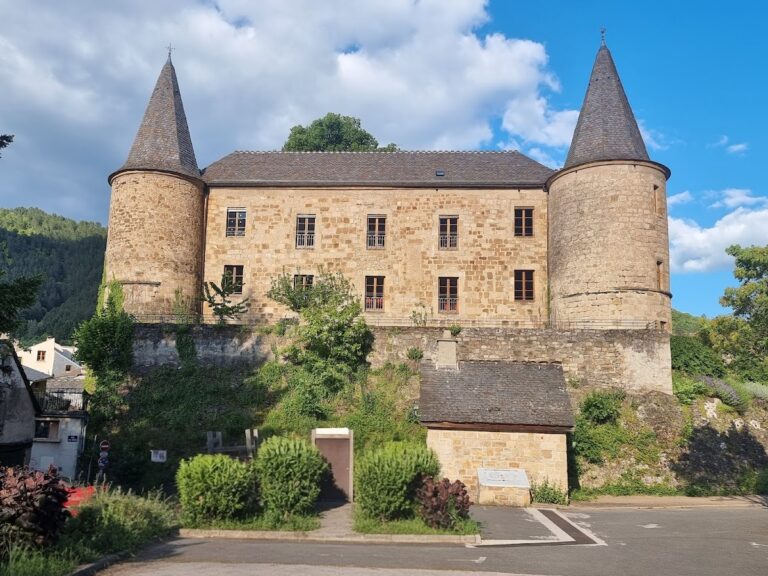
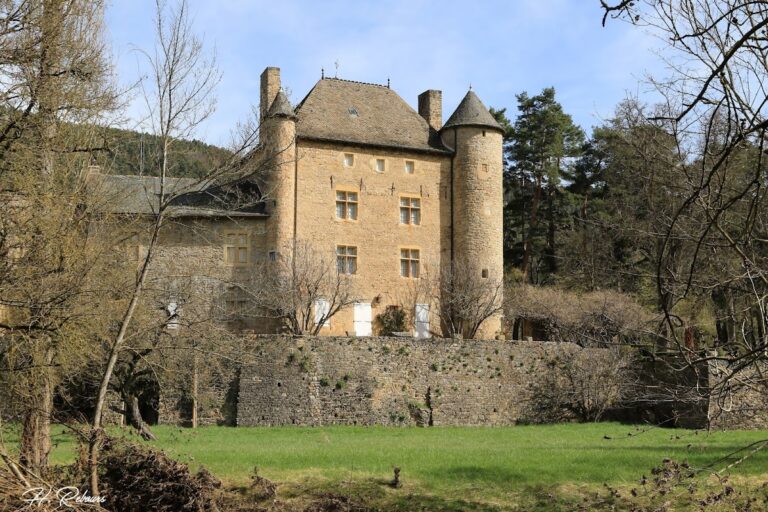
Château du Boy survives as a Renaissance-style castle with an interior courtyard. Its form reflects the property’s development from a large medieval farmstead into a fortified residence and later its transformation as an aristocratic seat. The surviving building stands near the source of the Nize, which forms from the confluence of several streams.
The château is in the Valdonnez valley of Lozère, within the historic territory of Gévaudan. Its architectural heritage is included in the Mérimée database under reference PA00103831, and the building has been listed as a French historic monument since 1943.
Nearby sites