Château de Florac: A Medieval Fortress and Cévennes National Park Headquarters


Site at a Glance
- Rating
- 3.9
- Popularity
- Very Low
- Country
- France
- Primary era
- Medieval
- External website
- Open
- Eras represented
- Medieval
- Civilizations
- French
- Site type
- Military
- Remains
- Castle
On this page9 sections
History
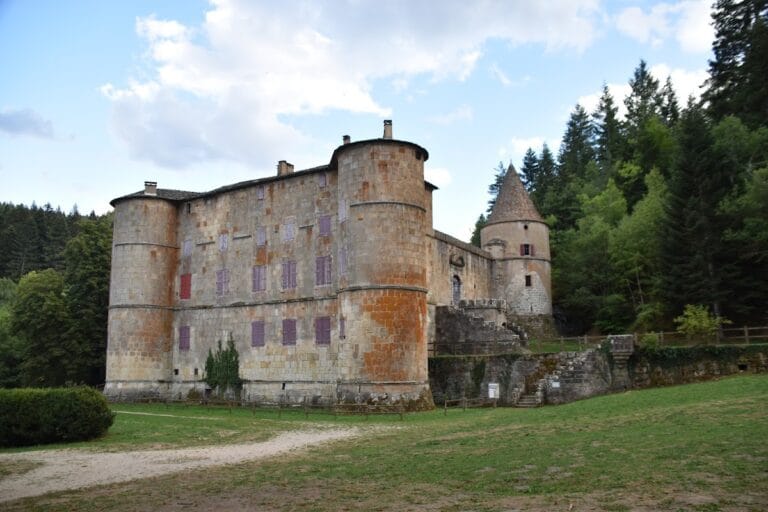
Château de Florac is a medieval fortress in Florac Trois Rivières, France, whose origins lie in the 13th century on the site of an earlier feudal castle. Built as both a residence and a defensive stronghold, it stood within Gévaudan, a historic territory broadly corresponding to the later department of Lozère. The castle was the seat of one of Gévaudan’s eight baronies and initially depended on the Barony of Anduze.
The barony of Florac
The Barony of Anduze included Alès, Sauve, and Sommières, as well as Florac. Raymond d’Anduze, Baron of Florac, also held lordships at Chabrières, Montvert, Eschamassou, Pierrefort, Saint-Laurent-de-Trèves, Castelbouc, Montbrun, Javillet, La Balme, Caodaze, Moissac, and Saint-Étienne-Valfrancesque. He rendered homage to the bishop of Mende, a formal act of allegiance to a superior lord.
At the end of the 14th century, the lord of Florac ceded the barony to the lords of Ventadour, a powerful family from Limousin. From the middle of the 15th century until the middle of the 16th century, Florac was held by the Poitiers-Valentinois family. The barony then passed to the La Mark family of the Ardennes, which was connected with the Montmorency and Valois families. The La Marks later sold it to François de Mirand, Treasurer General of France.
Destruction and rebuilding
The castle was destroyed during the Wars of Religion, the 16th- and 17th-century conflicts between Catholics and Protestants in France. It was entirely rebuilt in 1652. This rebuilding created the structure that forms the basis of the present castle, while retaining the site’s earlier association with a feudal stronghold.
During the French Revolution, when several regional castles, particularly those belonging to the bishops of Mende, were destroyed, Florac Castle was put to a new use as a salt storehouse. Such a storehouse held supplies of salt, a heavily regulated and taxed commodity in France before and during the revolutionary period. In 1810, the castle was sold to the state and converted into a prison.
From prison to national park headquarters
The prison occupied the building until its later transformation as the headquarters of the Cévennes National Park in 1976. The park restored the castle and gave it a new role connected with the interpretation of the Cévennes landscape, biodiversity, and cultural heritage.
Remains
The present Château de Florac stands on a tuff outcrop, occupying the site of the earlier feudal castle. Tuff, a porous building stone, and limestone were used in its construction. Its surviving form reflects the dual character of a medieval fortress, combining residential accommodation with defensive purposes, together with alterations made after its destruction and reconstruction.
Fortress and prison fabric
Rebuilt castle
The building visible today belongs chiefly to the reconstruction completed in 1652 after the Wars of Religion. Its stone fabric and position on the tuff outcrop preserve the relationship between the castle and its fortified site.
Prison features
The period as a state prison left physical traces within the castle, including barred windows and cell doors. These elements remain part of the building’s architectural evidence and show how the reconstructed stronghold was adapted for institutional use in the 19th century.
Exhibitions within the castle
The ground and first floors contain an exhibition devoted to the Cévennes National Park. It presents the park’s landscape, flora, fauna, and associated activities. The castle also houses Passengers of the Landscape, a permanent modern and interactive exhibition space presented in French, English, German, and Dutch.
Nearby sites