Château de Saint-Sauveur-le-Vicomte: A Medieval Fortress in Normandy


Site at a Glance
- Rating
- 4.3
- Popularity
- Low
- Country
- France
- Primary era
- Medieval
- Eras represented
- Medieval, Early Modern
- Civilizations
- English, French
- Site type
- Military
- Remains
- Castle
On this page15 sections
History
Château de Saint-Sauveur-le-Vicomte is a medieval fortress in France, at Saint-Sauveur-le-Vicomte, whose principal remains date from the fourteenth and fifteenth centuries. Built over an earlier fortified site on a raised earthwork mound, or motte, established in the late tenth or early eleventh century, it controlled routes across the Cotentin and traffic on the Douve. A first fortress may have been built by Vikings beside the river after they navigated upstream, but this attribution remains uncertain.
Norman Origins
The earliest timber fortification on the motte was probably established by Néel I de Saint-Sauveur, a Norman baron, lord of Saint-Sauveur, and vicomte of the Cotentin under Richard II, Duke of Normandy. It may instead have been founded by his ancestor Roger or Richard de Saint-Sauveur. During the minority of William the Conqueror, Néel II de Saint-Sauveur probably built a keep on the site.
Néel II joined a conspiracy against William in 1046. After the rebels were defeated at the Battle of Val-ès-Dunes on 10 August 1047, the keep was demolished and Néel II was sentenced to seven years of exile. His successor was his nephew Roger II, who died in 1138.
After Néel III died without a male heir, his niece Létitia married Jourdain Taisson before 1145. Their son Raoul IV Taisson became vicomte of Saint-Sauveur. Through Raoul’s marriage to Mathilde de Falaise, the barony of Saint-Sauveur and Néhou passed to the Taisson family. Around 1220, Mathilde brought the barony to Richard d’Harcourt as her dowry. The fief, or lord’s estate, occupied the geographical centre of the Cotentin and included Saint-Sauveur and two other castles.
Geoffroy d’Harcourt and the English Occupation
At the beginning of the Hundred Years’ War, a prolonged series of conflicts between the English and French crowns over control of the French kingdom and its territories, the castle belonged to Geoffroy d’Harcourt. After his final banishment from the kingdom on 19 July 1344, his possessions were confiscated and Saint-Sauveur-le-Vicomte was given to Jehan de Bresne. Geoffroy first went into exile in Flanders and then to England, where he paid homage to Edward III and persuaded the English king to land in Normandy.
Geoffroy fought for England in campaigns from 1346 to 1356 before returning to the French side after his banishment was annulled. Philip VI restored his lands, and Geoffroy began repairing the completely ruined castle. He died in November 1356 while fighting the French at the crossing of the Baie des Veys. His bequest of Saint-Sauveur and his other possessions to Edward III enabled the English king to seize the Cotentin.
English forces occupied the castle from 1356. Under the Treaty of Brétigny in 1360, it remained English, and in January 1361 Edward III installed John Chandos there. Chandos, an English commander and administrator, became lieutenant general of the English possessions in the French kingdom and constable of Aquitaine. He strengthened the fortress and equipped it with its large square keep. Saint-Sauveur became the headquarters of English troops in Lower Normandy and a base for mounted raids intended to devastate enemy territory and weaken its resources. Nearby fortified posts, including Garnetot, supported its operations.
The Siege of 1374–1375
French forces made an unsuccessful attempt to take the fortress in 1369. The withdrawal of Charles II of Navarre and Olivier de Clisson left the besiegers without enough troops to continue. In 1372, while English forces were occupied in Guyenne, French knights attempted a surprise attack. The English struck before a siege could be established, killing 160 attackers and capturing many others.
Charles V levied an exceptional tax of 40,000 gold francs in December 1372 to prepare a new campaign against Saint-Sauveur. The funds were intended for 3,000 men-at-arms, 600 crossbowmen, engineers, workers, and other personnel. Preparations continued for two years.
In September 1374, Jean de Vienne, a French admiral and military commander, isolated the fortress and built fortified siege positions at Pierrepont, Pont-l’Abbé, and Beuzeville. The attack included artillery, among it a large cannon made at Saint-Lô, another large iron cannon ordered at Caen, three large stone-throwing cannons, 24 bronze cannons from Paris, and five smaller weapons firing lead projectiles.
After a ten-month siege, Jean de Vienne captured the fortress on 3 July 1375 with artillery placed on the heights overlooking Saint-Sauveur. The English garrison had agreed on 23 May to surrender on that date if no relief force arrived. Eight English hostages guaranteed the agreement. Led by Thomas Katterton and his principal lieutenants, the garrison left with its arms and baggage for Carteret and then sailed to the Channel Islands. The surrender was negotiated for 40,000 gold francs, and the defenders had used 32 firearms.
French and English Restoration
The badly damaged fortress was repaired by Charles V, who granted it first to his chamberlain Bureau de La Rivière and later to Charles d’Ivry, chamberlain of Charles VI. Humphrey of Lancaster, Duke of Gloucester, retook the castle without a fight on 25 March 1418. In 1419, Jehan de Robessart, a lord of Hainaut, took possession for Henry V of England, followed later by his son Thierry.
Dunois, a leading French commander, retook the castle after a brief assault in 1450. The French victory at Formigny brought the definitive English withdrawal from Normandy. Jean de Robessart, then captain of the fortress with 200 men, submitted. Charles VII granted the barony to his chamberlain André de Villequier. It later passed to Baptiste de Villequier and, after 1559, to his son René de Villequier, first gentleman of the king’s chamber and a favourite of Henry III.
Religious Conflict and Later Uses
The castle still had a garrison of 30 men when it became involved in the French Wars of Religion, the sixteenth-century civil and religious conflicts between Catholic and Protestant forces. Protestant troops under the Count of Montgomery captured it in 1574, but royal forces soon recovered it. In October 1589, Catholic League forces, opposed to Henry IV before the consolidation of his royal authority, captured the fortress again and held it for several months. Léobin du Saussay was captain around 1580, followed by Guillaume de Pierrepont around 1590.
As artillery advanced, the medieval defences became obsolete and the castle lost its strategic importance. It fell into disuse, although Father Chaudran, a Jesuit, established a hospital there in 1685 and later an orphanage. In 1691 Louis XIV founded a hospital and hospice at the castle. From 1712 to 1789, it served as a prison. During the sixteenth and seventeenth centuries, the lordship passed through the hands of Henry III, Marie de’ Medici, and Louis XIV, while Louis-Alexandre de Bourbon and his descendants retained the property until the French Revolution.
Allied bombardment in 1944 caused severe damage. The site later housed the Barbey-d’Aurevilly Museum from 1956 and a retirement home. Since the beginning of the 2000s, restoration has helped the castle regain its original character. The ruins have been protected by the French state as historic monuments since 1840, a designation for sites valued for their architectural, archaeological, or historical importance. In 2020, the castle was included among Heritage Lottery projects for endangered heritage. The municipality of Saint-Sauveur-le-Vicomte owns the property, and the restoration programme includes work on the Prison Tower, repairs to wall facing, and renewed waterproofing along the curtain walls.
Remains
The ruins occupy the summit of a naturally rocky escarpment beside the Douve, at the entrance to the town. Human activity modified the elevated site, whose surviving layout is principally fourteenth- and fifteenth-century. A large upper bailey, an enclosed defensive court, forms the main polygonal enclosure. It measures about 50 by 60 metres and is surrounded by strong curtain walls, the defensive walls linking towers and gates.
Baileys and Entrances
Upper Bailey and Robessart Gate
The upper bailey has eight towers: five round towers, the two towers flanking the gatehouse, and the square keep at the southeast corner. Entry is through the Robessart Gate, a vaulted passage between two truncated towers. A rectangular building was added above the gate in the sixteenth century. The Robessart lodging connected the lower and upper baileys.
Lower Bailey
The lower bailey survives chiefly on the southwest side. Its curtain wall is badly damaged, but the southern remains of two towers and the ground floor of its entrance gatehouse are preserved. Deep ditches once surrounded the large mound. They have since been filled and now form an esplanade.
Principal Towers
Square Keep
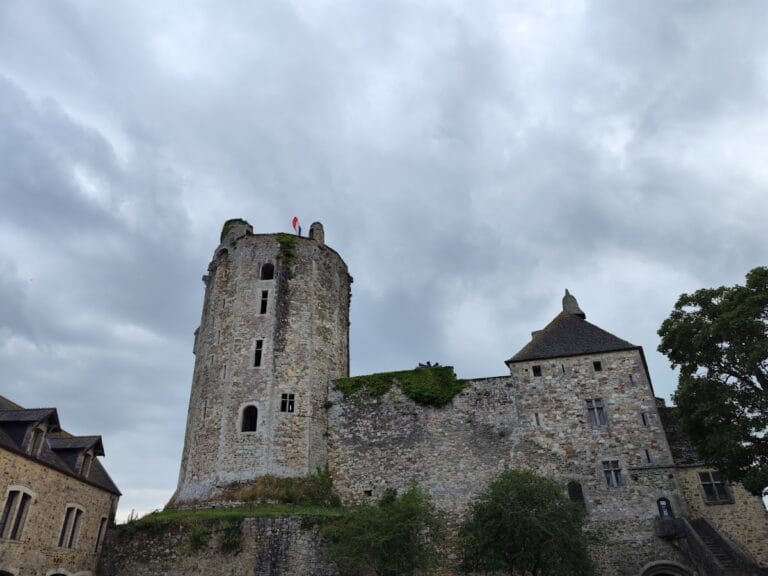
The square keep stands at the southeast corner, about 30 metres above the Douve valley. Built between 1346 and 1370 on the original motte, it is integrated into a thirteenth-century rampart. The structure rises about 25 metres, measures approximately 13.5 metres on each side, and has walls between 1.8 and 2.3 metres thick. Its construction is associated first with Geoffroy d’Harcourt and later with John Chandos.
Irregular sandstone rubble forms the keep, whose massive flat buttresses have a Romanesque character. It contains three residential levels and an upper room beneath the roof. The ground-floor chamber has a groin vault, a ceiling formed by intersecting curved surfaces, arranged in four pointed barrel sections. An octagonal central pier supports the vault, while broad windows light the chamber.
The upper rooms had wooden floors whose ceilings have been lost. A spiral staircase in the northwest corner provides access between them. The summit terrace has lost its parapet and battlements, and a small house was built above it in the sixteenth century. The original entrance was at first-floor level, reached by a bridge crossing the curtain wall on the southwest side.
Prison Tower
The Prison Tower stands in the southwest of the enclosure. Known as the Aillet Tower in the fourteenth century, it is about 11 metres in diameter. Its use as a prison during the seventeenth and eighteenth centuries left graffiti and drawings by prisoners, including crucifixes, gallows, and handcuffs. A window with fourteenth-century trilobed tracery, a three-lobed ornamental window pattern, lights the tower. The graffiti also includes a four-line religious song still sung at the Grand Pardon of the Sea at Granville.
Battery Tower
The Battery Tower, also called the Old Keep, occupies the northeast corner of the enclosure. Dating from the beginning of the thirteenth century, it has three storeys vaulted with domes. A firing passage runs through the thickness of its wall from one curtain wall to the other without connecting with the tower. After a siege, the curtain wall extending from the tower was shortened, creating an external platform.
Houlande and Stork Towers
The Houlande Tower stands on the western rampart and was built during the English occupation. Its name probably refers to the English governor Thomas Holand, who died in 1360. The Stork Tower occupies the northwest corner and may similarly preserve the name of John of Storkes, captain of the garrison in 1367. English influence is also visible in the style of their windows and fireplaces.
Nearby sites