Château de Rougemont: A Medieval Fortress in France


Site at a Glance
- Rating
- 4.5
- Popularity
- Very Low
- Country
- France
- Primary era
- Medieval
- Eras represented
- Medieval
- Civilizations
- Holy Roman Empire
- Site type
- Military
- Remains
- Castle
On this page7 sections
History
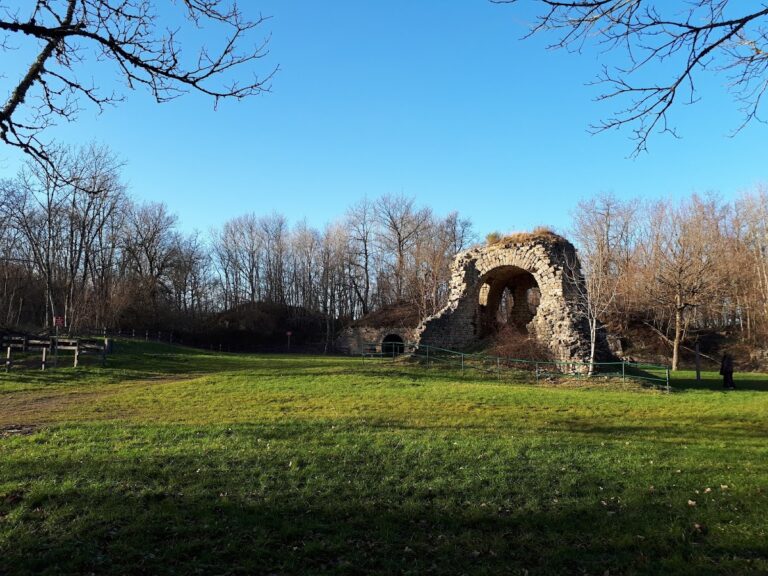
Château de Rougemont is a ruined medieval fortress in France, built by the Counts of Ferrette toward the end of the twelfth century in the southern Vosges. Its position served both defense and regional control, overlooking the route toward the southern entrance to Alsace and the entry to Burgundy.
Foundation and strategic role
The Counts of Ferrette established the castle to protect an ancient Roman road from Langres that crossed the Vosges and passed through Rougemont-le-Château. The fortress watched this route from the heights and expressed the authority of the rulers who controlled the surrounding region.
Inheritance and destruction
When the Ferrette dynasty became extinct in 1324, the castle and its lordship passed by inheritance to the Habsburgs, a major European ruling dynasty. After the death of John IV of Habsburg-Laufenburg, control passed to the Counts of Sulz.
At the end of the fourteenth century, the castle was burned and destroyed. The destruction probably occurred around 1375 during an English invasion, when troops commanded by Enguerrand VII of Coucy, a French nobleman who was Lord of Coucy and Earl of Bedford, attacked the region.
Excavation and protection
Archaeological excavations began in 1977 and were followed by a complete restoration of the castle. The work brought to light military, civil, and religious material, including more than 800 crossbow bolts and signaling horns or trumpets. These objects are preserved or displayed at the museum in Belfort. Château de Rougemont has been protected as a historic monument in France since 4 July 1996.
Remains
Hilltop layout
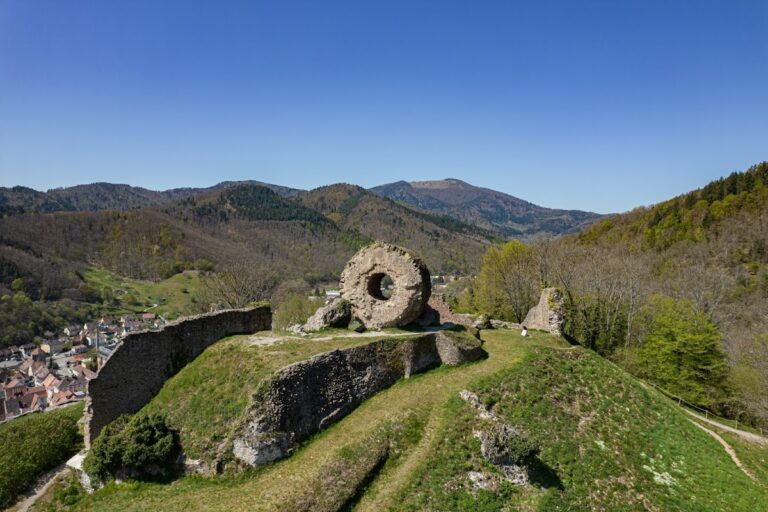
Château de Rougemont occupies a small hill or plateau at the southern foot of the Vosges, facing the Jura plateaux. At an altitude of 736 metres, the ruined fortress overlooks the entrance to Burgundy. The surviving layout includes a lordly residence and a circular keep positioned on the side facing an attack.
Keep and residence
The circular keep is the principal fortified tower of the castle and replaced an earlier quadrangular keep dating from the twelfth century. Together with the surviving residence, it forms the central architectural group of the restored ruins. Excavation also recovered the castle’s military, civil, and religious objects, including the crossbow bolts and signaling instruments now held at the Belfort museum.
Nearby sites