Schloss Seeheim: A Historicizing Late Gothic Villa in Constance

Site at a Glance
- Rating
- 4.6
- Popularity
- Very Low
- Country
- Germany
- Primary era
- Modern
- External website
- Open
- Eras represented
- Early Modern, Modern
- Civilizations
- German, Holy Roman Empire
- Site type
- Domestic
- Remains
- Castle
On this page7 sections
History
From Monastic Estate to Teutonic Order Property
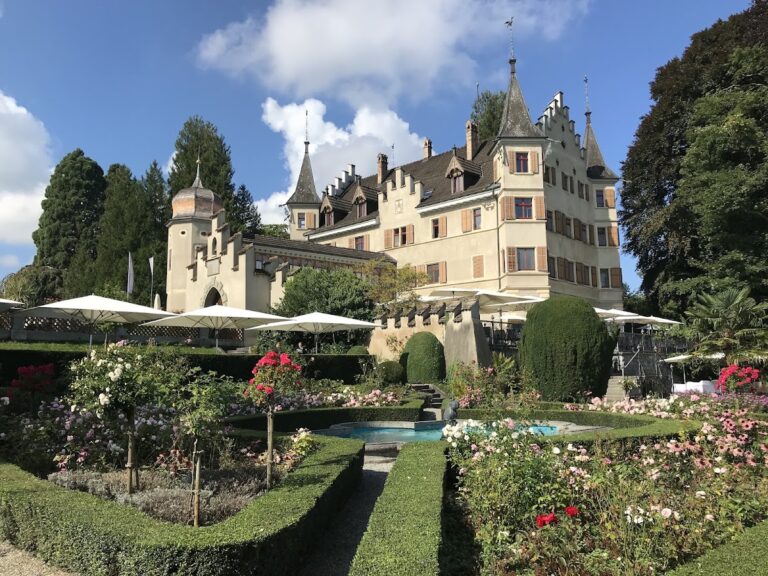
Schloss Seeheim is a castle-like villa in Constance, Germany, built in the historicizing late Gothic style between 1889 and 1890. Its grounds were once part of the Eichhornwald, most of which Petershausen Abbey acquired from Reichenau Abbey around 1230. These were important medieval monasteries in the Lake Constance region. By the seventeenth century, the property had become a vineyard estate at Hinterhausen associated with the Teutonic Order’s Altshausen commandery, an administrative estate of the religious-military order.
In 1659, Franz Theodor Lips, chief bailiff of the Teutonic Order at Altshausen, bought the estate, then known as the Land Commandery vineyard estate at Hinterhausen. He probably commissioned the earlier building on the site. The Altshausen commandery acquired the vineyard estate from Lips in 1672. In 1803, the Final Recess of the Imperial Deputation reorganized parts of the Holy Roman Empire and secularized many ecclesiastical and religious-military properties. Seeheim consequently passed to the Grand Duchy of Baden, a German grand duchy that existed from 1806 until the abolition of the German monarchies in 1918.
Hortense de Beauharnais and the Nineteenth-Century Estate
In 1816, Jacques Louis Macaire de L’Or, a Constance banker and textile manufacturer, acquired Seeheim from Grand Duke Leopold of Baden as trustee for Hortense de Beauharnais. The purchase cost 6,080 gulden plus fees. Hortense, who had been Queen of Holland and was Napoleon I’s adopted daughter, had arrived in Constance in 1815. From January 1816, she lived in a Petershausen building known as the Laterne, and Seeheim is thought to have served as her residence.
Political pressure on Baden, particularly from the French government, forced Hortense to leave Constance in 1817. She subsequently acquired Arenenberg Castle and estate as her official principal residence, while retaining Seeheim as a country house for occasional visits. Ownership formally passed from Macaire to Hortense in 1822, and she gradually enlarged the park. The property was sold in 1834, shortly before her death.
Later owners included Anton Meßmer, a Constance municipal councillor and merchant; Anatol Baron von Leykam, an Austrian general and adjutant of Radetzky; Adolf Guhl of Stühlingen; Theodor Friedrich Bettex, an educator at the Salon educational institution near Ludwigsburg; the City of Constance; and Ernst Lang, a fruit grower and fruit-wine producer from Baden-Baden.
The von Scholz Period and Modern Conservation
Adolf von Scholz, a German government official and politician, acquired Seeheim from Ernst Lang in 1885. He commissioned the architect Hermann Eggert to design a new building, which was erected on the foundations of its predecessor from 1889 to 1890. Prince Bismarck and Count Ferdinand von Zeppelin attended the opening. After Adolf von Scholz’s death, the property became the residence of his son, the poet Wilhelm von Scholz, and Wilhelm’s second wife, Gertrud, born Richter, in 1924. Wilhelm died at Schloss Seeheim in 1969, and Gertrud continued to live there until her death in 1986.
After Gertrud’s death, Heinz Weidenfeld, director of the Constance Volksbühne, took over the property as co-heir and estate administrator. In 1988, the main section became the property of the auditor Eberhard Teufel, while the west section passed to the lawyer Wolfgang Horn. Between 1993 and 1996, the building underwent extensive renovation and structural conservation under plans directed by the Constance architect Sabine Hermann. The work stabilized vulnerable parts of the structure and modernized its services. The Akademie Schloss Seeheim opened in 1996, followed by a café-restaurant in 2006.
Remains
Lakefront Setting and Historicizing Design
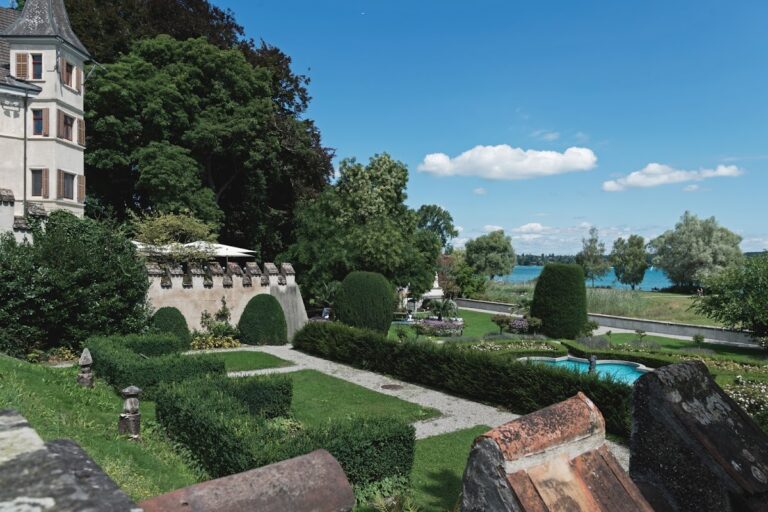
Schloss Seeheim stands on the shore of Lake Constance near the eastern end, known as the Horn, of the Bodanrück peninsula. It lies between the Constance Funnel, part of the Upper Lake, and Lake Überlingen, on the southern shore of the peninsula between the Bodensee-Therme and the Hörnle beach and open-air swimming pool. The villa originally stood directly beside a small bay. During an urban-development measure in the 1970s, an embankment was constructed in front of the property, carrying a public promenade.
The present villa has a castle-like form and a historicizing late Gothic architectural character. Its construction between 1889 and 1890 used the foundations of the preceding building, linking the nineteenth-century structure physically to the earlier estate. The property’s surviving arrangement also reflects its later division into a main section and a west section, established through the ownership split of 1988.
Conservation and Interior Alterations
The conservation campaign of 1993 to 1996 addressed the roofs and walls and included damp-proofing, the stabilization of endangered vaults, repairs to the veranda, and work on the ceiling between the principal floor and the attic. Dry rot, a fungal decay that damages timber and other building components in damp conditions, was removed. Ceilings were restored, and the attic was converted.
The same work introduced a glass lift and new central heating and sanitary facilities. These interventions altered the building’s internal services and attic use while preserving and stabilizing its principal historic fabric, including the vaults, veranda, roofs, walls, and principal-floor ceiling.
Nearby sites