Rocheplatte Castle: A Historic Estate in France


Site at a Glance
- Rating
- 4.7
- Popularity
- Very Low
- Country
- France
- Primary era
- Modern
- Eras represented
- Medieval, Early Modern, Modern
- Civilizations
- French
- Site type
- Domestic
- Remains
- Castle
On this page10 sections
History
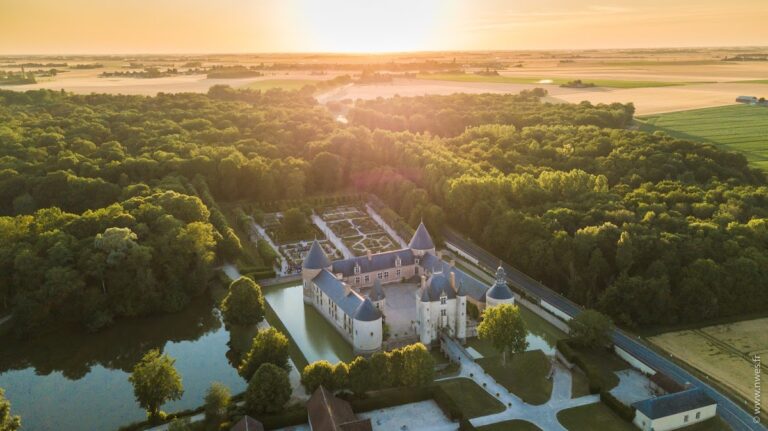
Rocheplatte Castle is a historic estate in France, located at Aulnay-la-Rivière in the Loiret. Its origins lie in a fortress associated with the former lordship of Les Grèves, while the surviving château reflects construction and alteration from the thirteenth to the nineteenth century, especially major works carried out between the seventeenth and nineteenth centuries.
The fortress of Les Grèves
By the end of the tenth century, the site lay within the former royal domain. The lordship of Les Grèves belonged to the lords of Pithiviers and stood near possessions of Fleury Abbey, a major medieval Benedictine abbey with fortified holdings in the Beauce. Together with other strongholds held by royal vassals, it formed part of the region’s defensive network.
Rocheplatte was first established as a fortress connected with this seigneurial territory. Tradition places Gilles de Rais, a fifteenth-century French nobleman and military commander later associated with the Bluebeard legend, among the last notable visitors before the ruin of Les Grèves compelled the Pithiviers family to surrender it. The seigneurial site was destroyed in 1480.
Transformation into a château
In 1676, the property was sold to the Colas de Marolles family of Orléans, who undertook major building works. From that point, Rocheplatte passed through inheritance rather than further sales. In 1724, Louis XV, king of France from 1715 to 1774, elevated the Rocheplatte estate to a county.
Further works during the eighteenth and nineteenth centuries established the château’s present architectural character. A chapel was arranged in the nineteenth century for Félix Dupanloup, the Catholic bishop of Orléans.
The La Rochefoucauld and Murat families
Jenny Crublier de Fougères married Charles-Joseph de Montbel in 1834. After his death in 1840, she married Albert Florizel de Drouin, Count of Rocheplatte. Her daughter, Marie-Luce de Montbel, later married Arthur de La Rochefoucauld.
Albert Florizel de Drouin designated Xavier de La Rochefoucauld-Montbel, the son of Marie-Luce and Arthur, as his heir. Rocheplatte became the property of the House of La Rochefoucauld, a historic French aristocratic family, in 1893. Xavier had married Marie du Val de Bonneval in 1890. Their daughter Solange later married Prince Paul Murat, and the couple took possession of Rocheplatte in 1919. The estate is held by the Murat family, descendants of Joachim Murat, Napoleon I’s marshal and king of Naples.
Rocheplatte Castle and its Gothic crypt received French historic-monument protection in 1973. The crypt was specifically classified as a historic monument, while the château’s interior was not classified.
Remains
Estate setting and watercourses
Rocheplatte Castle stands west of the town center of Aulnay-la-Rivière, in the Loiret department of the Centre-Val de Loire region. The estate lies in the Paris Basin and the Beauce region, along the Œuf and Rimarde watercourses. The Essonne River rises within the château park, giving the wider estate a setting shaped by several waterways.
Château and associated features
The château
The surviving château incorporates the results of substantial eighteenth- and nineteenth-century alterations to the earlier fortress site. These works gave the building its present architectural character. The nineteenth-century chapel arranged for Félix Dupanloup forms part of the estate’s later development, while the château interior remains outside the classification as a historic monument.
The Gothic crypt
A Gothic crypt dating from the thirteenth century survives as an associated feature of the estate. Its protection as a classified historic monument was confirmed in 1973.
The park
The château park contains plant species introduced to the region by Henri Louis Duhamel du Monceau, an eighteenth-century French botanist and agronomist known for studying and introducing plants. These surviving botanical elements form part of the estate’s physical and historical character.