Castle of Saint-Ulrich: A Medieval Hilltop Fortress in France


Site at a Glance
- Rating
- 4.7
- Popularity
- Medium
- Country
- France
- Primary era
- Medieval
- External website
- Open
- Eras represented
- Medieval
- Civilizations
- Holy Roman Empire
- Site type
- Military
- Remains
- Castle
On this page15 sections
History
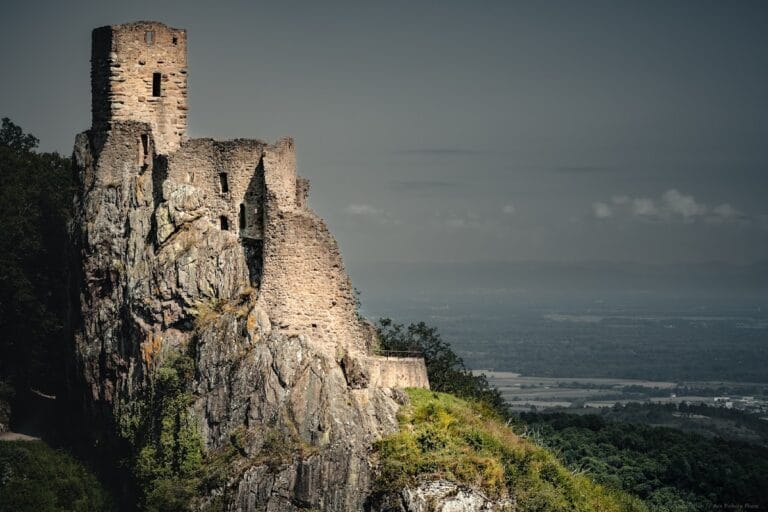
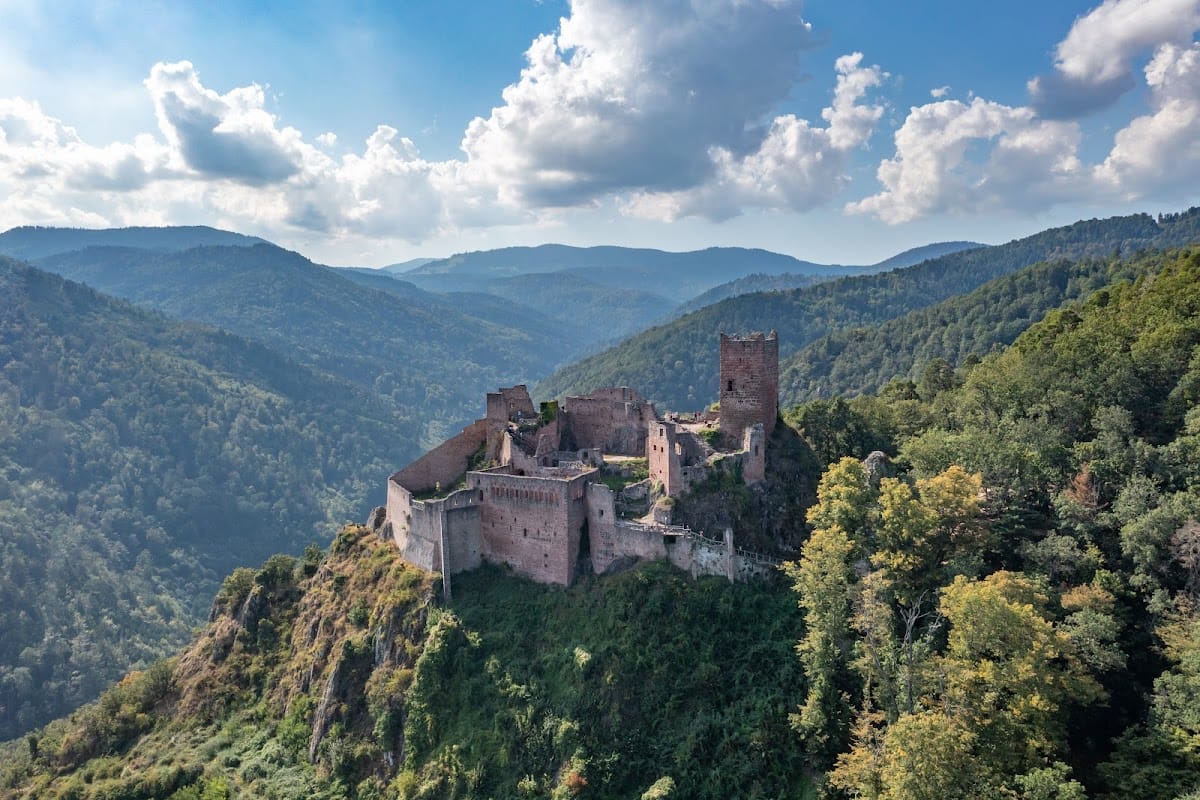
Castle of Saint-Ulrich is a medieval hilltop fortress above Ribeauvillé in France. Its foundation is traditionally placed in the eleventh century, when it was established by the Ribeaupierre family, and it later became the principal residence and administrative center of their lordship. The fortress, also known as Grand-Ribeaupierre, was originally associated with the German name Rappolstein. The name Saint-Ulrich comes from the chapel dedicated to Saint Ulrich within the castle complex.
Early references and imperial control
The site appears in written records in 1038 as the “rock of Reginbald,” probably a reference to Reginboldi, a lord mentioned in records from the early eleventh century. The exact date of the castle’s foundation remains uncertain, although the long-standing tradition connects its beginnings with the Ribeaupierre family.
On 21 March 1084, Emperor Henry IV, a ruler of the Holy Roman Empire, granted the castle to the prince-bishop of Basel. A prince-bishop combined ecclesiastical office with secular authority over a territory. In 1114, Henry V recovered the fortification and used it as a military base during his conflict with the counts of Eguisheim. The castle later returned to the bishop, who placed it under the control of the Ribeaupierre family.
The Ribeaupierre residence
Around 1163, Emperor Frederick I Barbarossa assigned the castle to his follower Egenolphe of Urslingen. Egenolphe, who died around 1188, probably married Emma, the heiress of the castle’s earlier lords. From the twelfth through the sixteenth century, Saint-Ulrich served as the main residence of the Ribeaupierre family and as the administrative center of the surrounding lordship.
The title “lord of Ribeaupierre” first appears in 1219 for Egenolphe’s grandsons, who had taken the name of the place. Anselm II of Ribeaupierre later expelled the other members of his family from the castle. He defended it successfully during sieges in 1287 by Rudolf I, King of the Romans, and in 1293 by his successor, Adolf I. The title King of the Romans was commonly used for the elected German king who might later be crowned Holy Roman Emperor.
At the height of its importance, Saint-Ulrich was one of the strongest fortresses in Alsace. Its traditional arrangement included an upper castle, or citadel, and a lower castle, or outer bailey. The Ribeaupierre family maintained both its residence and its administrative services within the complex.
Later use and decline
In the fifteenth century, Cunegonde of Hungerstein, born Billing of Willsperg, was imprisoned in the keep for almost twenty years. She had been accused of strangling her husband, Guillaume of Hungerstein, a Ribeaupierre vassal, in 1487. Her attempt to escape with the help of a guard failed.
Around 1435, the family built a chapel dedicated to Saint Ulrich, Bishop of Augsburg and a tenth-century Christian saint associated with that city. In the sixteenth century, the Ribeaupierres left the fortress for a more comfortable Renaissance residence. The lordship’s administrative center moved there in 1518. That later residence is now occupied by the Ribeauvillé secondary school.
Parts of Saint-Ulrich were dismantled during the Thirty Years’ War, a seventeenth-century conflict that brought widespread military destruction and political upheaval across central Europe. The Renaissance residence was later destroyed and completely demolished. During the seventeenth century, the castle rapidly fell into neglect. Its roofs were removed, many sections were taken apart, and local peasants reused the abandoned masonry as building material. Rain entered the unprotected interiors and accelerated the decay, leaving the complex as a picturesque ruin by the eighteenth century.
Conservation and legal protection
Local authorities began conservation work on the ruins in the late nineteenth century, and they continue efforts intended to prevent further deterioration. The castle ruins were classified as historical monuments in 1841, with that status reaffirmed in 1930. They are municipal property and are among the principal attractions of the Haut-Rhin department.
Remains
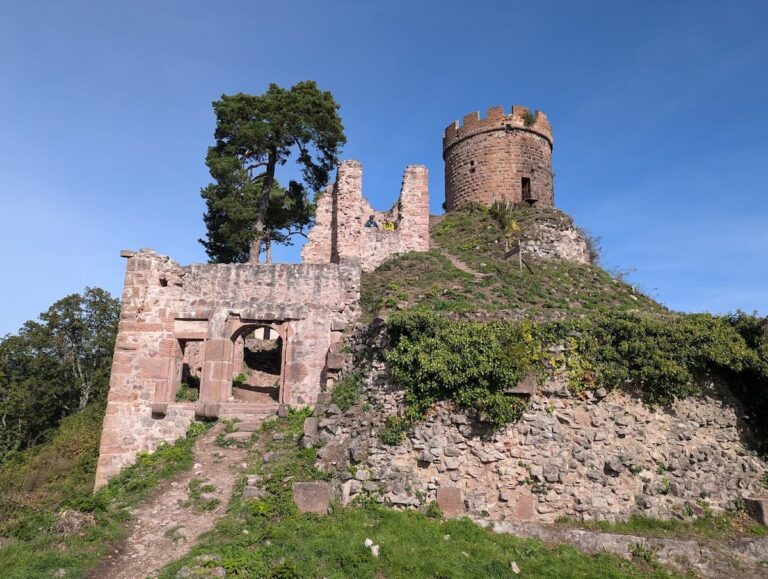
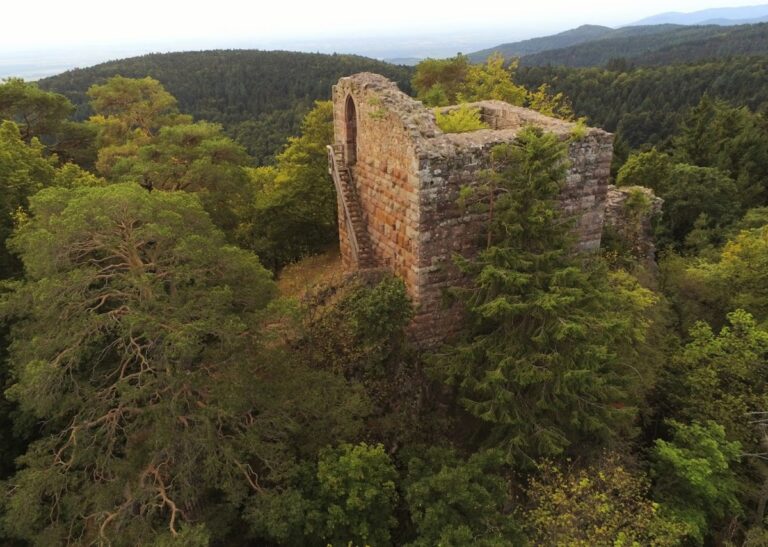
The ruins stand at approximately 528 metres above sea level above Ribeauvillé. Built of stone and brick, the medieval fortified complex occupies an arrangement of upper and lower enclosures. Saint-Ulrich forms part of a group of three castles, together with Girsberg and Haut-Ribeaupierre, that lie within sight of one another. The surviving remains include parts of the keep, residential buildings, ceremonial spaces, defensive works, and the chapel.
Keep and residential buildings
Twelfth-century keep
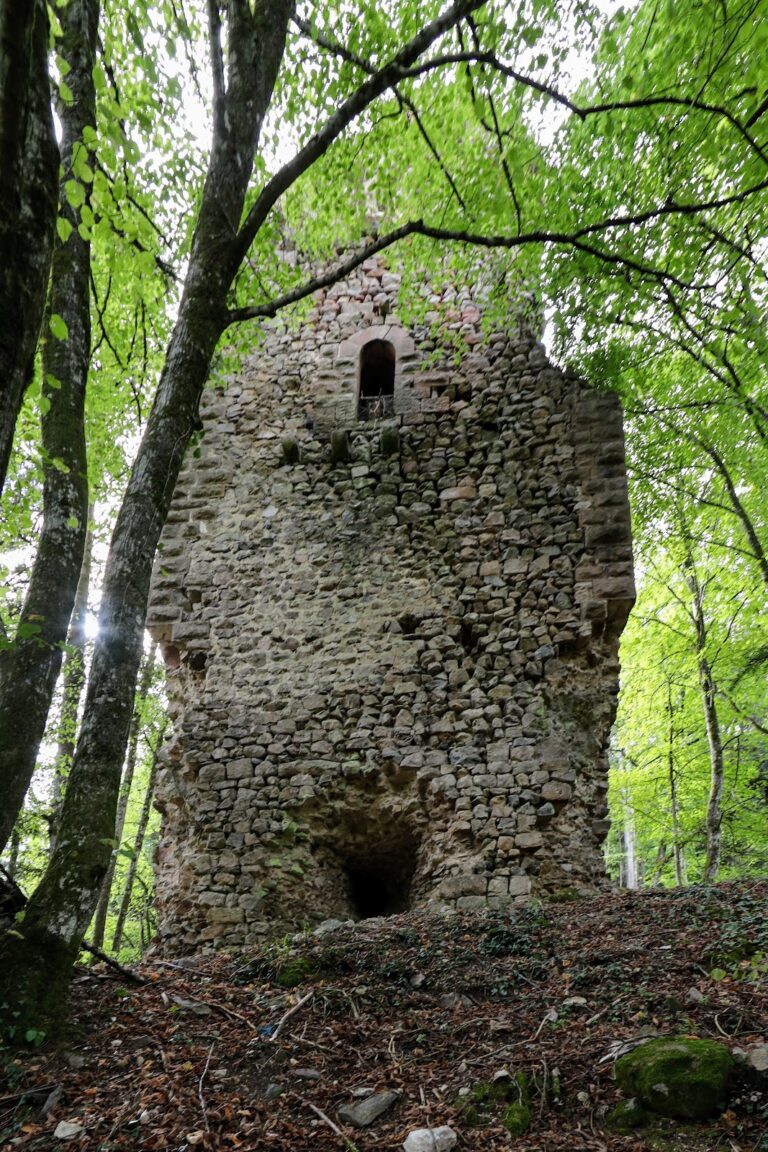
The square keep, the castle’s principal fortified tower, dates from the twelfth century. Portions of it remain identifiable among the ruins. The same period also produced a residential building with a fireplace, reflecting the domestic use of the fortress alongside its military role.
Great residential tower
The great residential tower dates from the thirteenth century. It formed part of a larger residential complex that included spacious living rooms with fireplaces. Surviving sections of these buildings preserve the relationship between the family’s residence and the fortified structure.
Ceremonial and communal spaces
Ceremonial building
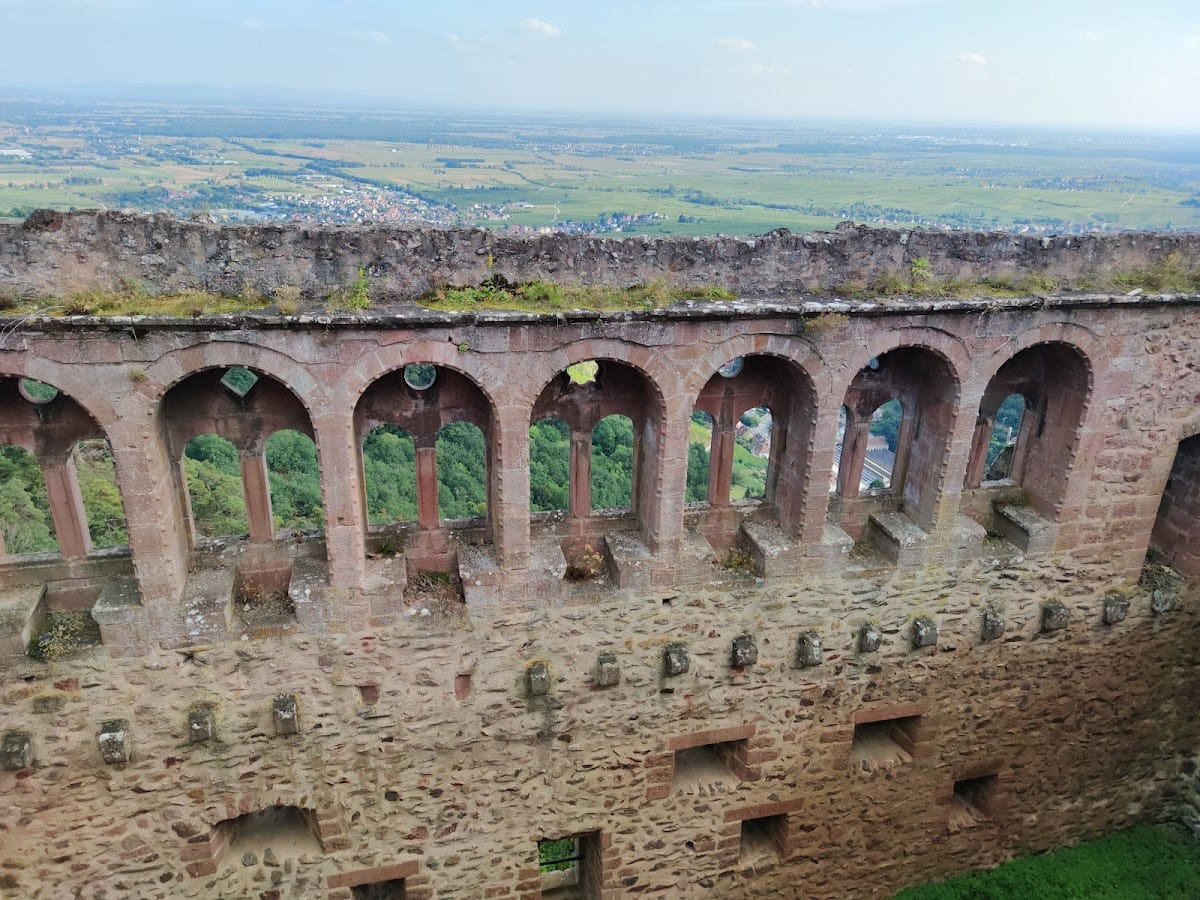
The castle was remodelled around 1200, or in the early thirteenth century, with the addition of a ceremonial building. Only its lower level survives. This section has paired windows, each divided into two openings and topped by circular openings called oculi, as well as stone benches along the sides.
Knights’ hall
The knights’ hall was built in the thirteenth century in the Romanesque style, a medieval architectural tradition known for heavy masonry and rounded forms. Nine windows from the hall remain visible within the ruins.
Defensive enclosures and chapel
Barbican and outer enclosure
The entrance barbican and the outer enclosing wall, or enceinte, date from the fourteenth century. A barbican is a defensive outwork protecting an entrance. The surviving arrangement includes an entrance to the outer enclosure and a separate entrance to the castle itself, preserving the distinction between the lower and upper parts of the fortress.
Saint-Ulrich Chapel
The Saint-Ulrich Chapel dates from around 1435 and is dedicated to Saint Ulrich, Bishop of Augsburg. It remains identifiable within the ruined complex, alongside portions of the keep, residential buildings, knights’ hall, great residential tower, barbican, and outer enclosure.