Château de Radepont: A Neo-Louis XIII Estate on a Medieval Castle Site


Site at a Glance
- Rating
- 4.1
- Popularity
- Very Low
- Country
- France
- Primary era
- Modern
- Eras represented
- Medieval, Early Modern, Modern
- Civilizations
- French, Norman
- Site type
- Domestic
- Remains
- Elite Residence
On this page7 sections
History
Château de Radepont in France is a Neo-Louis XIII château reconstructed at the beginning of the twentieth century on the site of a medieval castle begun under Henry I, the Norman ruler who became King of England. Its history reflects the rivalry between the English-Norman and French powers, as well as later changes in aristocratic ownership, industry, and social care.
The medieval fortress
Construction of the medieval castle began under Henry I, Duke of Normandy and King of England. Richard the Lionheart enlarged and remodeled it around 1196 while building Château-Gaillard, but the work at Radepont was never completed. Richard was a major military ruler of the late twelfth century, and the fortress formed part of the wider struggle between English-Norman and French authority.
Philip Augustus, King of France, laid siege to Radepont on the last day of August 1203. The castle fell after fifteen days, before Philip began the siege of Château-Gaillard. This capture ended the medieval phase of Radepont’s development as an unfinished stronghold.
From Neoclassical residence to industrial estate
A Neoclassical château was built on the site in 1788. Neoclassicism drew on the forms and proportions of classical Greek and Roman architecture. Augustin Léonor Victor du Bosc de Radepont inherited the estate, which later passed to Aimé-Louis du Bosc.
Aimé-Louis du Bosc sold the estate in 1844 to the industrialist Baron Charles Levavasseur. Levavasseur built a large Neo-Gothic spinning mill, a revival of medieval Gothic architecture, and acquired Fontaine-Guérard Abbey, also in Radepont. The spinning mill is now ruined, while the abbey and the château formed part of Levavasseur’s holdings in the area.
Reconstruction and twentieth-century uses
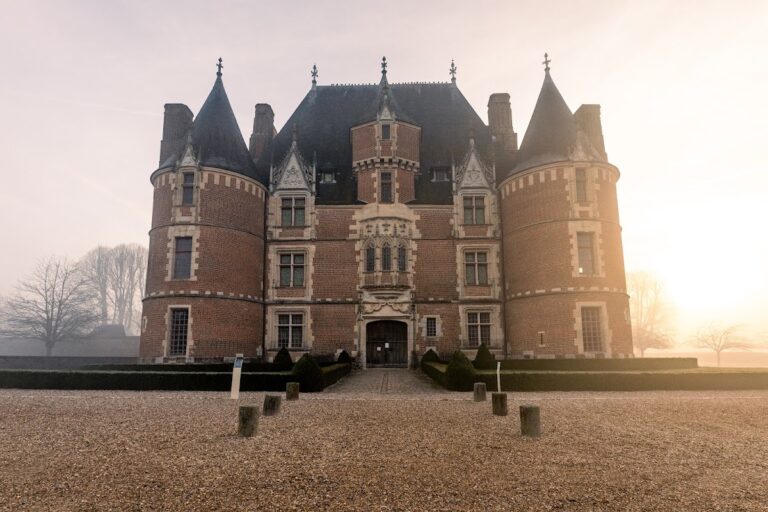
The present château replaced the eighteenth-century building. Its complete reconstruction extended from the late nineteenth century into the early twentieth century. The Parisian architect Duchesne and the Rouen architect Charles Lassire directed the work. After Lassire’s death, his son succeeded him, and construction continued mainly under his direction.
Several owners followed Levavasseur. In 1942, Fernand Colombel, who had no heir, bequeathed the estate to the Salvation Army, a Christian charitable and social-service organization. From 1952, it operated a rehabilitation and work-assistance center at the château. The institution housed several hundred people serving the supplementary punishment of relegation while on conditional release. Relegation was abolished in 1970, but the center continued to occupy the château until 2011.
The Salvation Army sold the estate in 2013 to Evgenii Kostenov, a Russian entrepreneur. Château de Radepont is listed in France’s General Inventory of Cultural Heritage.
Remains
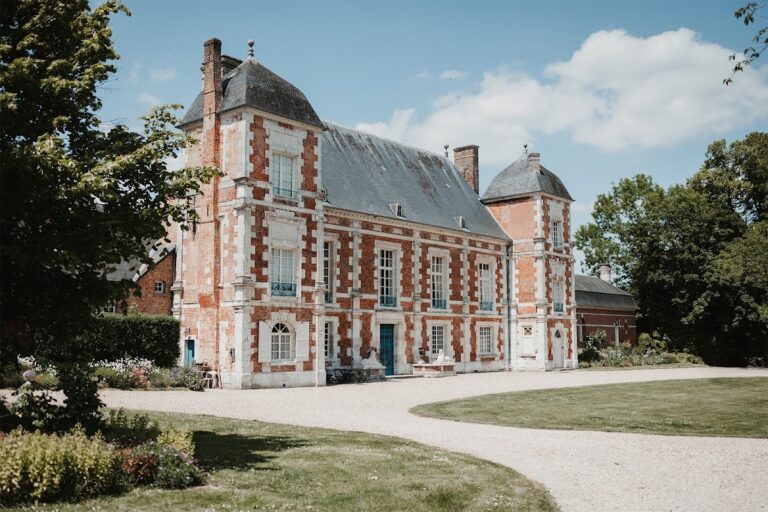
The surviving site combines the present château, an eighteenth-century chapel, and the ruins of the medieval fortress within the estate. The château stands outside the village center, approximately 350 meters southwest of Saint-Germain Church in Radepont. Its reconstruction follows the Neo-Louis XIII style, a revival of architectural forms associated with the reign of Louis XIII, and includes a steel framework.
The château and chapel
The present château occupies the site of the 1788 Neoclassical residence and was rebuilt at the beginning of the twentieth century. It is a Neo-Louis XIII building with a steel structural framework. The only surviving part of the eighteenth-century château is its chapel, which is dedicated to Saint Bernard.
The medieval fortress
The medieval castle ruins lie in the park of the present château. The fortress included a powerful keep with a projecting spur on its attack-facing side, oriented toward the plateau. The castle remained unfinished, and its ruins survive as a separate physical element of the estate, reached by a path near the church.