Château de Portes: A Fortified Castle Overlooking the Regordane Route




Site at a Glance
- Rating
- 4.4
- Popularity
- Medium
- Country
- France
- Primary era
- Medieval
- External website
- Open
- Eras represented
- Medieval, Early Modern
- Civilizations
- French
- Site type
- Military
- Remains
- Castle
On this page9 sections
History
Château de Portes is a fortified castle at the Portes pass in France, in the commune of Portes in the Gard department. Developed over several centuries from the eleventh century onward, it occupied a strategic position above the Regordane, a historic route across the Cévennes linking the Massif Central with the Mediterranean. Pilgrims traveling to Saint-Gilles, crusaders bound for the Holy Land, and traders used this route, helping explain the castle’s role in controlling movement and collecting tolls.
Origins and medieval development
The beginning of construction cannot currently be dated. No earlier fortified settlement, or castrum, has been identified at the site. One proposed explanation is that the castle developed gradually from a single square tower, perhaps with supporting buildings for a small guard force and a toll-collecting function. The castle is first mentioned in the eleventh century and may have been initiated by Raymond I of Anduze, the earliest known lord of Portes.
From the eleventh to the fourteenth century, the Anduze, Randon, and Polignac families paid homage for the castle to the abbot of Saint-Pierre-de-Sauve. The property later passed from the House of Anduze to Guillaume de Châteauneuf-Randon through the inheritance of his maternal grandfather, Bernard VIII of Anduze.
On 13 February 1321, Raymond Guilhem de Budos, a nephew of Pope Clement V, acquired the Barony of Portes-Bertrand from Guillaume de Randon, lord of Luc. He enlarged the thirteenth-century castle and added at least two towers. Thibaud de Budos recovered the property in 1384 after it had been taken from his father, André de Budos, who had supported the English at the beginning of the Hundred Years’ War. Expansion continued through the fifteenth and sixteenth centuries.
Renaissance military changes
During the Wars of Religion, a series of conflicts between Catholic and Protestant forces in France, the Budos family joined the Catholic League, a political and military movement defending Catholic interests. In February 1583, Jacques I de Budos received the elevation of his domain to a viscountcy, a hereditary lordship above a barony, as well as the collar of the king’s orders. During the 1570s and 1580s, the castle was extensively adapted to meet contemporary military requirements.
The lordship grew wealthier and more powerful. In December 1613, Marie de Médicis, acting as regent for her son Louis XIII, raised it to a marquisate, another hereditary rank above a viscountcy, for Antoine-Hercule de Budos. A maréchal de camp, a senior army rank under the French monarchy, Antoine-Hercule was killed at the siege of Privas in 1629.
Inheritance, revolution, and restoration
The Budos line ended with Antoine-Hercule’s daughter, Marie-Félice. In 1693, she inherited the castle to her nephew, the Prince of Conti. His descendants sold it to Louis XVI in 1781. During the French Revolution, the property was nationalized and then sold six times. The La Vernède family acquired it in 1841 and restored the neglected monument.
Intensive coal mining during the First World War caused the ground beneath Portes to collapse in places, creating structural problems in both the castle and the village. The village was evacuated in 1929, demolished in 1933, and rebuilt approximately 300 metres away on the opposite side of the hill. Underground galleries and cavities beneath the castle were filled around 1960, stabilizing the site, although the medieval section remained substantially ruined.
Local residents organized to save the castle in 1969, and the nonprofit association Renaissance du Château de Portes was founded in 1972 to prevent its definitive collapse. Volunteer restoration and management have continued through the association, which is affiliated with Union Rempart, a French network connected with volunteer heritage-restoration projects. The castle remains privately owned by heirs of the Coquebert de Neuville family. It has been protected as a French monument historique, a legal heritage designation, since 1984, and since 2011 has also been designated an ambassador of Cévennes National Park, a UNESCO World Heritage property.
Remains
Setting and overall form
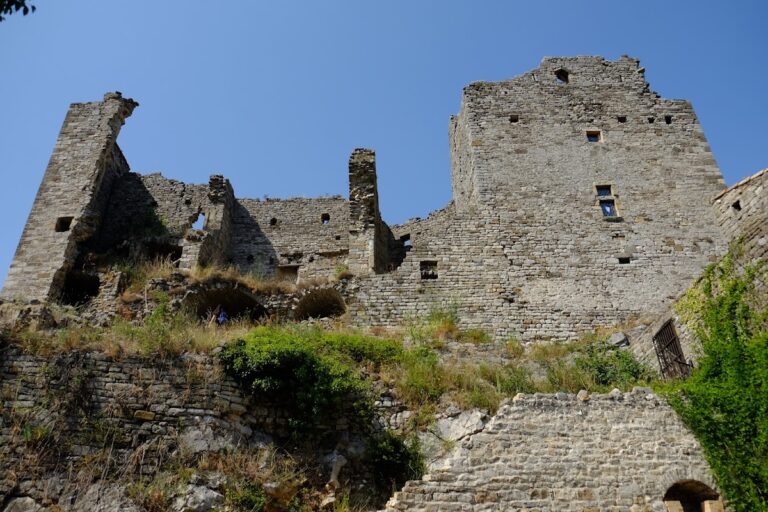
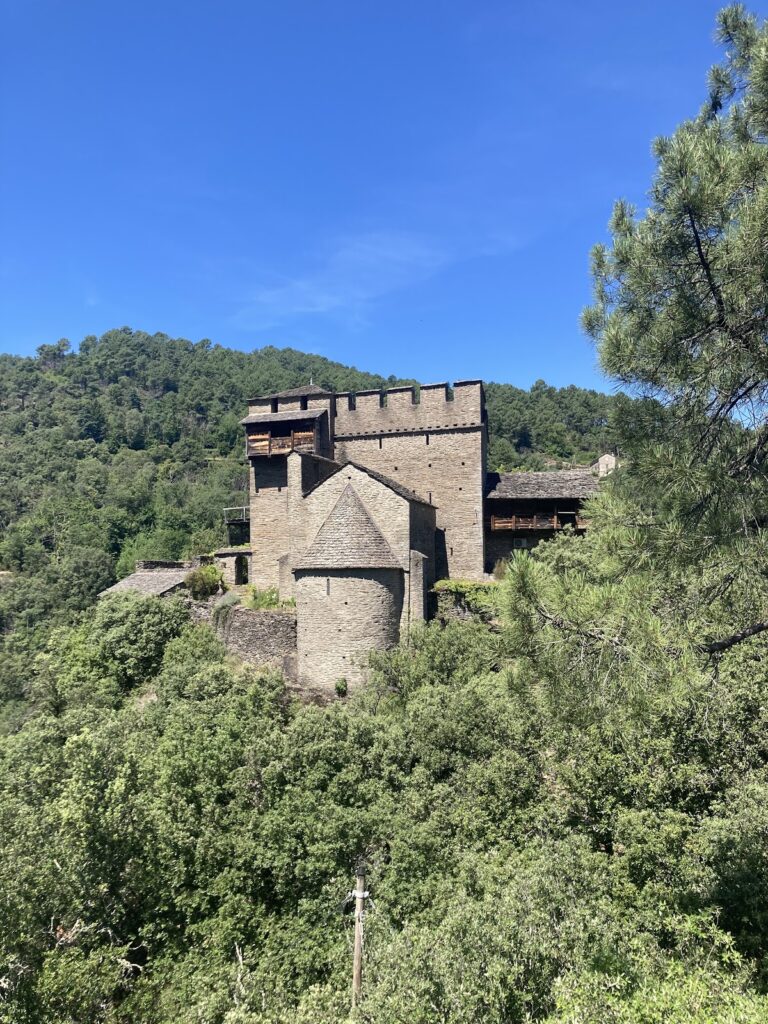
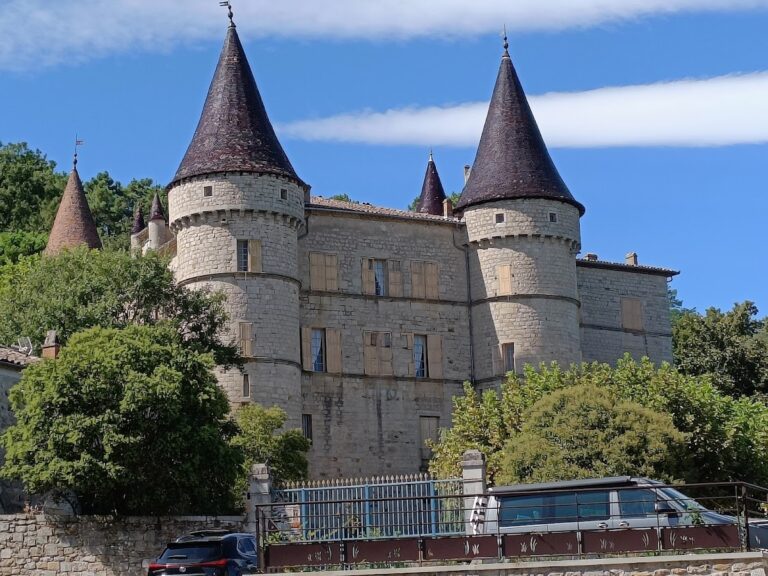
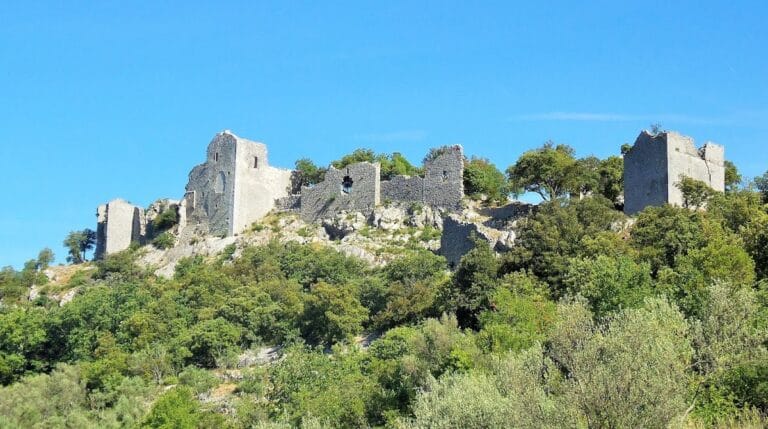
Château de Portes stands at an altitude of 577 metres at the Portes pass. Its position overlooks the Regordane route, while the site’s elevated setting provides a broad panorama extending from Mont Lozère to the Alps. The castle preserves evidence of fortified construction and architectural change across approximately six centuries. Medieval and Renaissance elements remain legible, with a particularly clear distinction between the medieval fabric and the later seventeenth-century work.
The most distinctive physical feature is a sharply inclined spur, set at an angle of 49 degrees and shaped like the bow of a ship. This unusual form gave the castle the nickname “the vessel of the Cévennes.” The surviving complex combines the medieval structure, later towers and curtain walls, and defensive additions made as military technology changed.
Medieval structure
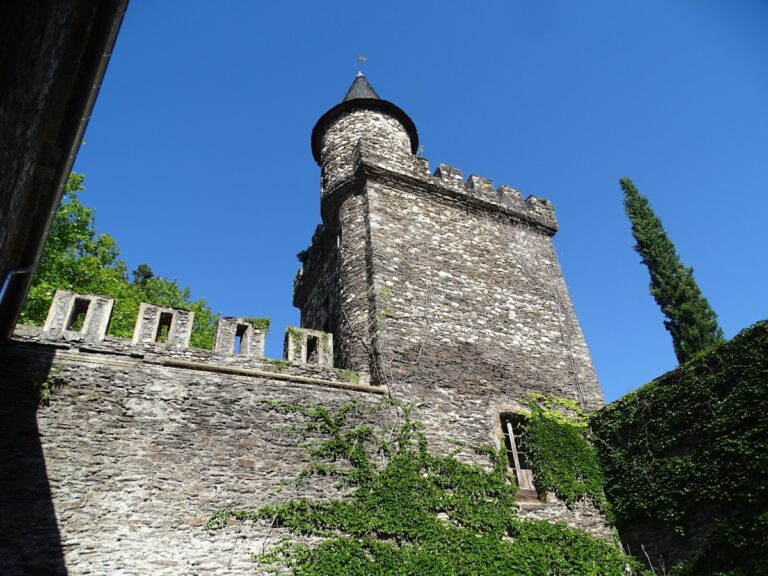
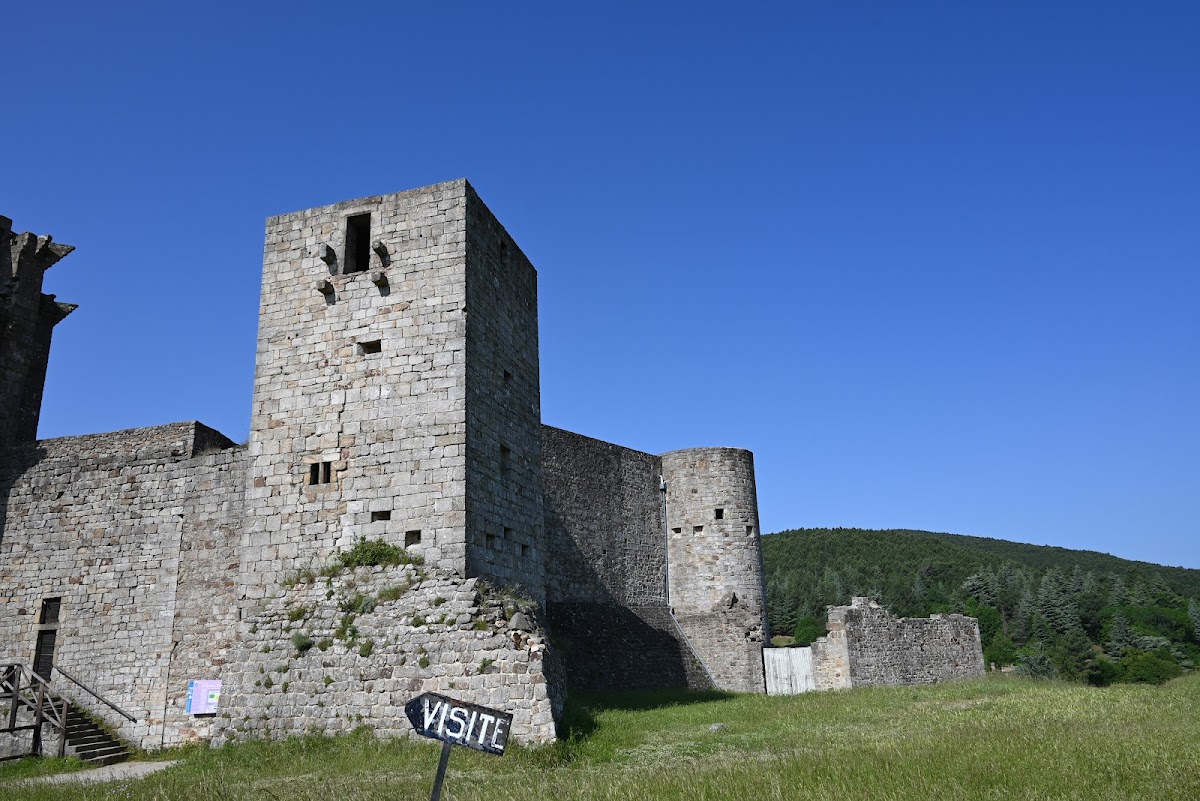
The medieval castle was enlarged in the thirteenth century and expanded again during the fifteenth and sixteenth centuries. At least two towers and curtain walls were added during the Budos period. The medieval masonry has comparatively rough stone cutting, while the later seventeenth-century work uses stone that was cut and finished more carefully and regularly. The medieval section remains significantly ruined, although restoration has recovered and conserved portions of the surviving structure.
Later defensive works
Military adaptations carried out during the 1570s and 1580s included a glacis, a sloping defensive embankment, a barbican, an outer defensive work protecting an entrance, and an artillery platform prepared for mounting guns. The southeast bastion, a projecting fortification designed to support defensive fire, was also raised. These features altered the castle’s defenses in response to the warfare of the late sixteenth century.
Mining damage and stabilization
Coal-mining subsidence caused part of the castle to collapse around the turn of the 1930s. The later filling of underground galleries and cavities stabilized the ground beneath the site. Subsequent volunteer-led work has conserved parts of the remaining structure while leaving the medieval section substantially fragmentary.