Château de Montendre: A Medieval Fortress in France


Site at a Glance
- Rating
- 4.1
- Popularity
- Low
- Country
- France
- Primary era
- Medieval
- Eras represented
- Medieval, Early Modern
- Civilizations
- Duchy of Aquitaine, French
- Site type
- Military
- Remains
- Castle
On this page9 sections
History
Château de Montendre is a medieval fortress in Montendre, France, built on a 114-metre-high spur overlooking the town and the historic regions of Haute Saintonge and Guyenne. It is thought to have succeeded a Roman castrum, a fortified settlement or military enclosure, and an earlier wooden fortress built around the ninth century. Construction of the castle is dated to the eleventh century, followed by rebuilding in stone during the twelfth century.
Early fortress and medieval lordship
The elevated position gave the castle views across the wooded areas of the Double forest and the surrounding countryside. Local tradition holds that Charlemagne stopped at the site while pursuing Duke Hunald, although the castle’s documented development belongs to the medieval period. The twelfth-century stone complex included a keep, an enclosure with substantial walls, four circular towers, and a square tower, while a wooden palisade stood lower down the spur.
During the Hundred Years’ War, the prolonged series of conflicts between the English and French crowns from the fourteenth to the fifteenth century, Montendre was repeatedly contested by the Anglo-Aquitanian and French parties. Ownership changed through purchase, confiscation, and force. The castle had belonged to the families of Didonne and, through marriage, Tonnay. Geoffroi IV, prince of Tonnay and Didonne, was first a loyal vassal of the Plantagenets, the English royal dynasty whose territories included much of western France. After Saint Louis IX defeated Henry III at Taillebourg in 1242, Geoffroi IV joined the Capetian side, the French dynasty that was consolidating control over these lands.
Geoffroi IV’s younger daughter Aumode, also called Almodis or Alénodis and described as the lady of Montendre, married Guy, viscount of Comborn. Their descendants formed the Comborn-Treignac line, which obtained the viscounty of Comborn in 1380. The succession of lords at Montendre remained unstable during the fourteenth and fifteenth centuries. Some accounts place the castle with a Jourdain family until about 1365, probably referring to a cadet branch of the princes of Mortagne represented by Geoffroi Jourdain and his son Raimond.
Hundred Years’ War
In April 1338, Edward III exchanged Montendre with Mathe d’Albret, who was married to Hélie-Rudel II, lord of Pons and Bergerac. In 1365, Edward of Woodstock, known as the Black Prince and prince of Aquitaine, confiscated the castle and entrusted it to Bernard or Brémond-Arnaud de Préchac, lord of Didonne and Soudan of Latrau. The Black Prince was Edward III’s eldest son and a leading English commander during the war.
French control was restored after Charles V and the commander Bertrand du Guesclin recovered Saintonge between 1371 and 1375. Du Guesclin served Charles V in the French reconquest of territories held by the English, and the Capetian Crown confiscated Montendre after the recovery. Charles VI later granted the castle, in 1385 or 1398, to the Harpedanne de Belleville family. Its holders included Jean I, seneschal of Saintonge, a senior royal administrative and judicial official, and his descendants Jean II and Jean III. The latter was Charles VI’s son-in-law.
Raymond II de Montaut-Mussidan subsequently appears as lord of Montendre and Montguyon and seems to have recovered Montendre from his son-in-law, Jean II Harpedanne-Belleville. Tradition places the Combat of the Seven at the foot of the castle on 19 May 1402. In this encounter, seven French knights fought seven English knights and the French prevailed, although the precise location remains disputed.
In 1452, shortly before the final collapse of English Aquitaine in 1453, French forces led by Jehan de Brosse captured the castle. Its fortifications then required major work. The walls were raised and the square tower was rebuilt, giving the surviving fortress much of the form associated with its later medieval phase.
La Rochefoucauld rule and the Wars of Religion
Montendre passed to a branch of the La Rochefoucauld family in the late fifteenth or early sixteenth century. Louis I de La Rochefoucauld, lord of Montendre, adopted the Reformed faith, the Protestant movement associated with the Reformation. During the Wars of Religion, he is described as having systematically destroyed the churches within his lordship.
After the conflict, Henry IV made Montendre a Protestant place of safety, a fortified town where Protestant communities were permitted protection and, in some cases, a garrison. Montendre joined Pons and Royan in receiving this status, and soldiers were housed in the castle for its protection. In 1608, a band of adventurers seized the castle without a fight in an episode remembered as the Surprise of Montendre. The surrounding towns were alarmed, but the intruders were soon expelled.
Eighteenth-century residence and modern preservation
At the beginning of the eighteenth century, the engineer and geographer Claude Masse described the lower enclosure as well built but badly ruined. He still considered the position capable of resisting a sudden assault and believed that artillery would be needed to capture it. At the same period, the marquis Louis II de La Rochefoucauld-Montendre abandoned his apartments in the square tower and commissioned a stone residence known as the Logis de La Rochefoucauld.
After Louis II died without a direct heir in 1742, the castle passed between several families. In 1923, Madame Faure owned the property and converted part of it into a public promenade that could be freely used. When she died in 1953, she bequeathed the castle to the commune. The municipality continued developing the site, including the construction of a green amphitheatre in 1959 and the establishment of a museum of local art and popular traditions in the square tower.
Remains
The surviving site occupies the high natural spur of the medieval fortress and is now arranged as a promenade overlooking Montendre, the surrounding heathland, and wooded areas. The twelfth-century stone fortification was organized around a keep, defensive walls, circular towers, and a square entrance tower. Today, only portions of this complex survive, including the tall square tower, a round tower, underground passages, and fragments of the defensive walls.
Medieval fortifications
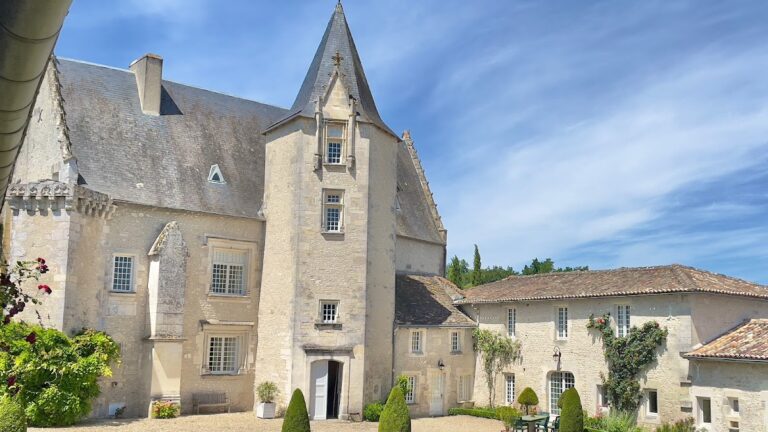
The square tower is a tall, three-storey structure that formed the entrance to the courtyard. Its principal present form dates from the fifteenth century, after the castle’s fortifications were repaired following the French capture of 1452, and it was remodelled in the nineteenth century. The tower now houses the museum of local art and popular traditions. A round tower and sections of the former defensive walls remain nearby, while parts of the underground passages were filled in for safety reasons.
Logis de La Rochefoucauld
The ruins of the Logis de La Rochefoucauld stand at the centre of the esplanade. This simple, one-storey noble residence was built in the eighteenth century for Louis de La Rochefoucauld de Fonsèque. It originally contained several bedrooms, two kitchens, and a service room, together with buildings for domestic and agricultural work, including stables, a harness room, a cowshed, a pigsty, a wine cellar, and a carriage house.
The residence was abandoned in the nineteenth century. It still appeared intact at the beginning of the twentieth century, but was later demolished except for a section of façade with a moulded doorway. This surviving façade now forms the backdrop of the green amphitheatre. Other buildings, including the House of the Feudalists adjoining the square tower, were also destroyed.
Green amphitheatre
Created in 1959 within the landscaped grounds, the green amphitheatre has 1,200 seats. It occupies part of the former residential area and is used for performances and shows during the summer season, placing a modern public function within the surviving framework of the castle site.
Nearby sites