Montecler Castle: An Unfinished Residence and Seat of a French Marquisate
Site at a Glance
- Popularity
- Medium
- Country
- France
- Primary era
- Early Modern
- Eras represented
- Early Modern
- Civilizations
- French
- Site type
- Domestic
- Remains
- Castle
On this page13 sections
History
Montecler Castle stands in Évron, France, on the boundary between Châtres-la-Forêt and Saint-Christophe-du-Luat. Its estate began as the lordship of Launay, also called Aunay-Péan, and passed to the Montecler family through marriage in the sixteenth century. The family’s residence later became the center of a marquisate, the title and associated territory of a marquis, raised by Louis XIII in 1616.
From Aunay-Péan to the Montecler family
Hamelinus de Alneto and Fromond de l’Aunay are considered probable early lords of the estate. In 1247, Fromond held land belonging to Philippe de l’Aunay in custody. The Cibel family, also known as Sibel, held Aunay-Péan in the fifteenth century. Michel Cibel’s 1477 declaration listed his high justice, meaning authority over serious criminal cases, along with farms and ponds at Ruaude, Gautrais and Oisillère. It also named fiefs, or lands held within a feudal hierarchy, at Mondoucet and Aubigné, and forest-warden offices at Viraille and Saulgé.
The Nepveu family later held Aunay. Jacques Nepveu was named as its lord in 1548 and 1569. In 1568, Renée Nepveu married Louis de Montecler, bringing the estate into the Montecler family, which held it hereditarily from then on.
Elevation and feudal jurisdiction
On 18 March 1605, Aunay became a châtellenie, a territorial jurisdiction organized around a castle, together with the fiefs of La Roussière and Moncrintin. It remained subject to the baron of Sainte-Suzanne and owed him a trained sparrowhawk and the glove used to carry it. In January 1616, Louis XIII granted the estate the title, dignity and precedence of a marquisate, recognizing Urbain de Montecler’s service, including during recent disturbances.
The marquisate held directly from the Crown and included fiefs such as Moncrintin, La Peillerie, La Saugère, Saint-Léger, Les Pins, Saint-Christophe and Sainte-Suzanne. These lands owed fifteen days of guard service. In 1644, after acquiring Tremblay, André de Montecler gained the baron of Entrammes’s consent for Montecler to be held directly from the king as a noble free allod, land held without an intermediate feudal lord, by virtue of his barony of Château-Gontier. The baron later relinquished his rights over Montecler for 4,000 livres. Tremblay remained dependent on Entrammes, whose lord retained a right of redemption. Before 1789, the portion of the castle in Châtres-la-Forêt depended on the king’s brother through Sainte-Suzanne, while the portion in Saint-Christophe-du-Luat depended on Tremblay.
Chapel and family residence
In 1618, Urbain de Montecler requested permission to hold Mass in a castle chapel. Bishop Émery de la Ferté administered confirmation at the chapel of Saint John in 1641. A provision for regular Masses was endowed there in 1710 to fulfil a vow, and in 1752 the marquis transferred to it the services of the chapel of La Saugère.
From about 1710, the marquises of Montecler usually lived at La Rongère rather than at the castle. During the Revolution, the castle was generally uninhabited apart from occasional visits. After returning from emigration, the marquise lived in Paris to defend her family’s interests, while the marquis stayed at La Rongère, partly because his health made Paris unsuitable. The neglected estate was placed under the management of Bourmault, who later served as mayor of Évron from 1800 to 1807.
Revolution and later ownership
After René-Georges-Marie de Montecler emigrated in 1791, his wife’s personal property was sequestered on the allegation that she was the mother of an émigré. She defended herself, and in 1795 Louis Dubois du Bais, a representative sent by the revolutionary government to exercise authority in the provinces, provisionally lifted the seizure pending a decision by the Committee of Legislation. Montecler’s fodder therefore did not go to the national granaries, despite a request from Peton, keeper of the forage stores.
On 26 June 1791, the National Guard from Évron removed weapons and an old cannon from the castle. Cardinal Richelieu had given the cannon to Louis de Monteclerc. The surrounding woods saw repeated clashes during the Revolution. On 4 April 1793, Évron’s National Guard searched them for people suspected of gathering there. On 6 January 1795, Republicans surrounded a small band of Chouans, royalist insurgents active during the Revolution, but the Chouans drove them back. On 5 April, Chouans took grain from the castle granaries and carried it away on horses. In January 1796, royalist general Claude-Augustin de Tercier came to drive off local pillagers.
In 1802, Eugénie-Henriette de Montecler received the estate as her share when she married Gaspard-Marie de Montecler, her father’s cousin. Their son Henri-Jean, born in 1813 and later the seventh marquis, left the estate to his grandchildren when he died in 1883. In 1812, François Morin and men avoiding compulsory military service frequently occupied the woods around Montecler. On 27 May 1832, royalist insurgents met at the castle intending to attack Évron, but abandoned the plan after a counter-order arrived. The present owners, Benoît and Odile de Ruffray, descend from the Montecler family.
Remains
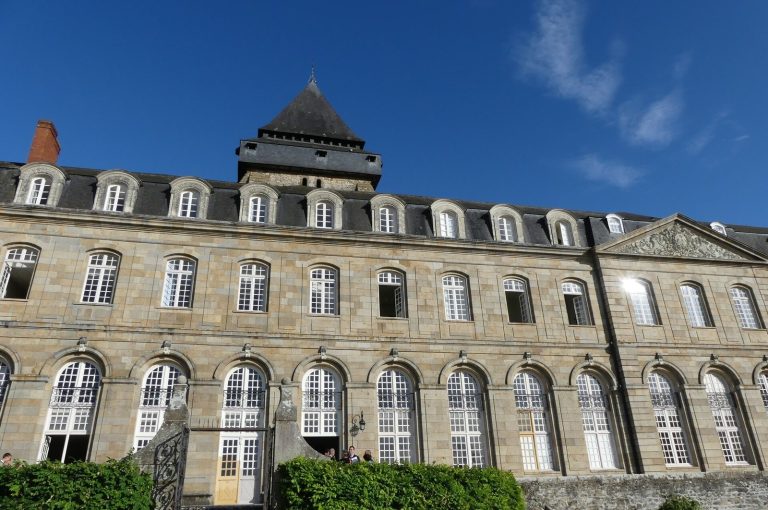
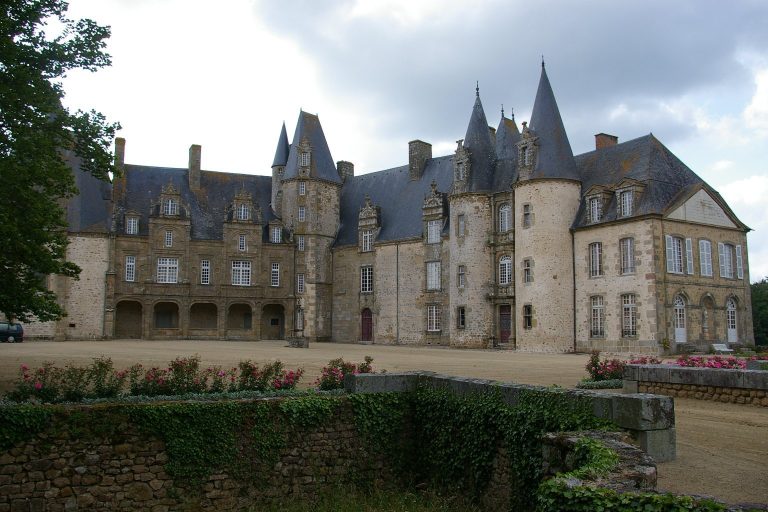
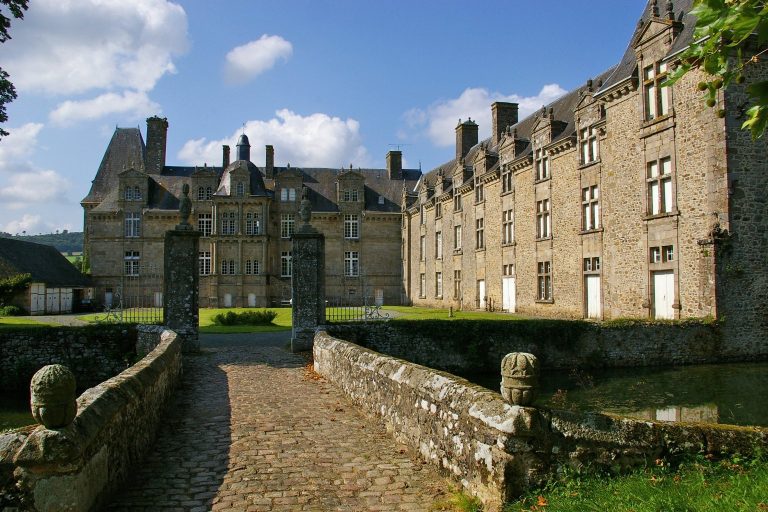
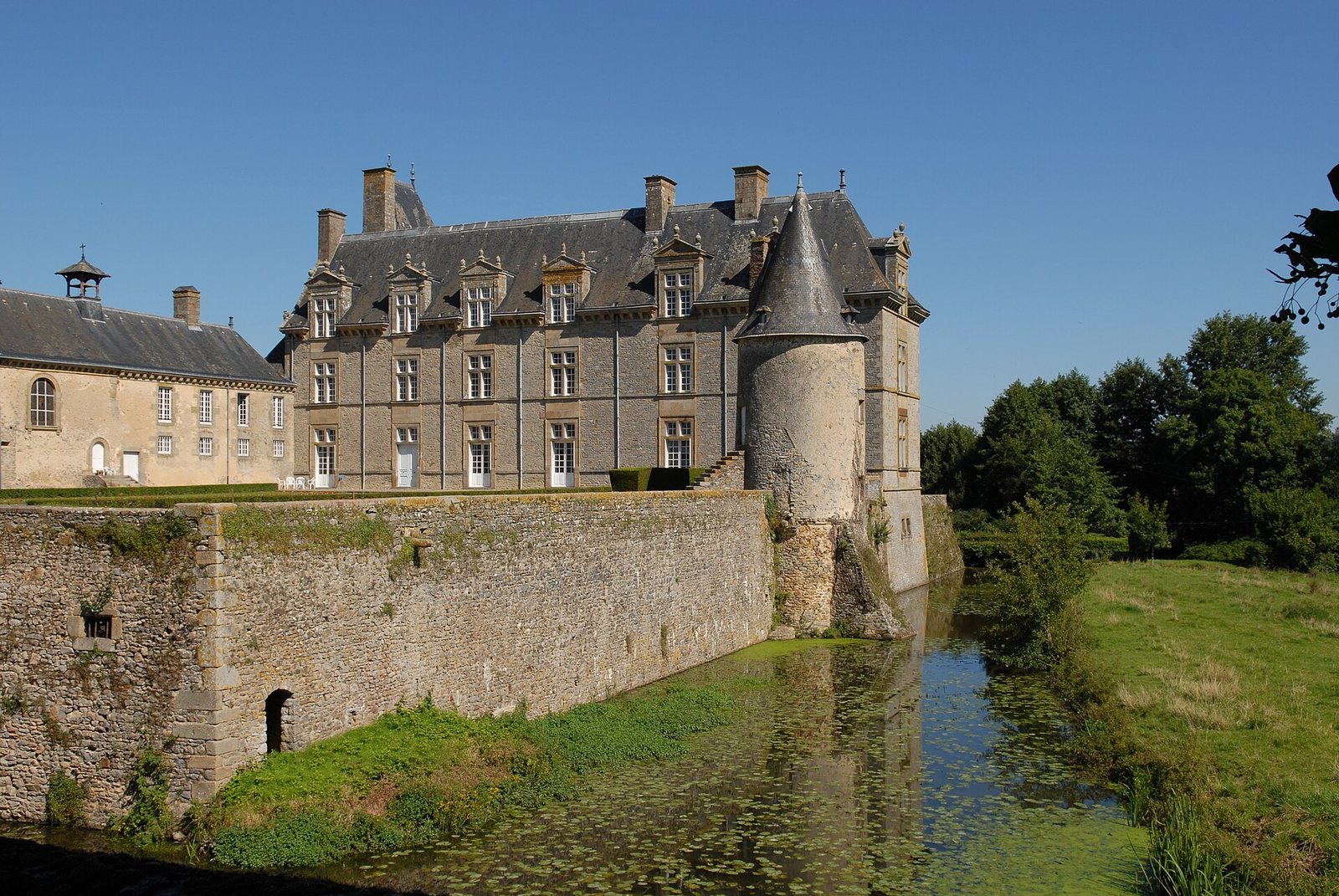
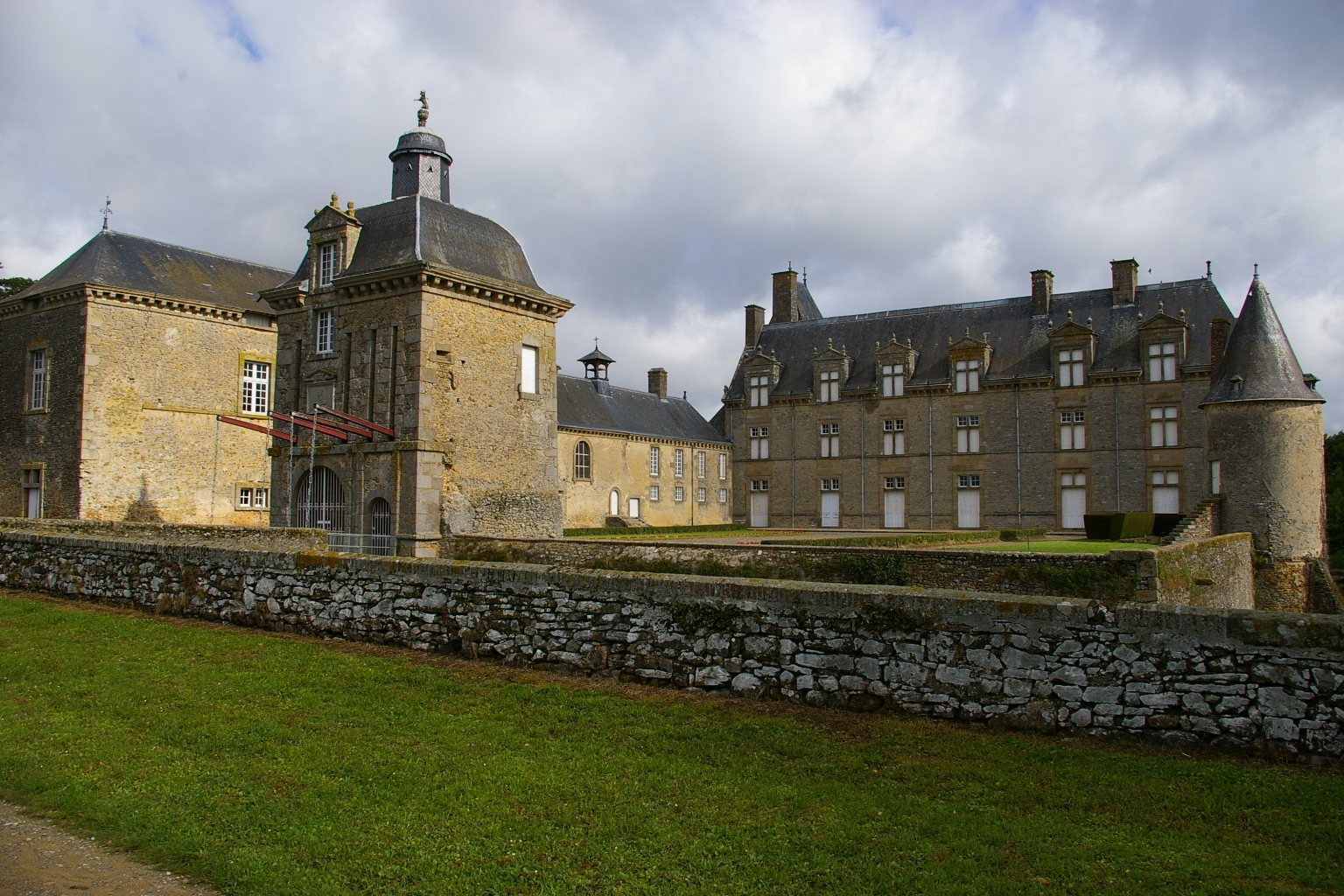
The castle is a large, unfinished residence comprising a main residential block, a pavilion beside the drawbridge, a chapel and adjoining service buildings. Its incomplete design and surviving structures preserve different aspects of the estate’s domestic and religious use.
Residential and entrance buildings
Main residential block
The main block is partly damaged and never received the steeply pitched roofs or pediments intended for it. Plans also called for another pavilion, and stones prepared for its construction remain visible.
Drawbridge pavilion
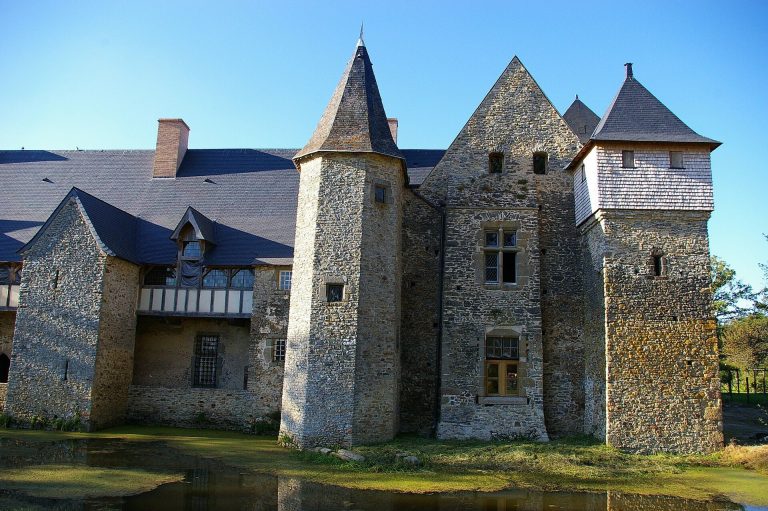
A pavilion beside the drawbridge survives as an accomplished example of the decorative design intended for the main residence, where such work would have been used more extensively. François-Augustin Gérault assigned the pavilion to the fifteenth century, but it is instead described as belonging to the intended decorative scheme of the larger building. An attached structure has a markedly twisting roof topped by an open gallery. A second elegant pavilion once stood beside the surviving one but has fallen.
Interior rooms
The interior includes a hall 14 metres long and a chamber with a fine fireplace framed by painted and carved panelling. This gilded chamber is notable for its decoration, which may be the work of Aimé Bouvier, a painter from Château-Gontier who was at the castle in 1693.
Chapel and service buildings
Chapels
A chapel described at the castle in 1618 had stone walls, a slate roof, glazed windows, a paved floor, a lock, an altar, a crucifix and several large paintings. The modest chapel of Saint John, founded around 1631, is also part of the complex. It had two bells dated 1634 and 1643.
Stables and Guards’ Hall
The adjoining stables have vaulted ceilings and support a large room known as the Guards’ Hall.