Château de Montdardier: A Medieval Fortress in France


Site at a Glance
- Rating
- 4.1
- Popularity
- Very Low
- Country
- France
- Primary era
- Modern
- Eras represented
- Medieval, Modern
- Civilizations
- French
- Site type
- Military
- Remains
- Castle
On this page7 sections
History
Medieval origins
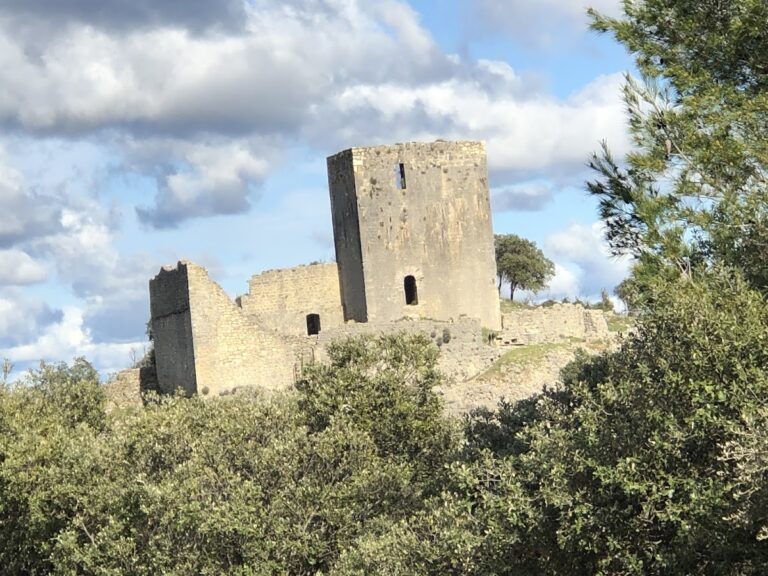
Château de Montdardier is a medieval fortress in Montdardier, France, built in the thirteenth century for the lord of Montdardier. Its original purpose was military, and its elevated position gave it control over the medieval route between Le Vigan and Lodève. The surrounding area appears in records as early as 1099, in the cartulary of Saint-Guilhem-le-Désert Abbey, a medieval compilation of documents concerning a religious institution’s property and rights.
The earliest castle or guard post associated with Montdardier may have stood away from the present château. It was probably located between the village, the hamlet of La Sanguinède, and the Gardie farmstead. This area retained the name “castel viel,” meaning “old castle,” which preserves a memory of the earlier defensive site.
A fortress on successive frontiers
Montdardier repeatedly occupied a frontier position. During the Hundred Years’ War, a long conflict between England and France, it lay between English and French territories. During the Wars of Religion, the religious conflicts between Protestants and Catholics in France, it stood between Protestant and Catholic areas. In the nineteenth century, it was situated between republican and royalist zones, while in the twentieth century it marked a boundary between industrial areas and agricultural surroundings.
Demolition, restoration, and protection
The fortress was demolished and restored several times. A major nineteenth-century restoration was undertaken by Eugène Viollet-le-Duc, a French architect and restorer known for Gothic Revival work and reconstructions based on historical interpretations of medieval buildings. The final construction phase is dated to 1860–1878, and the present château is associated with the Gothic Revival, a nineteenth-century movement inspired by medieval Gothic forms. Château de Montdardier has been listed as a French historic monument since 20 February 1989 and remains privately owned.
Remains
Hilltop setting and strategic outlook
The château stands on a hill above the Glèpe valley, at the southeastern edge of the Blandas Causse and at the boundary between the Cévennes and the Causse de Blandas. The Causse de Blandas is a limestone plateau in southern France, while the Cévennes form a mountain region of the Massif Central. From this elevated position, the château overlooks the valley toward Le Vigan and extends eastward toward Saint-Hippolyte-du-Fort. In clear weather, the view reaches as far as Mont Ventoux. Its position also allowed the fortress to control the route linking Le Vigan and Lodève.
Gothic Revival building and heraldry
The surviving building belongs to the nineteenth-century Gothic Revival phase associated with Eugène Viollet-le-Duc. Above the portal is the carved coat of arms of the Ginestous of Montdardier. The shield is quartered: the first and fourth quarters are gold with a red rampant lion, armed and langued in black, while the second and third are silver with three red crenellated bars, each made up of three pieces.