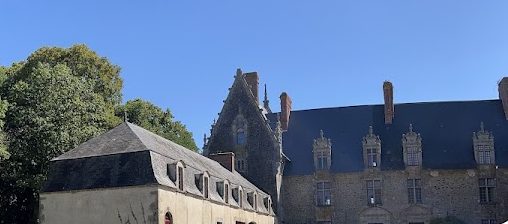
Château de Montaigu: A Medieval Fortress and Fortified Town in France


Site at a Glance
- Rating
- 4.2
- Popularity
- Very Low
- Country
- France
- Primary era
- Medieval
- External website
- Open
- Eras represented
- Medieval
- Civilizations
- Unclassified
- Site type
- Military
- Remains
- Castle
On this page10 sections
History
Château de Montaigu is a medieval fortress in Montaigu-Vendée, France, whose origins reach back to a ninth-century castrum, or fortified settlement, established during the period of Viking raids. The stronghold stood on a rocky spur between the Maine and the Asson, and its later Romanesque keep reflects the castle’s development as a major medieval seigneurial centre.
The Ninth-Century Stronghold
The first fortress at Montaigu was probably a wooden castle built on an earthen mound. It was created to resist Viking attacks after raiders had sacked Durivum, the settlement now known as Saint-Georges-de-Montaigu. The position between the Maine and the Asson gave the stronghold strategic value and helped determine the location of the later stone fortress.
The Lords of Montaigu
Maurice I de Montaigu is the first known lord of Montaigu. He witnessed the consecration of Saint-Nicolas Church at La Chaize-le-Vicomte in 1099. His successor, Brient I de Commequiers, held the lordship until 1174 and was married to Agathe de Montaigu. The succession then passed to their grandchildren, Brient II, Maurice II known as “the Younger,” and Marguerite.
Brient II may have commissioned the Romanesque keep in 1218. He may also have replaced the earlier wooden palisade with a broad ditch extending toward the Saint-Georges Gate. These changes formed part of the transition from an early timber stronghold to a more substantial stone fortress.
The Montaigu family was also known as Belleville after a marriage around 1180. The family acknowledged the authority of the Plantagenets, the royal dynasty that ruled England while holding extensive territories in France. Henry II, Richard the Lionheart, and John Lackland were successive Plantagenet kings.
Marguerite de Belleville-Montaigu, daughter of Brient de Montaigu and Agnès de Belleville and sister of Maurice II, married Hugues de Thouars in 1203. In 1227, the couple paid homage to Philippe Auguste, the French king Philip II, whose reign strengthened royal authority in France. After Hugues died in 1229, Marguerite married Pierre de Dreux, known as Mauclerc, in 1235. Mauclerc was duke-regent of Brittany.
Marguerite died childless in 1241, and the lordship passed to her nephew Maurice III de Belleville-Montaigu, the son of Maurice II. He became lord of Montaigu after Mauclerc’s death in 1250. The succession later continued through Maurice III’s family, including Jeanne and Maurice V. Maurice V married Sibylle, daughter of Geoffroy VI de Châteaubriant, and later Isabelle, also called Létice, daughter of Guillaume V Larchevêque de Parthenay.
Montaigu during the Hundred Years’ War
Jeanne de Belleville, daughter of Maurice V de Montaigu and Létice de Parthenay, married Olivier IV de Clisson in 1328. Olivier was beheaded after being suspected of treason in favor of the English during the Hundred Years’ War, the prolonged series of conflicts between the English and French crowns from the fourteenth to the fifteenth century. Jeanne responded by becoming a privateer with their children, Olivier V and Jeanne de Clisson, seeking revenge before being banished from France.
During Jeanne’s absence, the fortress was held by the English under the Treaty of Brétigny, later confirmed at Calais. This agreement temporarily transferred extensive French territories to England, and the English garrison at Montaigu pillaged the surrounding area. After losing her ship, Jeanne withdrew with her children to England.
Olivier V later returned to the French side and recovered his possessions in 1362. He fought the English alongside Bertrand du Guesclin, a major Breton commander serving the French crown. In 1373, Olivier and Bertrand expelled the English from Montaigu. Olivier then transferred the lordship to his sister Jeanne, who was married to the English captain Jean Harpedenne. Harpedenne subsequently joined the French king and became Jean de Belleville.
Late Medieval Fortification
Jean III de Belleville, the grandson of Jean Harpedenne, married Marguerite de Valois, the half-sister of Charles VII, in 1433. Louis I de Belleville later succeeded Jean III. Between 1464 and 1468, Louis XI advised him to fortify the town as protection against the Bretons. The château therefore formed part of a wider defensive system, rather than standing as an isolated castle.
The fortress and its surrounding town originally had ramparts and three fortified gates. Château de Montaigu is listed as a historic monument in France, with the designation recorded in 2011. Visible remains of the castle and its former fortifications preserve the outline of this medieval defensive complex.
Remains
The surviving site represents a fortified castle joined to a larger fortified town. The castle occupied an approximately oval enclosure with about ten flanking towers and an entrance gatehouse on the northeast side. A dry ditch, meaning a defensive trench without standing water, separated the castle from the town, while a barbican, an outer defensive work protecting a gate, guarded the approach to the gatehouse.
Castle Enclosure and Keep
Castle Enclosure
The castle enclosure contained the main fortified structures and was arranged around a courtyard. Its roughly oval perimeter was strengthened by flanking towers, which projected from the enclosing wall. The northeast gatehouse formed the principal entrance, and the barbican stood beyond it as an additional defensive element. The dry ditch between the castle and the town reinforced this separation.
Romanesque Keep
A Romanesque keep, the principal fortified tower of a castle, stood within the courtyard approximately midway along the north-south axis and toward the west. Associated with the regional Niort type, it was a large square tower with flat-sided towers at its corners. The keep had its own courtyard and small enclosure, giving the principal tower a distinct defended space within the larger castle.
Fortified Town
The town lay north of the castle and extended somewhat to the east. Its fortifications began near the present Rue de Gaulle. The Nantes Gate stood near Carré de l’Europe, and the ramparts continued along Rue de la Place du Champ de Foire before descending the Esplanade des Olivettes. The Tiffauges Gate stood near the roundabout at Rue des Jardins. From there, the ramparts followed the Asson, rose toward Rue du Pont Jarlet, and enclosed the barbican near the presbytery.
The town’s dry ditches reached a depth of 16 metres in the fifteenth century. Together with the ramparts, gates, castle enclosure, and inner keep, they formed a connected defensive landscape whose visible remains preserve the relationship between Montaigu’s seigneurial fortress and its fortified settlement.