Château de Lacoste: A Ruined Castle in Provence, France


Site at a Glance
- Rating
- 4.2
- Popularity
- Medium
- Country
- France
- Primary era
- Medieval
- External website
- Open
- Eras represented
- Medieval, Early Modern
- Civilizations
- County of Provence, French
- Site type
- Military
- Remains
- Castle
On this page8 sections
History
Château de Lacoste is a ruined castle in France that originated in the eleventh century and was substantially altered over later centuries. Built on a rocky spur above the village of Lacoste, it belonged for many years to the Simiane family, descendants of the House of Agoult, and later became closely associated with the Marquis de Sade.
Early occupation and the Simiane inheritance
Carved flints indicate prehistoric occupation on the site. Pottery from the Roman period points to a guard post on the rocky spur, positioned where routes linking Arles with Italy and Marseille with Aix-en-Provence and Lyon intersected.
The transfer of the castle from the Simiane family to the Sade family is explained by two competing family traditions. In 1627, Diane Simiane married Jean-Baptiste de Sade, traditionally identified as an ancestor of the Marquis de Sade. Another explanation places the transfer in 1716, when Isabelle Simiane bequeathed the castle to her cousin Gaspard François de Sade, Lord of Saumane and Mazan. The inheritance of 1716 is considered the more probable account.
The Marquis de Sade at Lacoste
The Marquis de Sade, an eighteenth-century French aristocrat and writer associated with controversial novels and libertine literature, took possession of the fief and became Lord of Lacoste in 1769. His father had given the castle to his son Alphonse when Alphonse married Renée Cordier. After taking possession, Sade began embellishing the residence.
Sade lived at Lacoste from 1769 to 1772, between the Arcueil and Marseille scandals. He returned after the Marseille affair and his flight to Italy, using the castle as a refuge until his imprisonment in the Château de Vincennes in 1777. After escaping during a transfer to Aix in the summer of 1778, he returned to Lacoste before being sent back to Vincennes.
During his longest stay, in 1772, Sade had a theatre built within the castle with seating for 120 spectators. His correspondence, especially his letters to Gaufridy, a notary from Apt who managed his Provençal affairs and property, conveys his strong attachment to La Coste during his imprisonments. He later described the castle in La Marquise de Gange, published in 1813, and in The 120 Days of Sodom, where it appears under the fictional name Château de Silling.
Revolutionary destruction and nineteenth-century ownership
In 1792, during the French Revolution, the castle was vandalised and largely destroyed. Its building materials were sold for reuse in other structures. Sade, then in Paris, was deeply distressed by the loss.
Burdened by debt, Sade sold the castle and estate in 1796 to Rovère, a deputy of Vaucluse from Bonnieux. Rovère intended to establish a family dynasty in the region, but after the Coup of 18 Fructidor he was deported to French Guiana, where he died at Sinnamary in 1798.
On 29 June 1816, Maître André drew up the sale of the Lacoste estate to Pierre Grégoire, a carpenter and farmer. Marie-Augustine Angélique de Vachon de Briançon-Belmont, Rovère’s widow, sold the property for 1,200 francs.
Restoration and cultural associations
André Bouer acquired the castle in 1952 and devoted himself to its restoration. The castle, its courtyards, and its dry moats, defensive ditches without standing water, were entered on the French register of monuments historiques, a legal designation protecting historic buildings and sites, on 21 August 1992.
Pierre Cardin, a French fashion designer of Italian origin and a member of the Académie des beaux-arts from 1992, bought the castle in 2001 and undertook further restoration. He committed to transferring it to the Institut de France, the institution that brings together several national academies, including the Académie des beaux-arts, after his death. Following Cardin’s death in 2020, his nephew Rodrigo Basilicati Cardin inherited his property, including the castle, and became involved in a legal dispute over the inheritance in 2023.
Cardin also established the annual Festival de Lacoste, presenting opera and theatre in the quarries west of the ruined castle. He launched the first Lacoste Film Festival in 2020. The castle appears as a setting in Didier Savard’s comic Dick Herisson, particularly in the album Le Vampier.
Remains
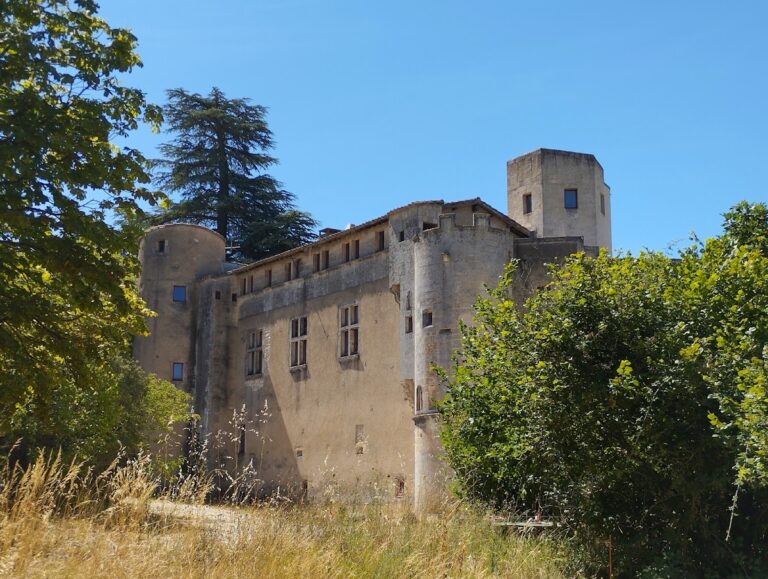
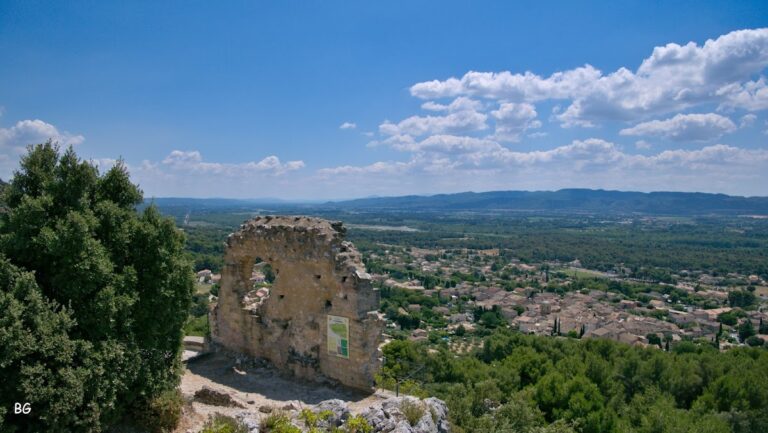
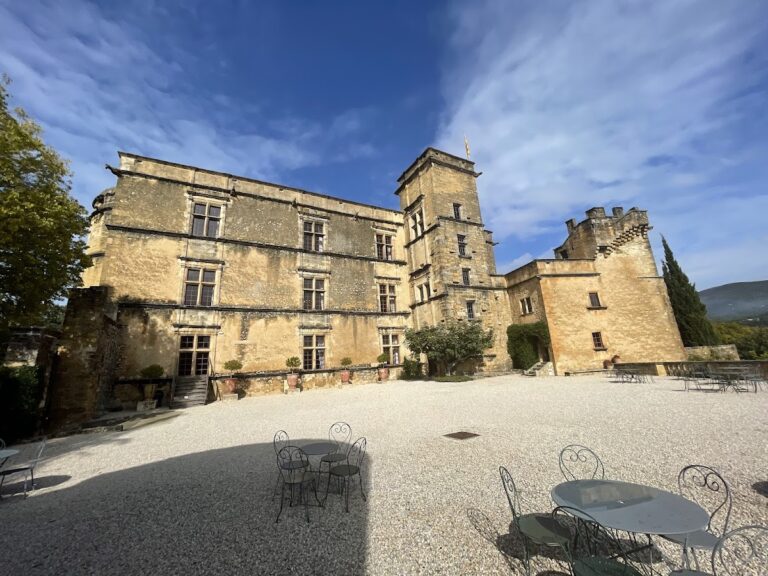
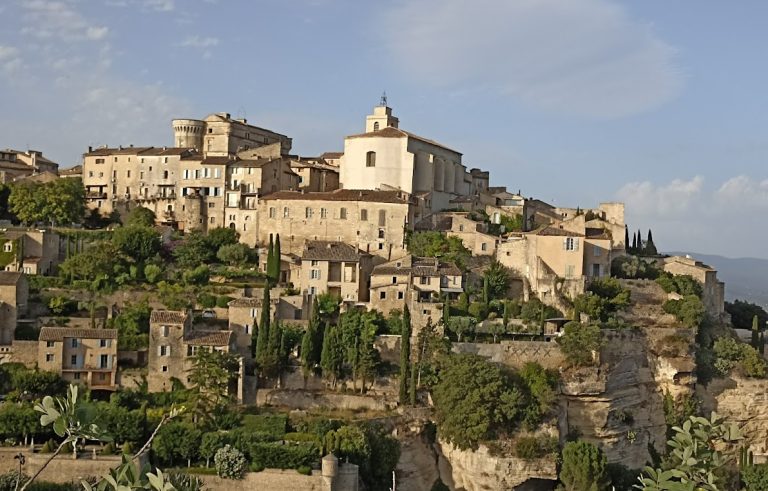
The ruined castle occupies a rocky extension of the northern flank of the Little Luberon, above the village of Lacoste. From this elevated position, the site overlooks the Calavon valley, the Monts de Vaucluse, Mont Ventoux, the Alps, and the village of Bonnieux on a nearby hill. The surviving complex consists of the castle, its courtyards, and its dry moats.
Castle fabric and grounds
The castle’s present form reflects its eleventh-century origin, later modifications, and the destruction of 1792. A sale document from 1816 described the building as being in ruins, without doors, windows, or iron fittings, and with only part of its roof remaining. The estate included dependencies as well as arable ground, uncultivated land, and rocky areas. Restoration work carried out after the twentieth-century acquisition has contributed to the survival of the castle and its associated courtyards and moats.
Theatre and western quarries
A theatre constructed inside the castle in 1772 formed part of the residence’s transformation under the Marquis de Sade. It was designed to accommodate 120 spectators. West of the ruined castle, the quarries used for Cardin’s annual artistic festival form another physical part of the site’s modern cultural setting.