Château de La Côte-Saint-André: A Medieval Castle in France


Site at a Glance
- Rating
- 4.2
- Popularity
- Low
- Country
- France
- Primary era
- Early Modern
- External website
- Open
- Eras represented
- Medieval, Early Modern, Modern
- Civilizations
- Duchy of Savoy, French
- Site type
- Military
- Remains
- Castle
On this page14 sections
History
Château de La Côte-Saint-André is a medieval castle in France, begun in the thirteenth century under the House of Savoy, a European ruling dynasty whose territories included the surrounding area. In 1273, Philippe I of Savoy initiated its construction to defend La Côte-Saint-André against incursions by Dauphinois soldiers. The castle therefore formed part of the military system of a parish then governed by Savoy.
Savoyard foundation and Dauphiné administration
During the fourteenth century, La Côte-Saint-André became attached to the Dauphiné, a historical province of southeastern France. The château then took on an administrative role as a venue for official functions. The Estates of the Dauphiné, the province’s representative political assembly, met there during that century.
Destruction and decline
Mercenaries returning from the Italian Wars, a series of conflicts fought mainly in Italy among European powers, sacked the château in 1518. Fighting associated with the Wars of Religion, the sixteenth-century religious and political conflicts that affected France, subsequently contributed to its ruin.
Educational use and municipal ownership
The Marist Brothers, a Catholic teaching congregation established for religious education, purchased the château and its estate in 1869. They raised the central building by adding another storey. The municipality acquired the property in 1906, and it housed a public school before the Second World War.
During the 1970s, the municipality carried out major repairs to the roofs, treated the timber framework, installed reinforced-concrete ties at the level of the load-bearing walls, and waterproofed the belvedere. The Commune of La Côte-Saint-André remains the owner. An order dated 21 March 1983 classified the château complex and its interior decorations as historic monuments under French heritage law, with the protection applying to specified elements of the château.
Cultural associations
The château has hosted part of the Festival Berlioz, an annual classical-music festival named for Hector Berlioz, who was born in La Côte-Saint-André. Its courtyard has been used for symphonic concerts. The grounds also housed the private Paradis du Chocolat museum, created from a project launched by local chocolatier Pierre Jouvenal in 1985. It opened in 1994 and closed in June 2019 after twenty-five years.
The château is also associated with Johan Barthold Jongkind, the Dutch painter and watercolourist regarded as a precursor of Impressionism. After settling in La Côte-Saint-André in 1878, he produced a watercolour depicting the town and its château.
Remains
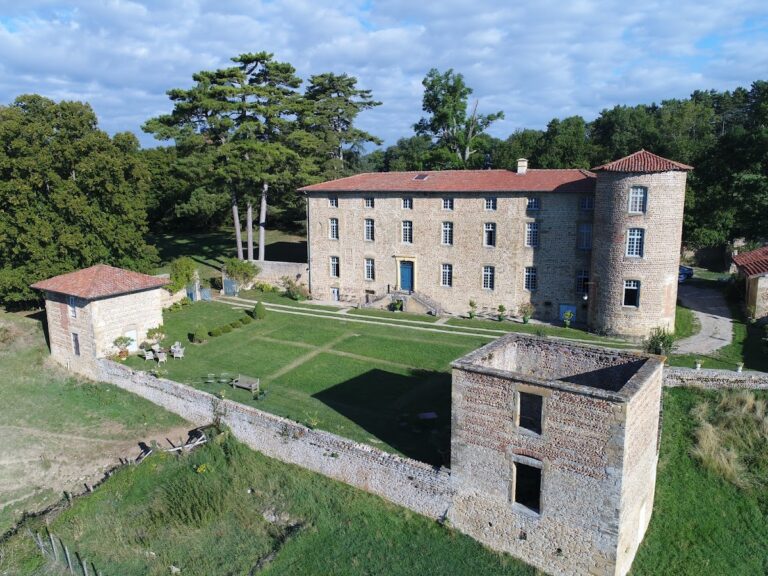
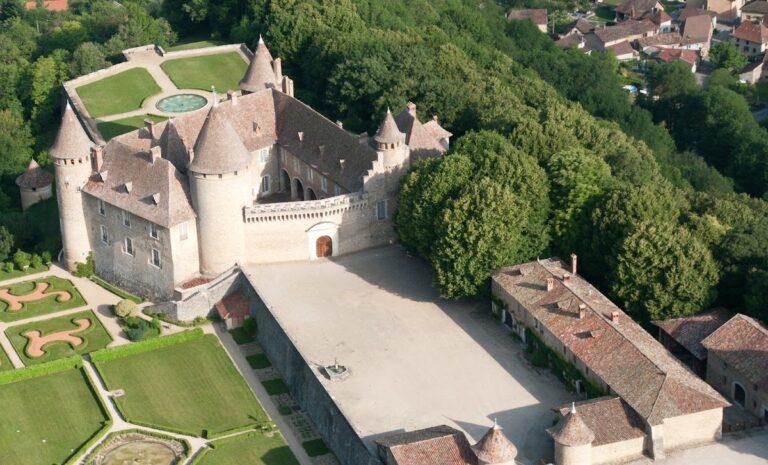
The château stands on a height in the centre of La Côte-Saint-André, overlooking the central built-up area. A large staircase connects the town centre and its medieval market hall with the principal façade. The complex was extensively remodelled during the nineteenth century and is formed around a large principal building with a substantial annex on the north wing.
Exterior buildings and courtyard
Principal building
The principal façade is austere and rectangular, rising through three levels. Its roof has windows with bossage, a form of rusticated projecting stonework. Although the complex underwent extensive nineteenth-century remodelling, the château as it now exists dates largely from the beginning of the seventeenth century.
North-wing annex
A substantial annex extends from the north wing of the principal building. This part of the complex formerly contained the stables, linking the château’s domestic and service areas within the larger architectural arrangement.
Courtyard dome
The inner courtyard contains a large dome that was converted into an auditorium. The dome was visible in 2019 and provides shelter for musicians and audiences during concerts. Festival Berlioz performances have also used a demountable installation near the rear façade, with covered accommodation for 1,400 people.
Principal interior spaces
Louis XI Hall
The large Louis XI Hall contains a monumental fireplace and exposed-beam French ceilings. Its name refers to Louis XI, king of France from 1461 to 1483, and forms part of the château’s interior arrangement.
Honour staircase
An honour staircase with a baluster railing is another principal interior feature. The staircase belongs to the château’s formal circulation spaces and survives within the remodelled complex.
Paradis du Chocolat museum building
The Paradis du Chocolat museum occupied a building adjoining the principal structure within the château grounds. Its installation added a modern cultural use to the historic complex while keeping the museum physically connected to the main château buildings.
Nearby sites