Chartreuse de la Sylve-Bénite: A Medieval Carthusian Monastery in France


Site at a Glance
- Rating
- 4.7
- Popularity
- Very Low
- Country
- France
- Primary era
- Early Modern
- External website
- Open
- Eras represented
- Medieval, Early Modern
- Civilizations
- French
- Site type
- Religious
- Remains
- Monastery
On this page9 sections
History
The Chartreuse de la Sylve-Bénite is a former Carthusian monastery in France, founded in 1116 in the Dauphiné de Viennois, a historic territory later incorporated into the province of Dauphiné. The Catholic monastery belonged to the Diocese of Grenoble and was established thirty-two years after the Grande Chartreuse, the first monastery of the Carthusian Order, founded near Grenoble by Saint Bruno in 1084.
Foundation and Carthusian community
Following a donation by a woman from the parish of Ars, six monks came from the Grande Chartreuse to establish the new community. They were led by Dom Othger, its first prior, on land donated by the marquises of Virieu. The monastery’s Latin name, Cartusia Sylva Benedicta, combined sylva, meaning forest, with benedicta, meaning blessed. The name therefore referred to a blessed forest.
The Carthusian way of life joined communal worship with a strongly solitary existence in separate cells. The professed fathers were choir monks who followed the contemplative rule, while lay brothers performed much of the manual and practical work. This division shaped the monastery into a High House for the professed fathers and a Low House, or service and agricultural section, for the lay brothers.
Benefactors, monks, and local traditions
The monastery’s early benefactors may have included Frederick I of Hohenstaufen, known as Frederick Barbarossa, who ruled as Holy Roman Emperor from 1155 to 1190. Terric, described as Barbarossa’s illegitimate son, was a lay brother at the monastery in 1168. Members of the Clermont-Tonnerre family, the lords of Clermont who dominated the Val de Paladru, were buried within the monastery precinct.
N. Molin entered the Grande Chartreuse after previously being a Benedictine, made his profession there on 1 June 1586, and later became prior of the Sylve-Bénite. He subsequently served as visitor of the Province of Burgundy, prior of Saint-Hugon and Val Sainte-Marie, and procurator of the Grande Chartreuse. He died in 1638.
Later traditions linked the monastery and the vanished village of Ars through four legends. The Legend of the Pilgrim tells of a hospitable woman and her daughter escaping the engulfing of the village. The Legend of the White Lady concerns the Countess of Ars, Barbarossa, and her lover. In the Legend of the Knight of Ars, the rejected lord of Maurienne obtains the village’s destruction through the Devil. The Legend of the Golden Bell tells of a bell repeatedly returned to the lake and the misfortune of its fisherman. These stories connect Ars’s disappearance with divine punishment, feudal conflict, pillage, and possibly an earthquake, but they remain legendary explanations.
Destruction, suppression, and later ownership
The monastery underwent many transformations and was partly destroyed during the Wars of Religion, the sixteenth-century conflicts in France between Catholic and Protestant factions. It finally closed in 1791 during the French Revolution. Church property was confiscated on 2 November 1789, inventories of ecclesiastical possessions were ordered on 18 November, and monastic vows and most regular religious orders were abolished in February.
The monastery’s property was dispersed and sold as national property. After the buildings were abandoned, extensive looting took place, and the community was dispersed in 1792. The remaining buildings, including part of the cloister, later passed into private ownership. The High House remains privately owned, while the Low House’s surviving tithe barn became the collectively owned Grange Dimière site. The grange received partial historic-monument protection through an order dated 9 June 1987. The former monastery is associated with the Via Gebennensis, the Geneva route of the Way of Saint James, which passes along the enclosure of the High House.
Remains
The former Carthusian complex stands at the western end of Villages du Lac de Paladru and the associated commune of Le Pin, at the edge of the Sylve-Bénite forest. The forest extends between the monastery, Château de Pupetières, and Château de Virieu. The surviving remains are divided between the enclosed High House and the Low House area, represented by the Grange Dimière. Historical and modern plans identify the principal monastic buildings, while historical descriptions preserve information about the conventual buildings and the monks’ cells.
The surviving monastic buildings
High House
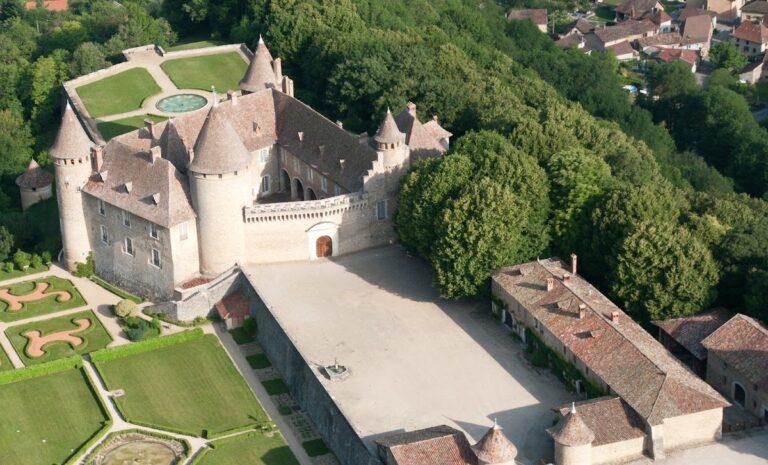
The High House was the convent of the professed fathers. Its enclosed surviving area contains most of the remaining monastery buildings, including the large cloister and the monks’ cells. The complex is partly destroyed, and the surviving buildings stand within a closed enclosure. A plan displayed in front of the former fathers’ refectory identifies the positions of the principal buildings.
Low House and Grange Dimière
The Low House, or correrie, served the lay brothers and formed the monastery’s service and agricultural section. Only its tithe barn survives from this part of the complex. A tithe barn stored the grain collected as the tithe, a customary levy paid in agricultural produce.
The Grange Dimière, also called the barn of the Courterie or Correrie, was built by the neighboring Carthusian monks in 1549 and rebuilt in 1655. The later date appears on the lintel above its entrance. Its walls contain mortared rounded stones from glacial moraines, gathered locally by the builders. The barn was renovated in 1993 and now provides a setting for exhibitions and other public events.
Landscape setting and surviving routes
The former monastery lies near the departmental road linking La Tour-du-Pin with the junction of the RD 520 at Oyeu. The Via Gebennensis follows the crest path above Lake Paladru, runs alongside the former monastery enclosure, and continues through the surrounding woodland.
Nearby sites