Château de L’Échelle: A Fortified Castle in France’s Ardennes


Site at a Glance
- Rating
- 4.4
- Popularity
- Very Low
- Country
- France
- Primary era
- Early Modern
- External website
- Open
- Eras represented
- Medieval, Early Modern, Modern
- Civilizations
- French
- Site type
- Military
- Remains
- Castle
On this page12 sections
History
Medieval origins and fifteenth-century occupation
Château de L’Échelle is a fortified castle in France’s Ardennes department, in the commune of L’Échelle. A first castle was probably founded beside the domain of Potées in the thirteenth century. Potées belonged to the Chapter of Reims, the governing body of Reims cathedral clergy, which held ecclesiastical property in the area.
During the fifteenth century, a band of Armagnacs occupied the castle. The Armagnacs were a faction involved in France’s political and civil conflicts, and armed groups associated with them could act as regional military forces. From the castle, they ravaged the surrounding area.
The transformation under Antoine de La Marche des Contes
Antoine de La Marche des Contes became lord of L’Échelle through his marriage to Anne de Maucourt in 1594. He was governor of Sedan from 1599 to 1640 and transformed the castle, giving it much of its present appearance. He died in September 1640 at the age of seventy-four.
The Spanish assault and later ecclesiastical ownership
At daybreak on 28 September 1642, Spanish troops pillaged the village and attacked the castle. The assault left cannonball marks in the walls and became part of the memory attached to several of the castle’s defensive features.
In 1730, the Chapter of Reims acquired Château de L’Échelle and adapted its buildings for agricultural use. During the French Revolution, the castle was sold as national property to Simon Pottier, a hatter from L’Échelle. He later transferred a substantial part of it back to the commune, which installed the town hall, a school, and the schoolteacher’s residence in the castle.
Civic use and preservation
The castle was entered on the French register of historic monuments in 1926 and is now entirely owned by the municipality. Part of the residential buildings in the north wing became the Museum of Yesterday’s School, devoted to primary schooling from the 1900s to the 1960s.
Remains
Plan and access
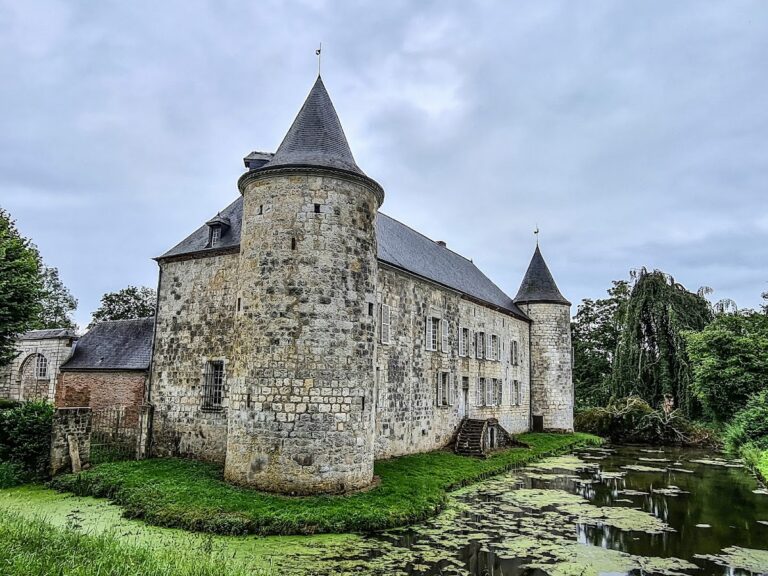
Château de L’Échelle stands at the heart of the village. Its buildings form a quadrangular plan open to the south and enclose a relatively small courtyard. A terrace built over the former moats faces the east wing and provides the principal access to the castle.
East wing and entrance defenses
The east wing is arranged around a broad central bay between two large circular towers. The southeast and northeast towers have few openings and retain gunports, openings designed for firearms or cannon, at their upper levels. The central bay contains seventeenth-century elements, including a large projecting bretèche, a defensive structure above an entrance from which defenders could observe or attack people below. It bears the town’s engraved coat of arms and stands above a gateway opening into the inner courtyard. A semicircular staircase above the gateway leads to the upper floor, where the schoolteacher’s residence was formerly located.
Corner tower and later-use buildings
Northwest corner tower
The square échauguette, a small projecting corner turret used for observation and defense, stands at the northwest corner. Its cartouche is dated 1604. The feature is associated with the names “Tower of Cannonballs” and “Tower of the Massacres,” which recall the destruction of the village, the killing of its inhabitants, and the Spanish assault of 1642.
North building
The high walls of the north wing are almost entirely windowless. In the nineteenth century, the north building was converted into a residence and given a brick-and-stone façade. It later served as the former communal school, and now houses the Museum of Yesterday’s School, whose displays include inkpots, Sergent-Major pen nibs, and slates.
West building
The west building was converted into a large barn. A cart passage runs through it beneath a Classical portal with a straight lintel.