Château des fées: A Medieval Fortress on the Meuse


Site at a Glance
- Rating
- 3.9
- Popularity
- Very Low
- Country
- France
- Primary era
- Medieval
- External website
- Open
- Eras represented
- Medieval, Early Modern
- Civilizations
- Carolingian, French
- Site type
- Military
- Remains
- Castle
On this page8 sections
History
Château des fées is a medieval fortress in France, situated at Le Waridon in Montcy-Notre-Dame near Charleville-Mézières. Its origins belong to the period between the ninth and eleventh centuries, and its original construction is traditionally dated to around 870. Built on the upper course of the Meuse, the fortress later became associated with a destruction around 1020, probably carried out by troops of the Archbishopric of Reims, the ecclesiastical jurisdiction governed by the archbishop of Reims.
Early fortress and destruction
The name Château des fées, or “Castle of the Fairies,” is associated with the site’s destruction and may have developed from château défait, meaning “ruined castle.” Legends subsequently gathered around the ruins. Archaeological layers indicate a fire in the late tenth or early eleventh century, while coins found in the keep and outside the enclosure help date the event. The sequence of occupation included an early structure made from perishable materials, a later masonry tower with eastern and western additions, destruction by fire in the eleventh century, and rebuilding in the sixteenth century.
Sixteenth-century rebuilding
At the beginning of the sixteenth century, François d’Aspremont, a local lord, rebuilt the fortress and transformed it into a seigneurial residence. Along with the fortress of Lumes, Château des fées allowed him to control the waterways leading toward Charleville and to extort money from boats and travelers. François I, king of France from 1515 to 1547, banished and dispossessed d’Aspremont in 1534, ending his control of the fortress. In 1629, the fortress of Woiru, or Woiridon, was described as destroyed.
Legends and archaeological rediscovery
After abandonment, vegetation covered the site. Clearing began during the 1940s and 1950s, and archaeological excavations started in 1984. Prosper Tarbé, a nineteenth-century French writer and historian, proposed in 1861 that the ruins inspired the legendary castle of Montessor, associated with the Four Sons of Aymon and Renaud de Montauban. These figures belong to medieval French epic poems known as chansons de geste, which recount the deeds of legendary or semi-legendary heroes. Château des fées has also been connected, with some uncertainty, to the castle of Oridon, described in several such poems as a tall tower on a rocky summit in the Ardennes forest.
Remains
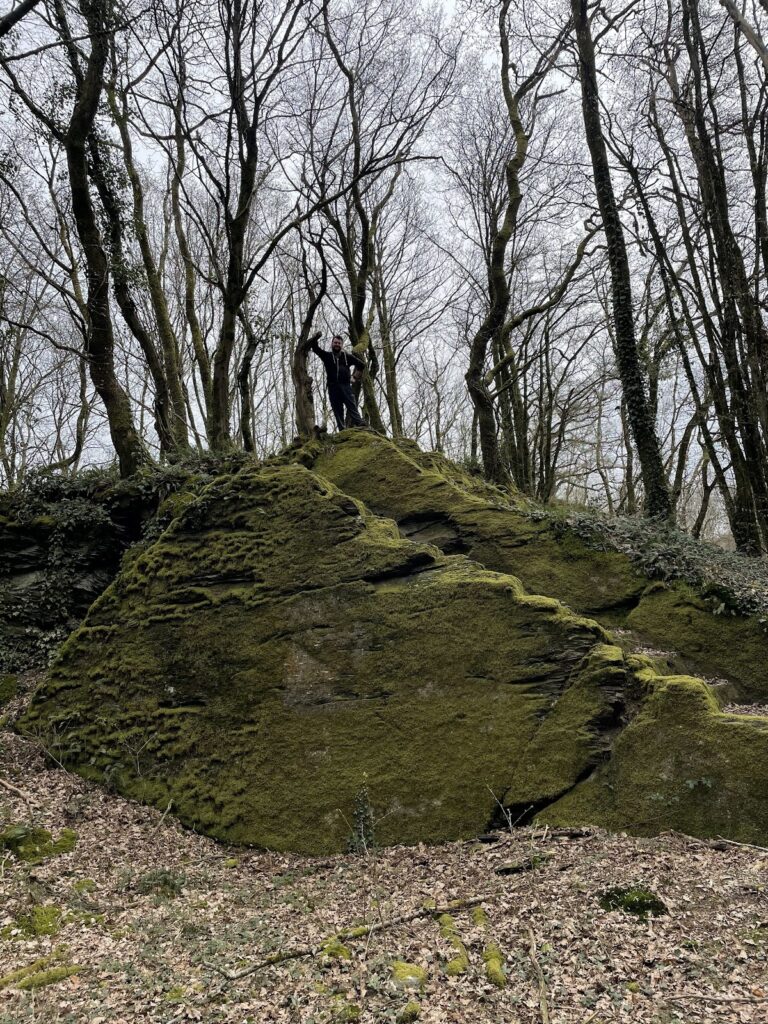
The ruins occupy a rocky spur overlooking the Meuse and Montcy-Saint-Pierre, a district of Charleville-Mézières. Excavation has revealed a rectangular building or enclosure measuring approximately 18 by 10 metres, together with evidence for several stages of construction. The remains combine early building methods with later masonry and provide evidence for a substantial high-status residence.
Excavated architectural sequence
Early rectangular building
The earliest identified structure had a rectangular plan and was built from perishable materials. Impressions left by its post holes preserve evidence of the supporting framework. A dry-stone wall belonged to a rectangular building or enclosure measuring about 18 by 10 metres, defining part of the early architectural arrangement on the rocky spur.
Masonry tower and annexes
The early structure was replaced by a large rectangular masonry tower whose foundations were cut into the bedrock. Its walls used fishbone masonry, a technique in which stones are set in angled rows that form a herringbone pattern. Annexes were later added on the eastern and western sides. Window lead recovered from the ruins, together with the use of stone, points to a substantial residence at a time when timber construction was more usual.
Excavations also yielded glass, lead and lead-alloy objects, coins, arrowheads, crossbow bolts, seeds, ceramics, animal bones including game remains, and engraved bones. The animal remains indicate a strongly meat-based diet. These materials are conserved at the Musée de l’Ardenne.
Nearby sites