Château de Guermantes: A Baroque Château in France


Site at a Glance
- Rating
- 4.6
- Popularity
- Low
- Country
- France
- Primary era
- Early Modern
- External website
- Open
- Eras represented
- Early Modern
- Civilizations
- French
- Site type
- Domestic
- Remains
- Elite Residence
On this page11 sections
History
Château de Guermantes is a Baroque château in Guermantes, France, whose construction was undertaken in the seventeenth century by the Viole family. The estate developed from the medieval lordship of Le Chemin and later became associated with the name Guermantes, which Marcel Proust adopted for a fictional aristocratic family in In Search of Lost Time.
From Le Chemin to the Viole family
The estate was originally known as Le Chemin, a name meaning “the way” or via. In the Middle Ages, it was held by a noble family that took the name du Chemin. A charter issued by Sainte-Geneviève Abbey in the fourteenth century referred to the lands as “in via de Guermant.”
In 1362, Jacqueline du Chemin, who was widowed, transferred the property through her marriage to Pierre Blanchet, a royal secretary. Around 1382, the lordship was divided among several holders. One portion went to Malnoue Abbey, another to the squire Jean Motelin, and the principal share probably passed to the squire Etienne Boulart, who was buried in the church at Guermantes in 1397.
During the fifteenth century, the lordships of Le Chemin and Roquemont belonged to Pierre Poignant, an advocate and councillor of the Parlement of Paris, the high court of the French monarchy. He also held Athis, Aigremont, Tillières, and Archères. Le Chemin later passed to one of his sisters, who was married to Nicolas Viole, a councillor of the Chamber of Accounts, the institution that audited royal finances. The Viole family retained the lordship from the sixteenth century and undertook the construction of the château in the seventeenth century.
The Guermantes estate in the seventeenth and eighteenth centuries
During the seventeenth century, both the estate and the village adopted Guermantes as their official name. This change followed Pierre Viole’s recognition as Seigneur de Guermantes, formerly Seigneur de Le Chemin. The new name gradually replaced the older designation as the Viole family developed the château.
Paulin Pondre purchased the estate in 1698. A receiver of the finances at Lyon and one of the most powerful financiers during the reign of Louis XIV, Pondre commissioned Jules Hardouin-Mansart, a leading architect of that reign, to restore the château. The work was completed in 1710. Pondre also entrusted André Le Nôtre, the foremost designer of formal French gardens in the period, with the layout of the park. After Pondre became president of the French Court of Accounts in 1713, the château hosted memorable fêtes.
In 1719, the Scottish financier John Law bought the estate for 800,000 livres. His purchase coincided with the collapse of the Mississippi Scheme, a speculative financial bubble for which he was principally responsible. The collapse in 1720 led to Law’s bankruptcy and flight from France. He left the country in December 1720, departing from Château de Guermantes, after which Paulin Pondre recovered possession. The Pondre family kept the estate until it was confiscated during the French Revolution.
Later owners and preservation
After the French Restoration, the period when the Bourbon monarchy returned following Napoleon’s fall, the estate came back to the Pondre family. A lightning strike caused a fire that destroyed the library in 1756. In 1812, the architect Antoine-Léon Thomas Vaudoyer prepared designs for aviaries for the château’s owners.
A timber merchant acquired the estate in 1920 and began cutting trees. His plans for a housing development or a clinic failed, and he resold the property after several months. In December of that year, banker Maurice Hottinguer purchased the château, and restoration work followed in 1921. In 1942, Hottinguer transferred it to his son Pierre on the occasion of Pierre’s marriage to Sylvie Feray.
In 1944, occupying forces threatened to destroy the château in retaliation for Resistance members’ execution of a German soldier. Blanche Hottinguer, née de Maupeou, intervened and helped preserve the building. The château was protected as a French historic monument on 9 August 1944 and received a further classification on 21 December 1970. The property was sold in 2008 and converted into a seminar and conference centre. It remains privately owned and is not open to the public.
Marcel Proust and the name Guermantes
Marcel Proust visited the real château in 1908 and took the name Guermantes for the fictional Guermantes family, the Duchess of Guermantes, and the third volume of In Search of Lost Time, The Guermantes Way. The building itself does not appear directly or indirectly in the novel.
Proust’s fictional château was based mainly on Château de Villebon, north of Illiers, rather than on the building at Guermantes. In earlier drafts, he used “the side of Villebon” for one of the directions taken by the narrator’s family from fictional Combray, later replacing the name with Guermantes. He apparently preferred the sound of Guermantes, especially its “mythical” syllable “-antes,” and used it partly to conceal concrete references to his home region.
Before adopting the name for his fictional noble family, Proust reportedly made inquiries to establish whether a real Guermantes family still existed. He presented his fictional dukes of Guermantes, counts of Combray, as descendants of the dukes of Brabant and associated them with the legendary Genevieve of Brabant. The Duchess of Guermantes was partly modeled on Élisabeth de Riquet de Caraman, Countess Greffulhe, while the interiors of the fictional château drew influence from Château de Balleroy.
Remains
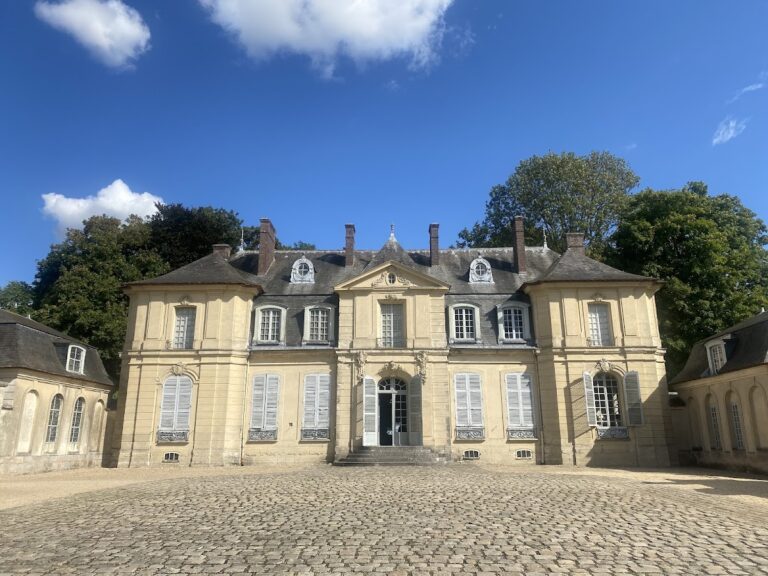
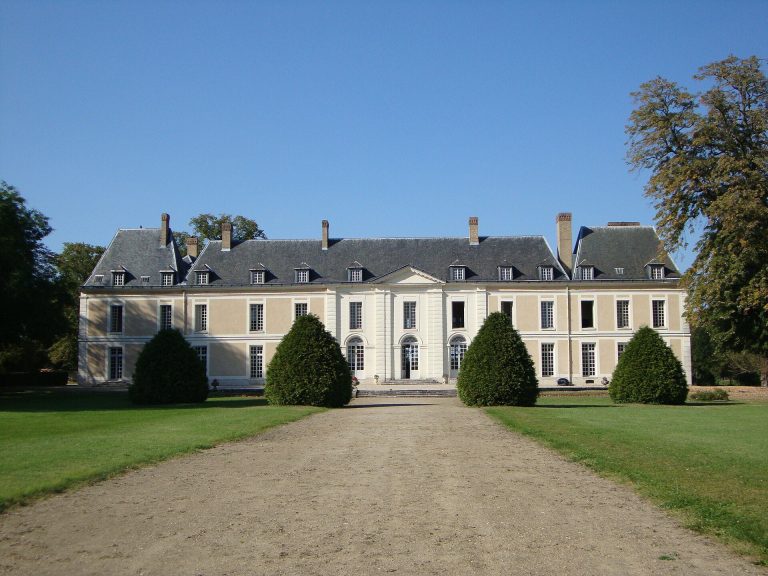
Château de Guermantes is a brick building in the Baroque style, faced with stone and finished with stone quoins at the corners. Its H-shaped plan consists of a central block with projecting pavilions on either side. Tall, steep roofs covered in slate rise above the structure and are marked by high chimney stacks. The château stands within a large park, where the approach drive follows the side of an uninterrupted lawn. On the garden side, the building occupies a terrace with steps descending toward the former parterre, a formal garden of planted beds and ornamental patterns, which is now lawn.
Park and water feature
The park includes a formally shaped body of water described as a very large water mirror, an expanse designed to reflect architecture or landscape. From its far end, the château is reflected in its entirety. The water feature forms part of the estate’s formal garden layout associated with André Le Nôtre’s work.
Interior spaces and decorative remains
Ceremonial gallery
The main ceremonial gallery measures 31 metres in length. It retains luxurious wood paneling, painted canvases, and chandeliers. The decoration is attributed to Robert de Cotte and was executed by Jean Hanard. Its design visibly drew on the Hall of Mirrors at Versailles.
Rooms and library
Several rooms preserve painted decoration and other ornament from the seventeenth and eighteenth centuries, including surviving decorative wood paneling. The library was destroyed by fire in 1756, while designs for aviaries were prepared for the estate in 1812 by Antoine-Léon Thomas Vaudoyer.
Tapestry series
A related set of five wool-and-silk tapestries was woven around 1640–1650 from designs by Simon Vouet. The series included scenes such as Renaud in the Arms of Armide. It was associated with the château during the nineteenth and early twentieth centuries before the furnishings were sold at the Drouot auction house on 19 November 1917. The tapestry depicting Renaud later appeared in an exhibition in Bordeaux in 1966.