Église Notre-Dame de Villedieu-les-Poêles: A Gothic Catholic Church in France
Site at a Glance
- Rating
- 4.5
- Popularity
- Very Low
- Country
- France
- Primary era
- Medieval
- Eras represented
- Medieval, Early Modern
- Civilizations
- French, Knights Hospitaller
- Site type
- Religious
- Remains
- Church
On this page9 sections
History
Église Notre-Dame de Villedieu-les-Poêles is a Catholic church in France, built in the Gothic tradition and dedicated to Notre-Dame. Construction began in the thirteenth century, and the church was associated with the Diocese of Coutances and Avranches and the Sainte-Bernadette-de-Villedieu parish. Its patronage belonged to the Hospitaller Brothers of Saint John of Jerusalem, a medieval religious-military order that held properties, operated hospitals, and administered religious foundations.
Medieval rebuilding
The church was rebuilt at the end of the fifteenth century after the Hundred Years’ War, the prolonged conflict between the English and French crowns from the fourteenth to the fifteenth century. A visitation record from 1495 states that wartime destruction had left the building entirely demolished. It was then being rebuilt under Commander Brother Jehan Routier and the parishioners.
Religious conflict and reconstruction
On 17 August 1562, several Protestant gentlemen pillaged the church. In 1590, Protestants seized Villedieu and were compelled by Catholics to take refuge inside the church, where they were massacred. A fire in 1632 destroyed most of the building, although the choir survived. Reconstruction began during the seventeenth century, while the façade was rebuilt in the eighteenth century. Major works, especially to the side aisles, followed in the nineteenth century.
Protection and transferred furnishings
The church was classified as a French historic monument by an order dated 27 December 1979. Several statues were transferred from the former churches of Saint-Pierre-du-Tronchet and Sainte-Trinité de Saultchevreuil-du-Tronchet. Protected movable furnishings include the Education of Mary, listed in 1944; Saint Venice, listed in 1954; the Virgin and Child from Saint-Pierre-du-Tronchet, listed in 1956; the pulpit and tabernacle, listed in 1958; Céneric of Saultchevreuil, listed in 1959; and the choir stalls and other statues, listed in 1966.
Remains
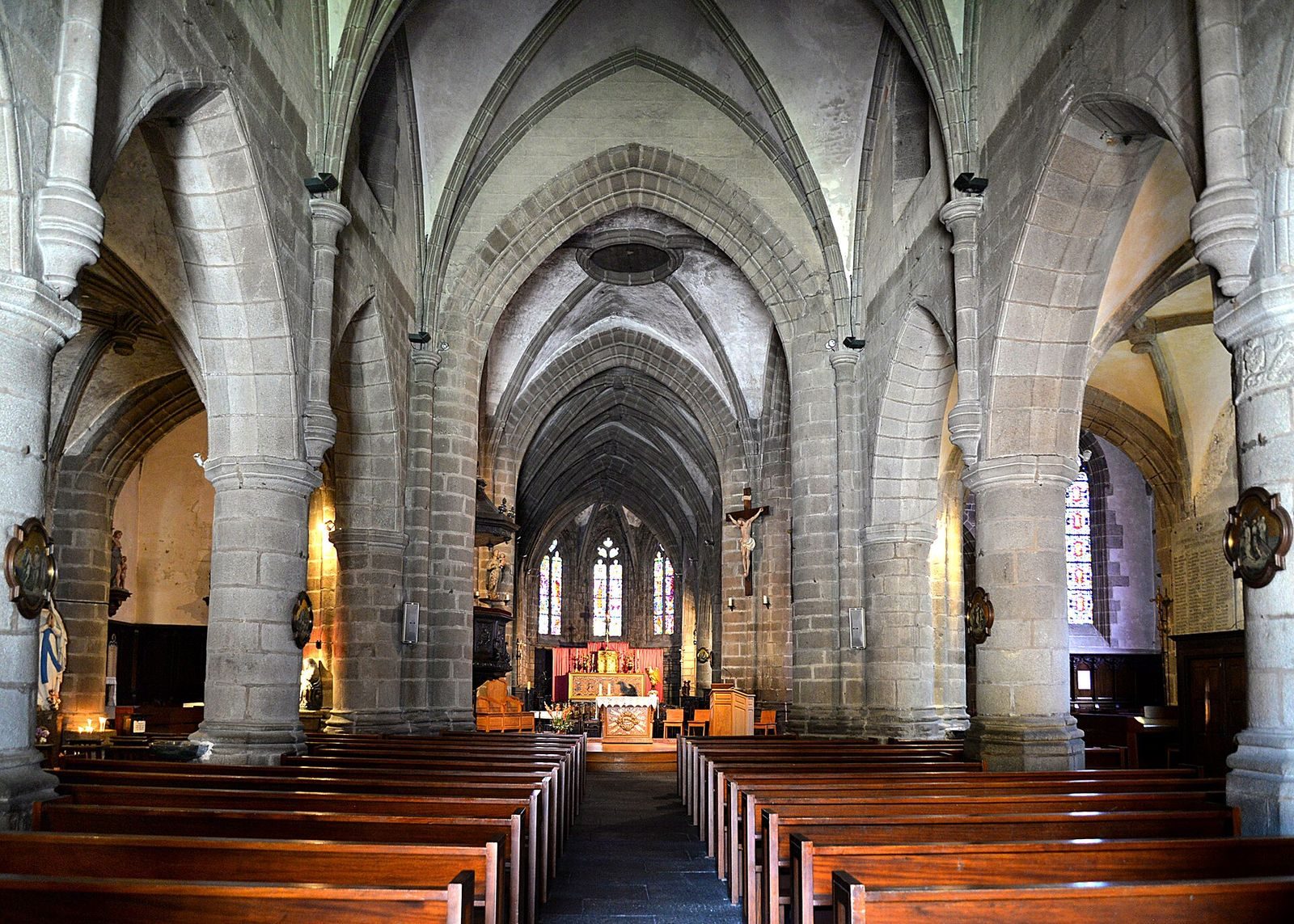
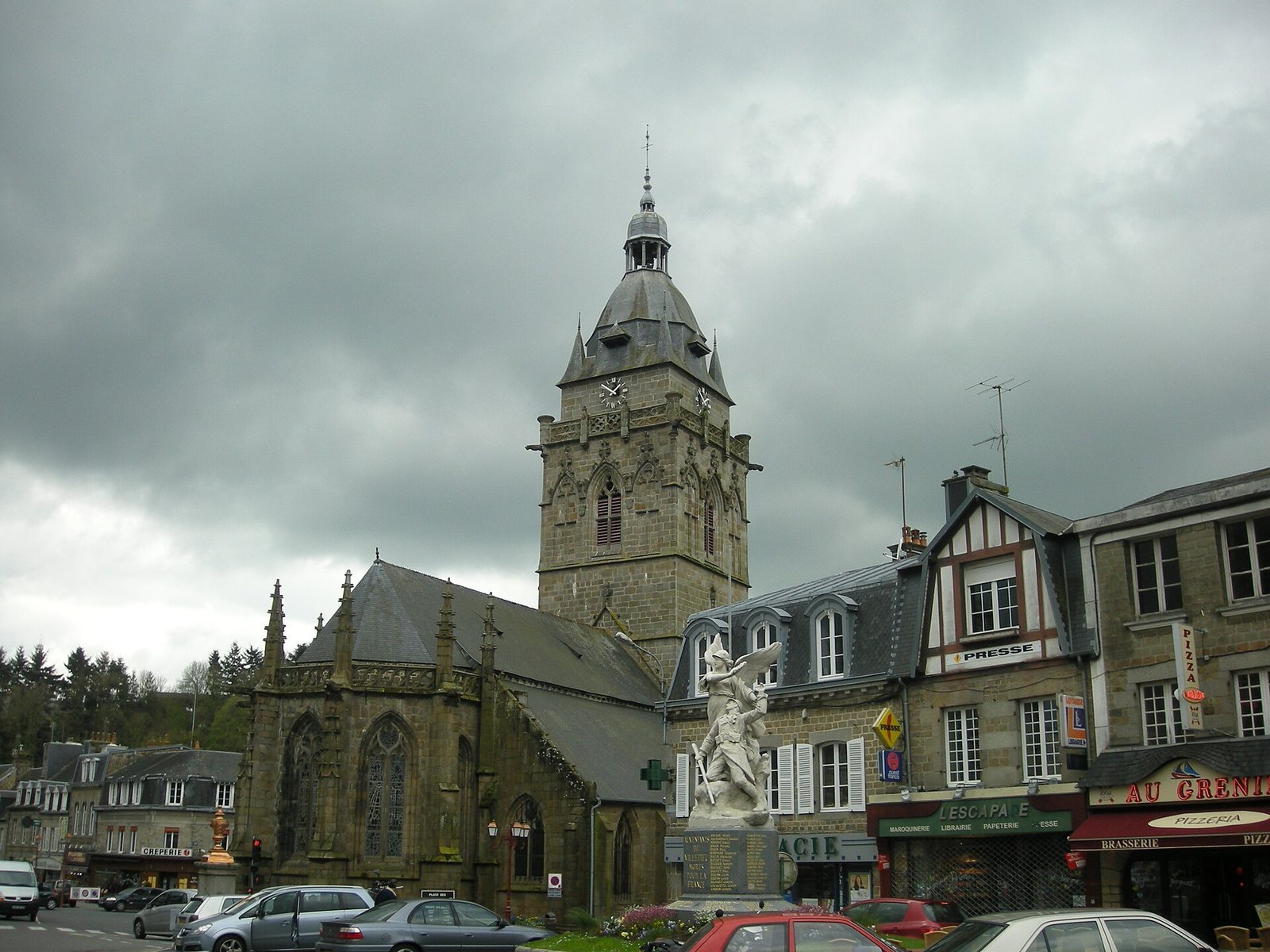
The church stands in the centre of Villedieu-les-Poêles, a delegated commune within the new commune of Villedieu-les-Poêles-Rouffigny in Manche, Normandy. It is oriented and built of granite on a cruciform plan, with side aisles ending in polygonal terminations. The choir and transept, the crosswise section intersecting the nave, date approximately from 1466 to 1490. The nave and bell tower belong to the seventeenth-century rebuilding and use the Flamboyant Gothic style, a late Gothic style known for elaborate tracery, pointed forms, and flame-like ornament.
Bell tower and upper structure
The square tower dates from the late fifteenth century, although its upper termination was added later. Each of its four faces has three ogival openings, meaning openings with pointed arches. The two lateral openings on each face are blind. The openings are topped by finials, decorative ornaments placed at the tops of structures, and contain cross-shaped mullions, the vertical elements dividing an opening. Above them, an openwork balustrade, a parapet formed by small supporting posts, completes the upper part, with its corners softened by columns.
Interior furnishings and music
Statues and liturgical furnishings
The church contains a Pietà, a representation of the Virgin Mary mourning over the dead Christ, together with statues of Saint Emerentiana, Saint Anne with the Virgin, Saint Célerin or Saint Céneri, and Saint Venice. Its furnishings also include a tabernacle, the receptacle in which consecrated Eucharistic elements are reserved, and a painting of Saint Hubert, bishop, with the stag.
Gallery organ
The two-part gallery-organ case is surmounted by musician angels and fire pots. The joiner Jean-François Le Héricé made it in 1830, and it is protected as a historic movable object. The organ’s instrumental portion was made by the organ builder Guérin in 1831. Jean-Loup Boisseau and Bertrand Cattiaux completely restored and supplemented it in 1987. It is a French classical organ with three keyboards and a pedalboard, comprising thirty stops, each stop being a set of pipes producing a particular tone.
In the early twenty-first century, the instrument was expanded with a nasard, tierce, grosse tierce, and sixteen-foot bourdon on the Grand Organ keyboard, as well as an oboe and a chamade trumpet on the Swell keyboard. The nasard and tierce are mutation stops, the bourdon is a covered flute stop, and the chamade trumpet is a reed stop whose pipes project horizontally.