Fosseuse Château: A Historic Noble Estate in France


Site at a Glance
- Rating
- 4.4
- Popularity
- Very Low
- Country
- France
- Primary era
- Early Modern
- External website
- Open
- Eras represented
- Early Modern
- Civilizations
- French
- Site type
- Domestic
- Remains
- Castle
On this page8 sections
History
Fosseuse Château is a sixteenth-century residence in France, now within Bornel in the Oise department. Built during the Renaissance period, it was initially owned by the Montmorency family, one of the leading noble houses of France. Its history is closely connected with the transformation of Baillet-sur-Esches into the seat of the Fosseux barony.
The Montmorency inheritance
The settlement was originally known as Baillet-sur-Esches. Its connection with the Montmorency family began when Rolland de Montmorency-Fosseux married Louise d’Orgemont, lady of Baillet-sur-Esches and Champs, in 1483. After the acquisition, the settlement was renamed in reference to the Montmorency barony of Fosseux in Artois.
Louise d’Orgemont came from the younger branch of the d’Orgemont family of Méry. The senior branch had held Chantilly and Montjay before joining the ducal Montmorency line. Both branches descended from the chancellor Pierre d’Orgemont. Rolland, for his part, descended from Jean II de Montmorency and his first wife, Jeanne de Fosseux of Nivelle.
The connection with the Artois barony changed in 1577. On 24 July that year, Pierre I de Montmorency-Fosseux, the grandson of Rolland and Louise, sold the lordship of Fosseux in Artois to Jean d’Hénin de Cuvilliers. Baillet was then gradually abandoned as the local name, while Fosseux, also written Fosseuse, became the enduring place-name. The settlement consequently served as the seat of the Fosseux barony.
From noble estate to marquisate
The château and estate left Montmorency ownership at the end of the seventeenth century, following the death of François de Montmorency-Fosseux in 1684. They were sold to Louise de Prie, widow of Marshal de La Mothe-Houdancourt. The Montmorency family nevertheless retained the title of Baron of Fosseux.
After Louise de Prie’s death in 1709, the estate passed to Philippe Thomé, a councillor of the Parliament of Paris. He secured the elevation of Fosseuse and Bornel into the Thomé marquisate, a hereditary noble title. His son René Thomé, born in 1732, later used the title Marquis of Thomé.
In 1789, the lordship belonged to Jacques Louis Le Boulanger, a master of requests, a senior royal administrative and judicial official. He had become president of the Chamber of Accounts in 1770, an institution responsible for supervising royal finances. As lord of the Fosseuse barony, he was summoned to take part in the election of the nobility’s deputies to the Estates-General, the representative assembly called by the French monarchy that year, in the bailiwick of Beaumont.
The Kergorlay period and later protection
Count Florian de Kergorlay bought the château and estate from the Le Boulanger family in 1807. He was elected deputy for Oise in 1815, 1820, and 1822. In 1823, he became a hereditary Peer of France, a member of the kingdom’s high-ranking peerage, through a majorat based on the Fosseuse estate. A majorat was property legally attached to a title to preserve its hereditary financial basis. Kergorlay also served as a general councillor and presided over the Oise general council during two periods between 1824 and 1828.
The Kergorlay family held the estate for just over a century. Florian was followed by his son Louis-Gabriel-César de Kergorlay, deputy for Oise from 1871 to 1876 and a close friend of Alexis de Tocqueville. The next owner was Louis-Gabriel-César’s son, Geoffroy de Kergorlay, who lived from 1854 to 1903.
Geoffroy’s widow, Jeanne Donon, inherited the estate and later remarried Count Xavier de Florian. He outlived her and inherited the château, whose heirs sold it in 1933. After the resale, Fosseuse Château was progressively restored and became a guesthouse. It has been listed as a historic monument since 27 July 1992.
Remains
Building and grounds
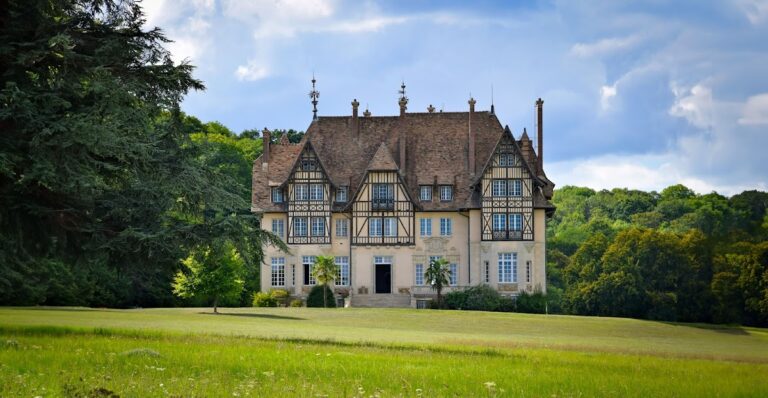
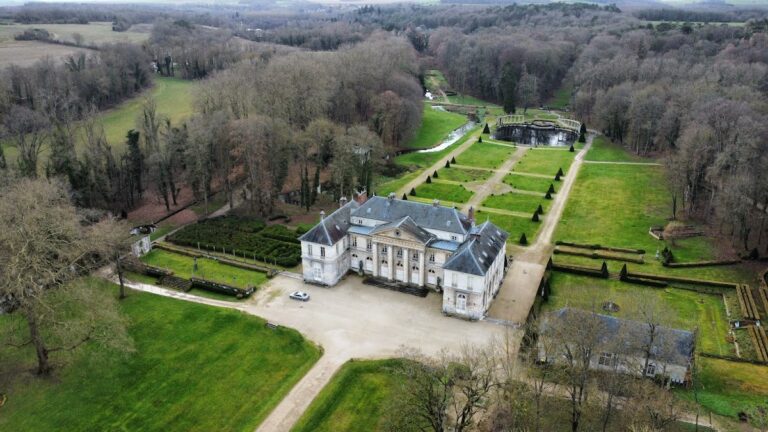
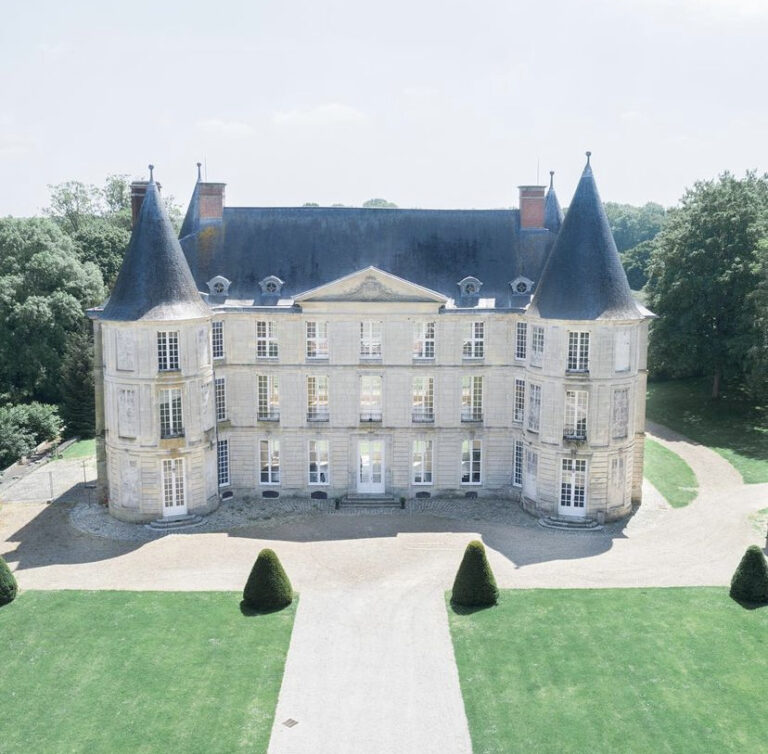
Fosseuse Château is built of brick and stone and rises two storeys above a relatively high basement. A tall roof covered in slate crowns the building, giving the structure a strongly vertical profile. The château stands within an English-style landscaped park near a body of water.
Tower and pavilion
The building has an asymmetrical arrangement. A tower extends from one end, while a square-plan pavilion projects from the other. These attached elements frame the main residence and form the principal surviving external features described for the château.
Landscaped park
The château is set in an English-style park beside a body of water. The landscaped grounds form part of the estate’s surviving physical setting and place the brick-and-stone residence within a designed rural landscape.
Nearby sites