Côte du Libéra Covered Passage: A Neolithic Burial Monument in France
Site at a Glance
- Popularity
- Very Low
- Country
- France
- Primary era
- Stone Age
- Eras represented
- Stone Age
- Civilizations
- Unclassified
- Site type
- Burial
- Remains
- Tomb
On this page8 sections
History
The Côte du Libéra Covered Passage is a Neolithic burial monument in France, formed as a long covered gallery. The Neolithic was a prehistoric period associated in much of Europe with farming and polished stone tools.
Discovery and excavation
Quarrying in limestone uncovered the tomb in February 1884, and a local commission excavated it immediately. The commission included Chouquet, mayor of the commune; Barret, parish priest of Amblainville; and Grimot, parish priest of L’Isle-Adam and the commission’s vice-president. The excavation found 180 human skulls belonging to men, women, and children.
Damage and protection
Road widening destroyed the antechamber in 1901. On 25 January 1963, the monument received classification as a French historic monument, a formal heritage-protection status. The regional archaeology service restored it in 1970.
Remains
The tomb is a long gallery, partly cut into the limestone hillside and partly formed from upright stone slabs, masonry, and roof slabs.
Setting and layout
At an elevation of 90 metres, the passage lies on a hillside along the Sausseron’s east bank, about 350 metres from the river. It follows the natural slope on an east-southeast to west-northwest axis, with the entrance at the west-northwest end. The gallery is about 12 metres long and 1.75 to 2 metres wide. Roughly two-thirds of it was cut into the limestone slope, like a tomb excavated into bedrock.
Walls and roofing
Limestone slabs set upright form the side walls, standing between 0.65 and 1.80 metres high. Dry-stone masonry, made of stones fitted without mortar, was added above the slabs to reach the ceiling; it also forms the full wall in parts of the front and short stretches near the rear. At least one side slab extends from the floor to a ceiling slab. The entrance is 1.80 metres high. At the rear, quarrying destroyed the natural ceiling, which may have reached 2.50 metres. A covering slab remains over the rear third of the passage; it measures 2.90 metres long, 3 metres wide, and 0.55 metres thick. The front ceiling area was partly damaged or destroyed during the nineteenth-century investigation. Two upright slabs stand side by side against the bedrock at the rear, and small limestone slabs pave the floor.
Entrance
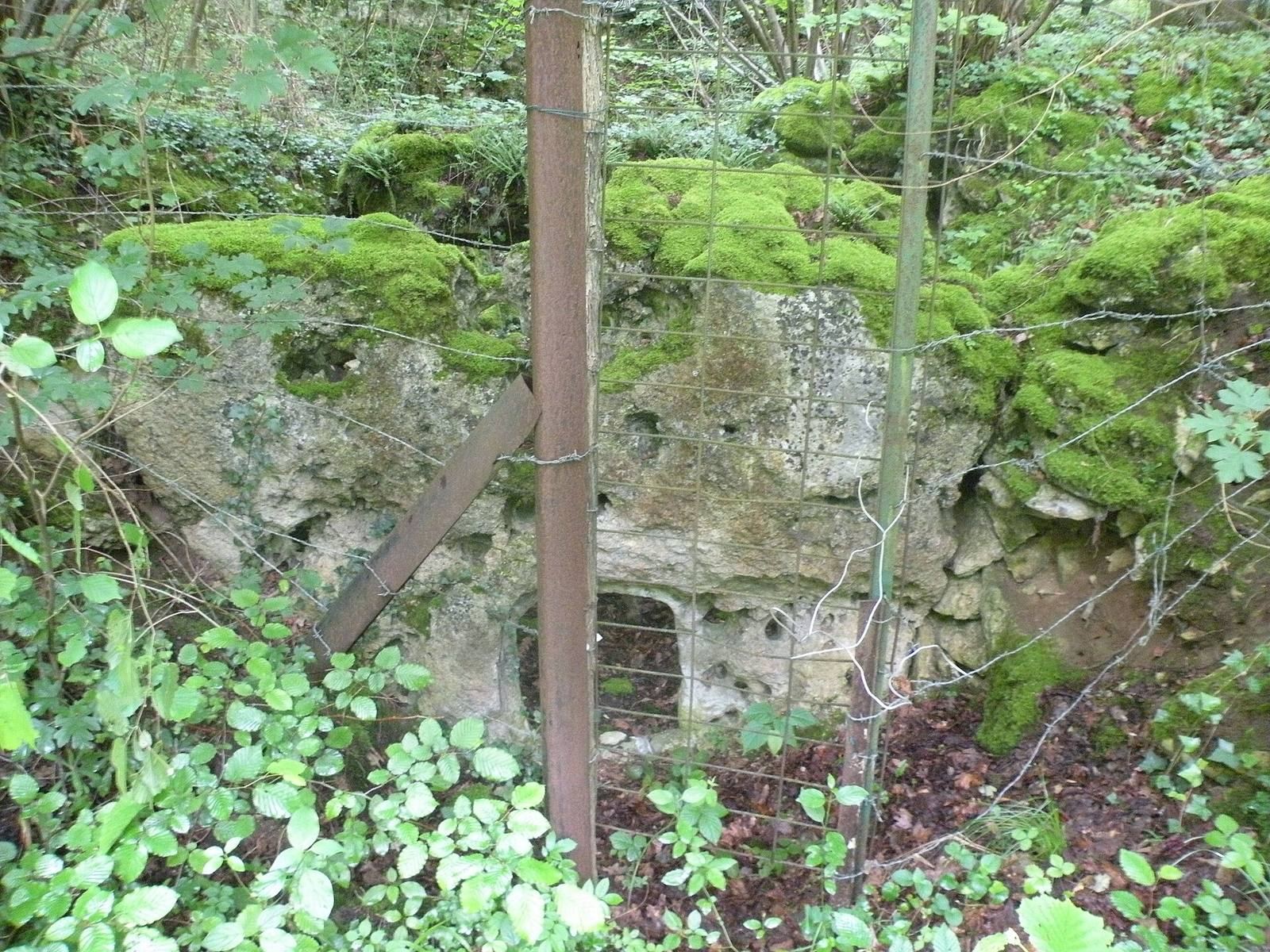
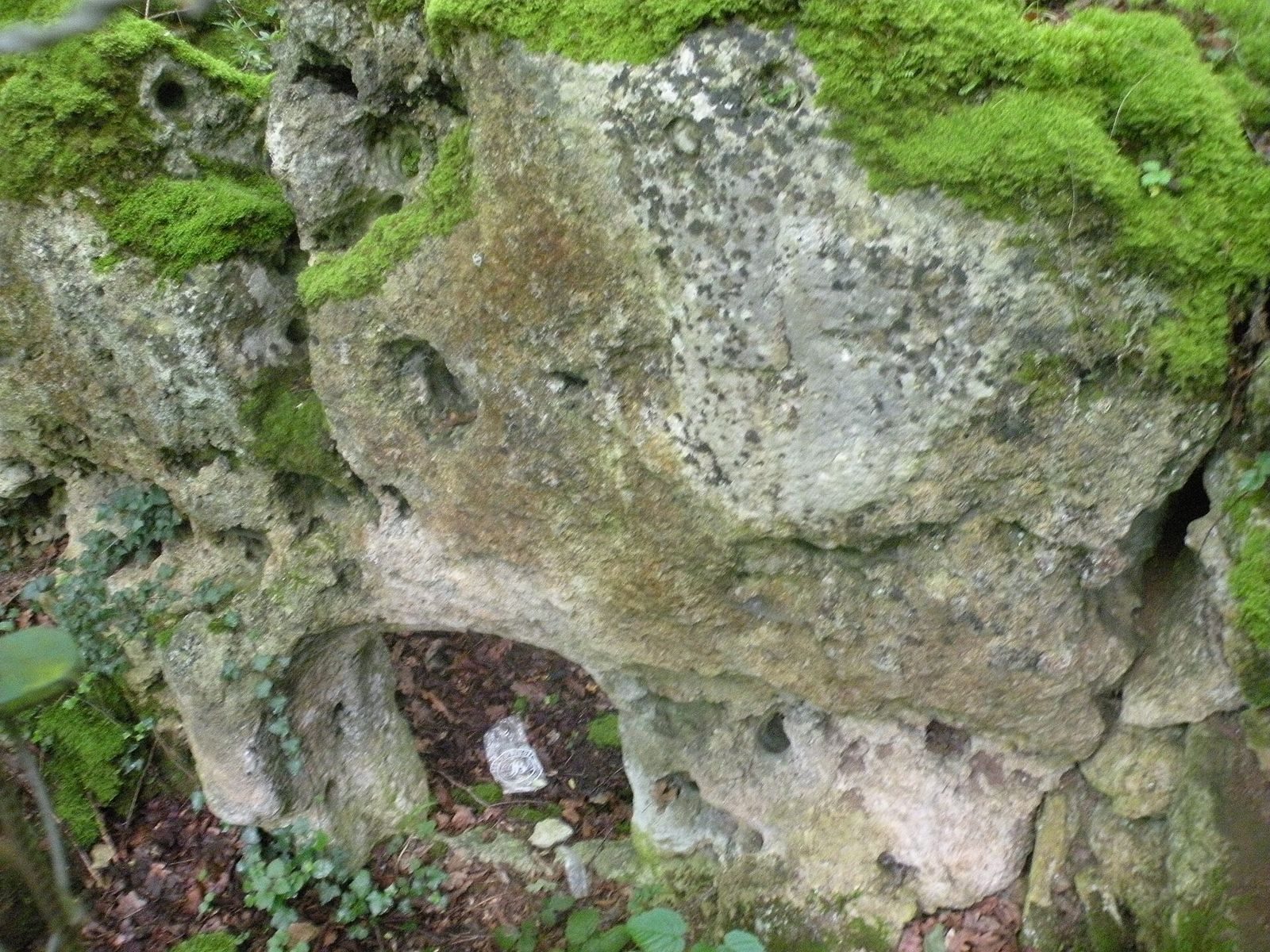
A stone slab closes the entrance. Its inner face is flat, while cavities and cup-shaped hollows mark the upper part of its outer face. Low and slightly off-centre, a roughly rectangular opening with rounded corners measures 0.56 metres high by 0.58 metres wide on the inner face. This arrangement is characteristic of dolmens, prehistoric tombs built from large stones, associated with the Seine-Oise-Marne culture, a prehistoric culture of the Seine, Oise, and Marne region. The entrance plug was in place during the 1884 excavation. A hole in a raised area on the slab’s left side probably held the end of a stick used to secure it.
Excavated objects
Grave goods included flint tool fragments, blades, scrapers and other tools, as well as a bone awl. A deer antler tine may have served as a pick. Excavators also recovered coarse pottery sherds decorated with impressions made by a thumbnail.