Château de Roquedols: A Historic Château in France



Site at a Glance
- Rating
- 4.6
- Popularity
- Very Low
- Country
- France
- Primary era
- Early Modern
- Eras represented
- Medieval, Early Modern
- Civilizations
- French
- Site type
- Domestic
- Remains
- Castle
On this page10 sections
History
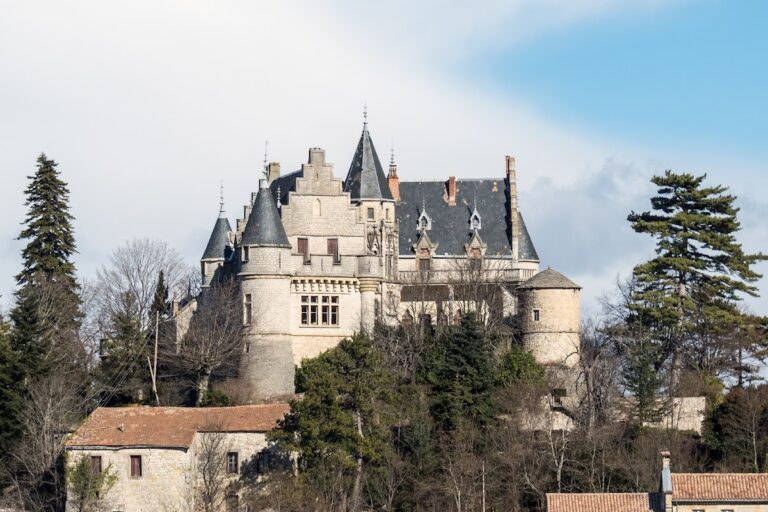
Château de Roquedols is a historic château in France, located near Meyrueis in Lozère, in the former territory of Gévaudan. Its site lies about two kilometres south of Meyrueis in the Béthuzon valley. The earliest recorded place-names, Repedolsa and Rocadels, refer to soft or tender rock. A fortified house probably occupied the site in the fourteenth century, while the present château was built or substantially developed before 1534.
Medieval estate and the Pagès family
The earliest surviving archive, from 1300, refers to a mas, a traditional rural estate or farmstead, at Roquedols. In 1329, Pierre Pagès, from a prominent Aquitanian family, acquired all the cens, or feudal land rents, belonging to the Roquedols domain. The estate formed part of the barony of Meyrueis, a territorial lordship held by a baron. Later generations of the Pagès family repeatedly served Meyrueis as consuls or viguiers, local judicial or administrative officials.
A date of 1534 is carved into the entrance-door lintel. The first written document to describe the property explicitly as a château dates from 1607. Claims made during the nineteenth century that Roquedols retained Romanesque towers and walls, or that a twelfth-century troubadour song placed a courtly romance there, were inventions by a nineteenth-century author rather than reliable evidence of the site’s medieval history.
Religion, lordship, and nineteenth-century ownership
Hérail de Pagès, lord of Pourcarès, became a Huguenot captain during the French Wars of Religion, the conflicts between Catholics and French Protestants, chiefly members of the Reformed tradition, during the sixteenth century. In 1604, Henri IV raised Roquedols to a barony in recognition of the Pagès Pourcarès family’s loyalty to his cause during those conflicts.
In 1715, the château passed to the Dupont de Bossuges family. During the nineteenth century, the Baron of Roquedols pursued a successful political career in the locality. After the last member of the Pagès line died in 1885, the barony was sold to Breuil, Dayre, and Jouve, while the château itself was acquired by the Dol family, industrialists from Marseille.
The three associated owners subjected the estate to intensive forestry exploitation, but the enterprise failed. After the property was seized, its land was resold to Madame Dol in 1893. Following her death, Roquedols passed to her grandson, Gabriel-Joseph-Auguste Dol. In 1933, he authorized the timber merchants Jaubert and Fabre to exploit the surrounding woodland for twenty-five years, with trees near the château excluded from the agreement.
State ownership and wartime use
The national forestry administration was offered the property in 1934. A decree of 1937 classified its 269 hectares as protected forest, a legally designated woodland whose conservation receives special priority. The sale completed in 1938 transferred the forest, château, and dependencies to the administration.
From 1939 to 1945, during the Second World War, Roquedols sheltered forestry services withdrawn from eastern France. The château also held deposits from several national museums, including the Musée Fabre of Montpellier. The Mona Lisa may have been kept there for part of the war, although this remains uncertain.
Forestry administration and heritage protection
After the war, the château became a holiday residence for senior forestry conservators and was entered on the inventory of sites in 1960. In 1973, the National Forestry Office entrusted the château and its immediate surroundings to Cévennes National Park, a protected mountain-area institution founded in 1970 to conserve the region’s natural and cultural heritage. Repairs followed under delegated management from the state property administration.
The commune of Meyrueis later became the owner, and the château housed an information centre for Cévennes National Park. Roquedols was registered as a French historic monument, a site protected under national heritage legislation, by order of 15 February 2012. It is listed in the Mérimée architectural-heritage database under reference PA48000015.
Remains
Fortified enclosure and principal buildings
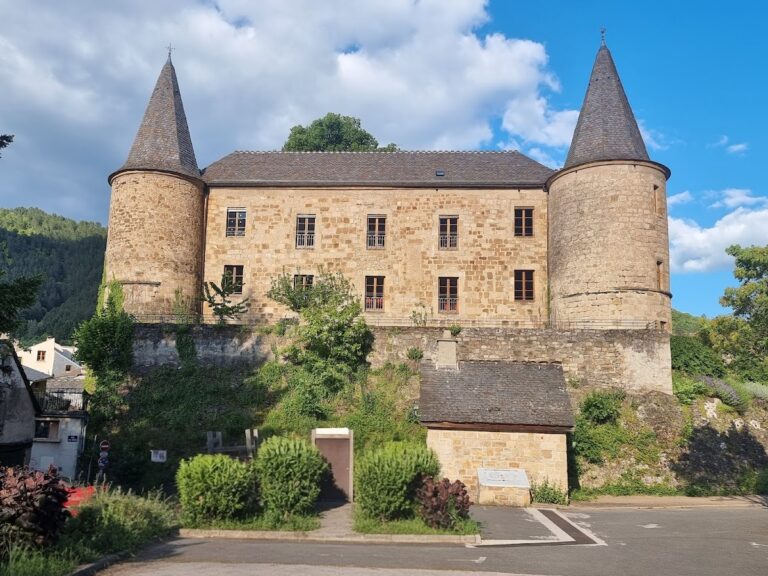
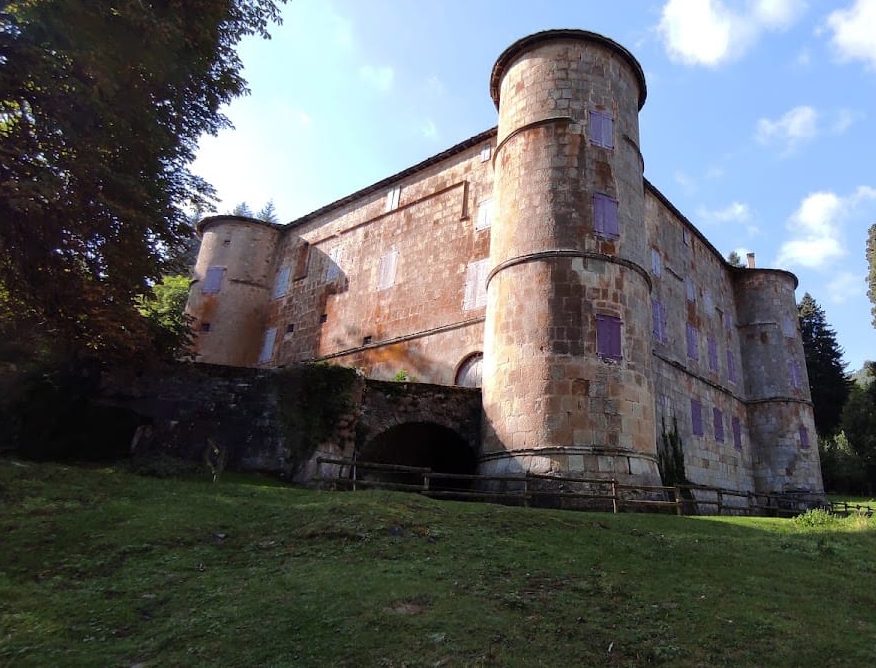
The château forms a roughly square quadrilateral, about 25 metres on each side. Two rectangular wings stand along the north and east sides at right angles, while two enclosing walls complete the interior courtyard. Four towers flank the enclosure, measuring between 6 and 8 metres in diameter. Three are truncated at roof level, and a smaller fourth tower occupies the south-east corner, where the enclosing walls meet. The north and east wings contain the principal accommodation.
The walls average about 80 centimetres thick and are built from dressed, coursed ochre sandstone. Regional slate covers the roof, whose framework is made from pine beams. On the south side, an ancillary wing runs along the courtyard wall and contains the former kitchens. The west façade wall includes the courtyard entrance, which is preceded by a rounded landing.
Interior and associated grounds
Rooms, circulation, and furnishings
The north façade contains two levels of vaulted rooms beneath the accommodation floor. These correspond to rooms on the southern side, which were built without basements. The lowest vaulted room served as a sheepfold until 1885. The former kitchen south of the main courtyard had previously been a stable, also until 1885, and retains a monumental fireplace. Around 1914, M. Dol replaced the earlier double-flight entrance staircase with the present horseshoe-shaped landing.
The interior contains rooms measuring approximately 7 by 11 by 8 metres, including a drawing room and dining room with exposed beams. A Renaissance-style stone staircase rises in two flights between the floors and has a sculpted coffered ceiling. Surviving furnishings include a late-sixteenth- or early-seventeenth-century table with columns and runners, cupboards from the seventeenth and eighteenth centuries, and an eighteenth-century side-opening buffet. Twelve nineteenth-century monumental paintings show landscapes and hunting scenes. The state-owned furniture was classified in 1997 and 2003.
Garden, woodland, and watercourse
A formal French garden extends north of the château. West of the entrance landing, the wooded grounds contain chestnut trees, Corsican laricio pines, larches, spruces, and an avenue of fir trees. A sequoia planted in 1876 rises to 45 metres and measures 8 metres in circumference. A dovecote stands near this wooded area.
Around 1839, the Pauchètes stream crossed the western lawn in front of the entrance landing through a small ravine. This stream, a tributary of the Béthuzon, now runs underground. An educational forest trail associated with the property includes ten interpretive stops and takes approximately twenty minutes to complete.