Château de Demptézieu: A Medieval Fortress in France


Site at a Glance
- Rating
- 4.4
- Popularity
- Very Low
- Country
- France
- Primary era
- Medieval
- Eras represented
- Medieval, Early Modern
- Civilizations
- French
- Site type
- Military
- Remains
- Castle
On this page8 sections
History
Château de Demptézieu is a medieval fortress in Saint-Savin, France, whose establishment appears to date from the eleventh century, although the building is also dated to the twelfth century. Its construction date therefore remains uncertain. The surviving complex reflects successive transformations, especially during the fifteenth and sixteenth centuries.
Early lordship
The earliest known châtelain, an official responsible for administering and defending a castle and its territory, was Hugues de Demptézieu, who held the office from 1075 to 1080. Medieval documents also recorded the place as Danthesieu. For a period, the land belonged to the abbots of Saint-Chef, also known as Saint Theudère.
Acts of 15 April and 1 May 1251, which used the names Dentesiaci and Dentesiaco, state that part of the rights over the castle was granted to Pierre de Savoie. A member of the ruling house of Savoy, Pierre held these rights from his father, Thomas I, and was the brother of Count Amédée IV of Savoy.
Between Dauphiné and Savoy
Demptézieu became involved in the conflict between the Dauphiné, a historic principality in southeastern France ruled by the Dauphin, and Savoy. Under the peace treaty concluded on 10 June 1314 between Dauphin Jean II of Viennois and Count Amédée V of Savoy, Savoy surrendered Demptézieu, along with Montrevel in Bresse and Meyssieu in the Lyonnais, to the Dauphin.
A testament dated 29 July 1343 by Dauphin Humbert II of Viennois, the last independent Dauphin before the territory passed to the French crown, mentions Denteysiaci as belonging to Guichard de la Cote.
Later ownership and preservation
During the second half of the fifteenth century, the castle and lordship passed to a branch of the Alleman family. When its last descendant died without issue, the property passed around 1686 to his nephew Alexandre Vallin. Alexandre Vallin’s grandson, Laurent Marguerite de Vallin, became the last lord of Demptézieu. During the French Revolutionary period, he appears already to have sold part of his lordship to the Comte de Menon.
The building and estate became communal property in 1904, and the château is now privately owned. Its façades and roofs, together with the spiral staircase inside the fifteenth-century hexagonal tower, were listed as historic monuments by decree of 15 September 1954. Restoration was under way in 2019.
Remains
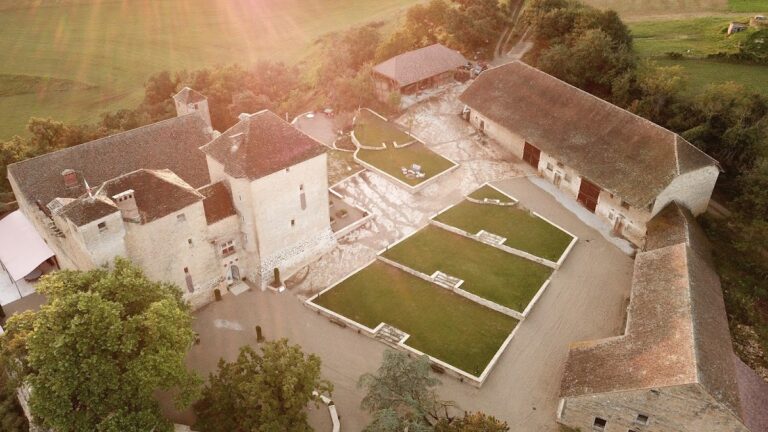
The surviving remains consist of one wing and a tower, only a small part of the former fortress. The site lies in the hamlet of Demptézieu within the commune of Saint-Savin. The earlier stronghold was said to have included about fifteen towers joined by a curtain wall, a continuous defensive wall, approximately 1.30 metres thick and 800 metres in perimeter. A wide, deep ditch defended its southern and eastern sides.
Surviving residential and defensive structures
South-eastern tower
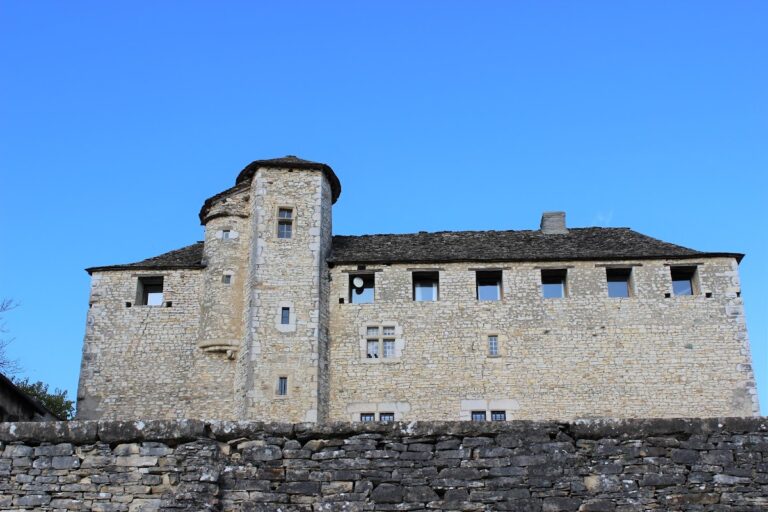
The remaining tower stands at the south-eastern corner of the former fortress and may have served as the keep, the principal fortified tower of a medieval castle, although that identification remains uncertain. The fifteenth-century remodelling gave the complex the form of a rectangular residential building with a massive circular keep at one corner. The tower contains finely formed arrow slits, narrow openings for archers, and a spiral staircase built into the thickness of its walls.
Sixteenth-century turret
A sixteenth-century hexagonal turret survives as another element of the remodelled château. Its finely crafted mullioned windows, divided by vertical stone members, provide the building with richly worked architectural detail. Together with the remaining wing and tower, it represents the later form of a fortress whose original extent was much greater.
Nearby sites