Schloss Ernich: A Neobaroque Manor House and Diplomatic Residence in Germany


Site at a Glance
- Rating
- 4.4
- Popularity
- Very Low
- Country
- Germany
- Primary era
- Modern
- Eras represented
- Modern
- Civilizations
- French, German
- Site type
- Domestic
- Remains
- Elite Residence
On this page10 sections
History
Schloss Ernich is a neobaroque manor house in Remagen, Germany, built between 1906 and 1908 for Cologne industrialist Arnold von Guilleaume and his wife, Elisabeth “Ella” von Guilleaume, née Deichmann. Designed by Ernst von Ihne, a German architect and court master builder, it became the couple’s country and summer residence and later played a role in the occupation and diplomatic history of postwar Germany.
Construction and the Guilleaume residence
Construction began on 12 August 1906, when the first spade was turned. The topping-out ceremony followed in 1907, and the Guilleaume family moved into the completed property on 18 April 1908. The estate took its name from the field known as “Im Ernich.” Until 1930, Arnold and Ella von Guilleaume used the house as a country and summer residence.
The grounds continued to develop after the main house was completed. A coachman’s dwelling, a bowling alley, and a machine house were added, while a large exterior staircase was built in 1910. In 1933–34, a new kitchen wing supported the estate’s conversion to a hotel restaurant.
Occupation, hotel use, and wartime functions
After the First World War, American occupation forces took over Schloss Ernich for two years from 1919 and housed 30 soldiers there. In 1933–34, the Richardsen family established a hotel restaurant at the property. It became particularly popular with Cologne society, and Adolf Hitler reportedly stayed there several times during this period, including on 12 April 1937. The hotel operation closed during the Second World War, and the estate served as a military hospital until 1945.
On 5 March 1945, near the end of the war, American occupation troops took the property. It was evacuated on 13 March, and its previous occupants were relocated to Unkelbach. Remagen families whose homes had been destroyed were subsequently accommodated at the estate. British occupation authorities later confiscated the property and removed its furniture and 30 beds before withdrawing.
French occupation and diplomatic residence
On 15 July 1945, the commander-in-chief of the advancing French occupation forces established a holiday home for Parisian children and a school for children of the occupation forces at Schloss Ernich. From October 1947, members of the Guilleaume family were again able to occupy several rooms. After a temporary vacancy, the International Film Union used the property from 8 January 1949 as a guesthouse for temporarily contracted employees.
In autumn 1949, the French Republic established the residence of its High Commissioner at Schloss Ernich, raising the French flag there on 7 September. André François-Poncet held the office. As High Commissioner, he represented France within the Allied occupation system, through which the Western occupying powers exercised specified supervisory rights in West Germany before the restoration of German sovereignty. Although his official seat was in Bad Godesberg, François-Poncet maintained close relations with Remagen.
During his first state visit to Germany, French Foreign Minister Robert Schuman stayed at Schloss Ernich from 13 January 1950. On 15 January, he negotiated there with Federal Chancellor Konrad Adenauer, the first Federal Chancellor of West Germany, on the sovereignty of occupied Germany. Their meeting took place during the postwar process that led toward the restoration of German sovereignty.
Embassy residence and later ownership
After German sovereignty was achieved in 1955 and the Allied High Commission was dissolved, the French High Commission became a regular embassy. Released from confiscation and rented by France, Schloss Ernich then served as the residence of the French ambassador to the Federal Republic of Germany. Some of its valuable furnishings were replaced, and later French state guests also stayed there.
The Guilleaume family had retained ownership until the property passed into French ownership in 1959. When the French Embassy moved from Bonn to Berlin in 1999, the former residence stood empty but remained the property of the French Republic. A proposal by Federal Chancellor Helmut Kohl to establish a German-French cultural center there did not succeed.
German film producer Ulrich Felsberg bought Schloss Ernich from the French Finance Ministry in December 2006. Renovation began in 2007 and was largely completed by 2011. Plans to convert the estate into a hotel became public in 2018. The house and its park are protected together as a cultural monument under heritage law.
Remains
Schloss Ernich stands at about 134 metres above sea level, roughly 85 metres above the Rhine, on plateau-like ground that descends from west to east. The estate lies between central Remagen and Oberwinter, above the B9 federal highway and the Cologne–Koblenz railway line on the left bank of the Rhine, opposite Unkel. Its outlook faces southeast toward the Rhine.
Main house
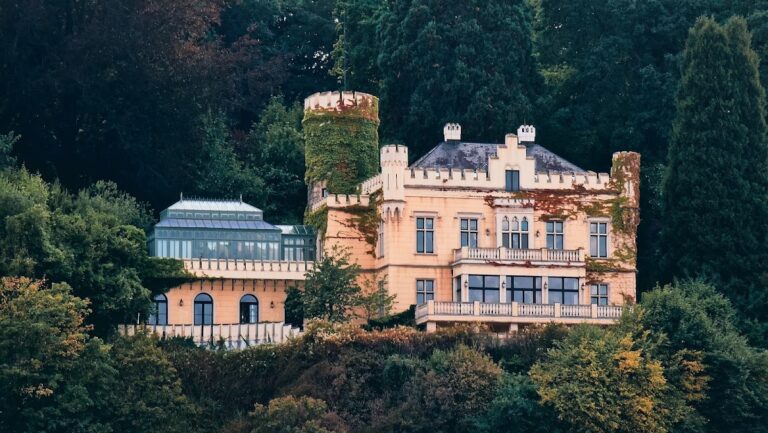
The principal building is a rectangular structure of two to three storeys with short side wings and a mansard roof, a roof with two slopes on each side, the lower slope steeper than the upper one. A roof turret ornaments the building. The representative garden facade faces the Rhine and contains eleven bays. Three bays form a projecting central avant-corps, or projecting section of a facade. Its single-storey entrance portal supports a balcony and is crowned by a triangular pediment, the gabled element of a classical composition.
The side wings have contrasting facades. The western wing contains two semicircular projections shaped like terraces, while the eastern wing has one continuous projection. These elements, together with the mansard roof and classical central composition, form the house’s early twentieth-century neobaroque character.
Gardens and estate buildings
Terraced garden
Southeast of the house, the garden is arranged in three successive stepped terraces. It extends toward the edge of the steep slope descending to the Rhine. An observation pavilion stands at the northeastern edge of the estate, while a tennis court occupies its southern edge.
Service and occupation-period structures
The estate includes the later coachman’s dwelling, bowling alley, and machine house. The large exterior staircase dates from 1910, and the kitchen wing constructed in 1933–34 was added for the hotel restaurant. During the period when Schloss Ernich served as the French High Commissioner’s residence, barracks for the French gendarmerie were built at the beginning of the access road. The gendarmerie was a police force organized along military lines and served policing and security functions during the occupation period.
Nearby sites