Château de Puymartin: A Medieval Fortress in France



Site at a Glance
- Rating
- 4.4
- Popularity
- Medium
- Country
- France
- Primary era
- Medieval
- External website
- Open
- Eras represented
- Medieval, Early Modern, Modern
- Civilizations
- French
- Site type
- Military
- Remains
- Castle
On this page9 sections
History
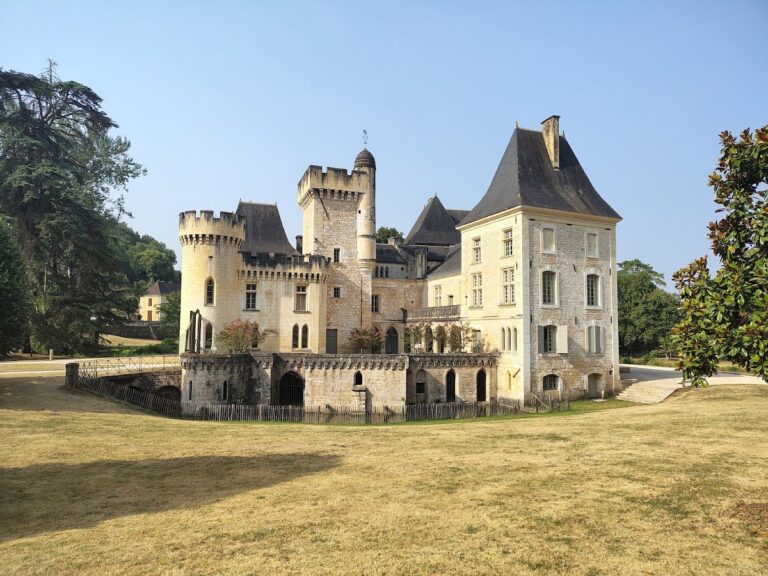
Château de Puymartin is a medieval fortified château in France, near Sarlat-la-Canéda in the commune of Marquay. Construction began in 1270, establishing a thirteenth-century fortress whose position secured the roads northwest of Sarlat. One tradition attributes its original construction to the abbots of Sarlat, while around 1270 the property passed into the possession of the Serviens family.
Fortress and English occupation
Puymartin stood in a contested region during the Hundred Years’ War, the prolonged conflict between the English and French crowns fought mainly in France from the fourteenth to the fifteenth century. The château became English-held in 1357 or 1358. After a peace settlement, the consuls of Sarlat-la-Canéda bought the estate back from the English.
Repeated sieges and assaults had left the fortress severely damaged. Its gates and drawbridges had been torn out, while its roofs were destroyed and burned. The property was then abandoned for a period, leaving the medieval stronghold in a deteriorated condition.
Rebuilding and religious conflict
Radulphe de Saint-Clar bought back the abandoned estate in 1450. He rebuilt and enlarged the château, adding external architectural elements and refurbishing its interior rooms. These works established a later phase in the building’s development after the destruction associated with the Hundred Years’ War.
In the sixteenth century, Raymond de Saint-Clar used Puymartin as a headquarters during the French Wars of Religion, conflicts between Catholics and Protestants. Holding the title “Captain of Puymartin,” he drove Huguenot forces, French Protestants associated largely with the Reformed tradition, from Sarlat-la-Canéda. He was also described as a leader of the Catholics of the Périgord Noir.
Ownership, decline, and restoration
During the seventeenth century, Jean de Saint-Clar and his sister Suzanne disputed ownership of the château for approximately forty years. Suzanne ultimately became its owner. Through her marriage to Claude de Lapleynie, the estate passed to their descendants, and under Louis XIV it was held by the Lapleynie family.
The château was abandoned during the eighteenth century. During the French Revolution, its owner François Roffignac de Carbonnier de Marzac was imprisoned, and the building fell into decline. In the nineteenth century, Marc Roffignac de Carbonnier de Marzac, Marquis de Marzac and an ancestor of the present owning family, restored the château. By about 1890, he had restored and partly remodelled it in a Neo-Gothic style, financing the work with his wife’s dowry.
The Marquis’s only daughter married Count Jacques de Montbron in 1920. After the death of Count Henri de Chérade de Montbron on 31 July 2002, the château was inherited by his wife and children in 2003. Château de Puymartin entered the French register of historic monuments by order of 6 December 1948. A seventeenth-century panelled and painted chamber was classified as a historic monument, and the studiolo was classified in its entirety, by order of 1 March 1977.
The White Lady tradition
A local legend identifies Thérèse de Saint-Clar, a sixteenth-century chatelaine, as the “White Lady.” According to the story, her husband caught her with her lover and imprisoned her for the final sixteen years of her life in a small room in the north tower. After her death, her body was walled in there. The legend says that her ghost appears around midnight on the staircase and wall-walk before entering the room.
Remains
Fortifications and entrance
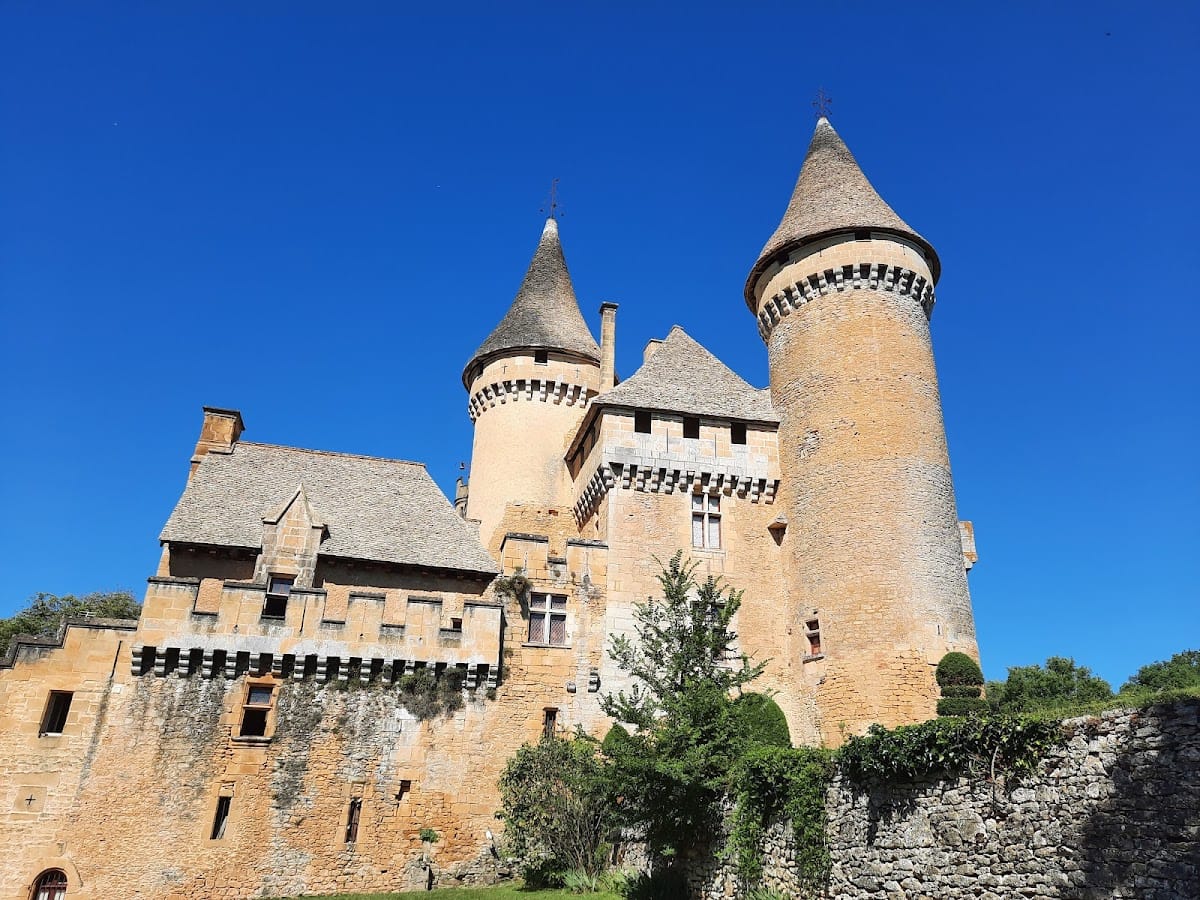
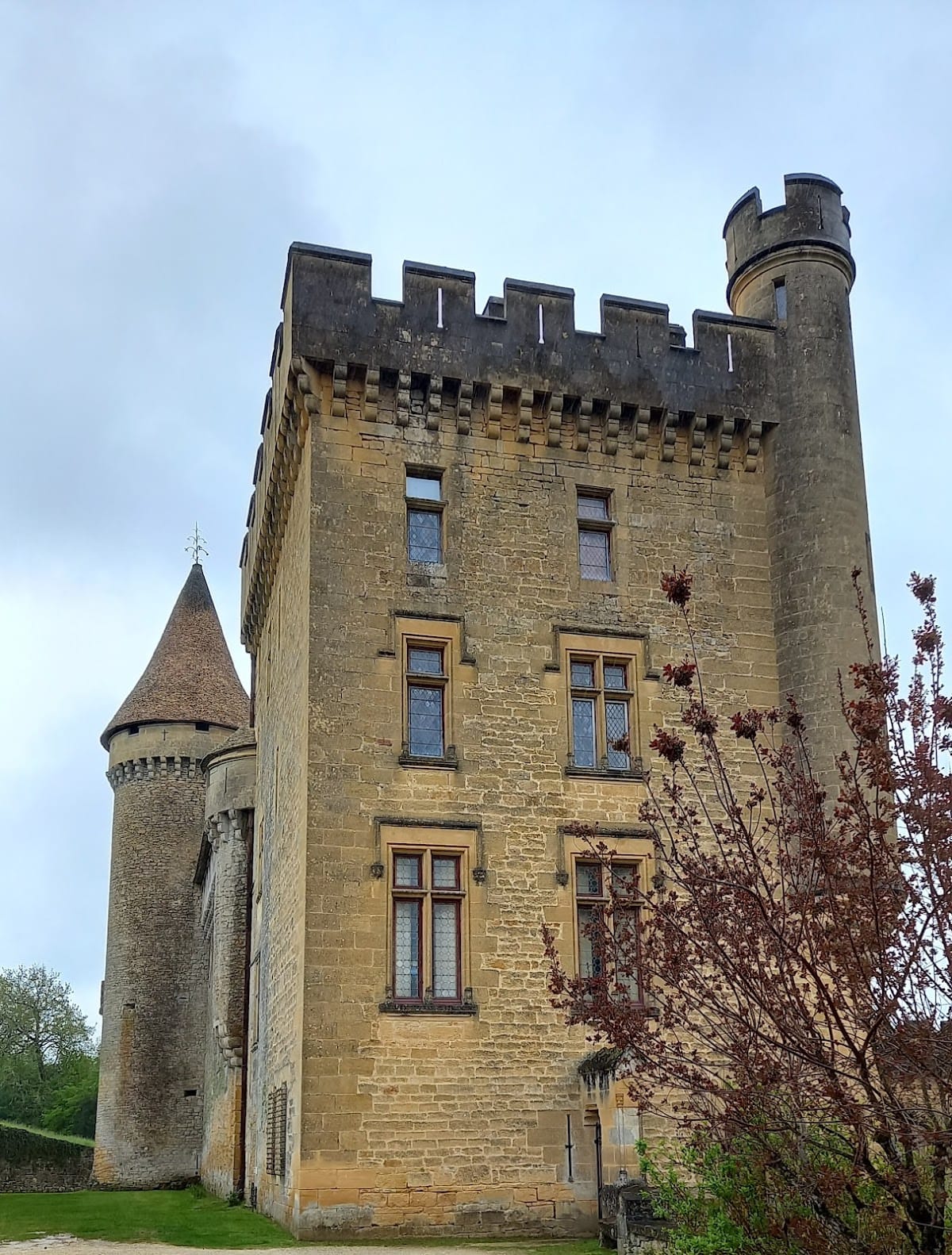
Château de Puymartin stands on a steep hill. Its buildings are connected by towers and protected by curtain walls, defensive walls linking towers or other strongpoints. A wall-walk, a protected passage along a defensive wall used for movement and surveillance, forms part of this fortified arrangement.
Access is provided by a gatehouse consisting of two buildings. One has been extensively restored, while the other was completed during the Renaissance and is described as an example of fifteenth-century architecture. Together, the gatehouse buildings form the principal entrance within the château’s defensive layout.
Interior rooms and furnishings
The interiors contain seventeenth-century furniture and paintings, wood panelling, fireplaces, and ceiling beams made in the French manner. The principal reception room contains Aubusson tapestries, woven wall hangings traditionally produced in the Aubusson region of France.
The small chamber in the north tower is associated with the White Lady legend. The staircase and wall-walk are also linked to the story, which places the reported appearances of Thérèse de Saint-Clar’s ghost in these parts of the château.
The studiolo
On the second floor, a rare studiolo, or small private study, occupies a separate room. Described as unique in the Périgord, it has walls entirely covered by eight wooden panels painted in grisaille, a monochrome technique using shades of grey to imitate sculpture or relief.
The panels depict mythological scenes and figures associated with the Halcyons, Argos, Bellerophon, Oeneus, Perseus, Meleager, Memnon, and Clytie. Their imagery derives from classical Greek and Roman traditions. Philippe Lemaire of Laon produced the decoration in 1679 while working as a painter at Puymartin.
Lemaire copied the eight scenes almost exactly from engravings in the 1655 collection Tableau du temple des Muses tirez du cabinet de feu M. Faverau. Pierre Brébiette made the drawings, and Corneille Bloemaert produced the engravings. The decoration was created when Henry-Claude de Lapleynie, Abbot of Puymartin, had inherited the estate from his brother, Captain Henry de Lapleynie.
It remains uncertain which brother devised the studiolo’s iconographic programme. Its meaning may have concerned virtues expected of a ruler, or religious lessons about divine assistance, the consequences of violating sacred or moral laws, and the ruin brought by destructive passions.