Castle Malevirade: A Defensive Castle in France

Site at a Glance
- Rating
- 4.4
- Popularity
- Very Low
- Country
- France
- Primary era
- Early Modern
- External website
- Open
- Eras represented
- Medieval, Early Modern
- Civilizations
- Duchy of Aquitaine, French
- Site type
- Military
- Remains
- Castle
On this page8 sections
History
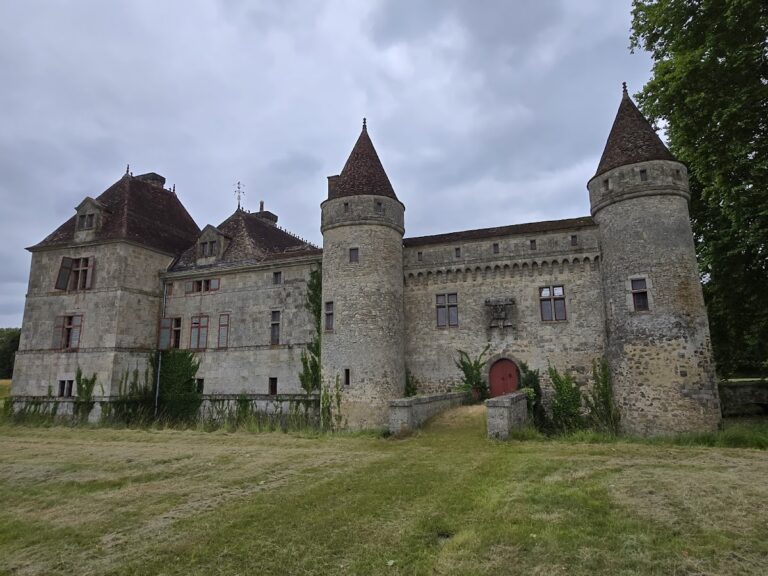
Castle Malevirade, also called Malvirade, is a historic defensive site in Malvirade, France. It formed part of a defensive line protecting the eastern frontier of Aquitaine, including the fortified town of Casteljaloux, and developed from a medieval surveillance installation into a castle between the fifteenth and sixteenth centuries.
The Aquitanian and English frontier
Around 1136, after inheriting the Duchy of Aquitaine, Eleanor of Aquitaine is said to have ordered the construction of a rectangular, multi-storey tower at Malevirade. The structure reused older Gallo-Roman remains, dating from the period when Roman institutions and culture were established in Gaul. Designed for surveillance and first-line defence, it helped guard the eastern approaches to Aquitaine.
Following Eleanor’s marriage to the future Henry II of England, the site continued its defensive role under the English Duchy of Guyenne, the historical name for southwestern France under English rule. This function lasted until the end of the Hundred Years’ War in 1453, a series of conflicts between the English and French crowns.
Transformation into a castle
After the Battle of Castillon in 1453, Pierre de Sacriste, a vassal of the powerful Albret family, took possession of Malevirade and is identified as its first occupant. The Sacriste family began transforming the earlier defensive installation into a castle during the last quarter of the fifteenth century. The work continued into the sixteenth century, during the period associated with the House of Albret, the Gascon dynasty that later produced Henry IV of France.
Malevirade still retained defensive features during the Wars of Religion, the sixteenth-century conflicts between Catholics and Protestants in France. The military importance of nearby Casteljaloux contributed to the need for additional defensive works. In 1577, Bernard de Brocas was killed near Malevirade during a battle fought by the Protestant Reformers of Casteljaloux under Sieur de la Vachonnière. Vachonnière also died in the engagement, while his 25-year-old lieutenant, d’Aubigné, was seriously wounded.
The Sacriste family and the name
Members of the Sacriste family continued to hold the titles of lords of Malvirade, Le Gréset, and Samazan during the seventeenth century. Alexandre and Pierre Sacriste attended the 1642 wedding of Rose de Brocas and Benjamin de Feytis, and Jeanne Sacriste of Malvirade married Nicolas de Brocas in 1644.
The meaning and date of the name Malevirade or Malvirade remain uncertain. It may combine mala, also found as male in Old French and meaning “bad,” with the Old Occitan term virada, referring to a bend or turning in a road. The intended meaning has not been established. The castle was partially listed as a historic monument by decree on 28 December 1995.
Remains
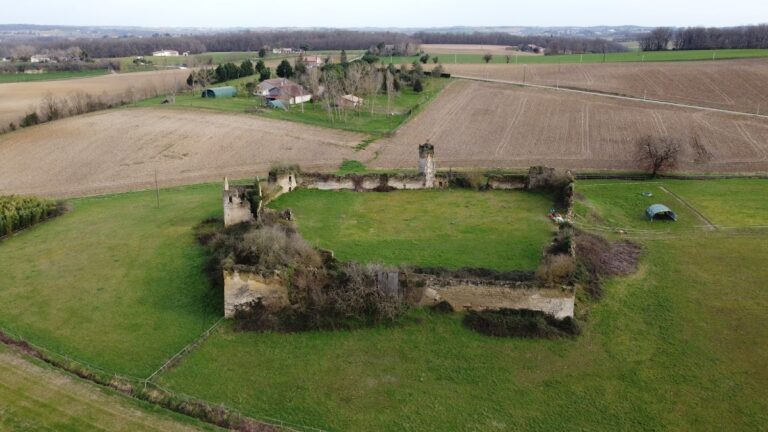
The surviving site reflects the combination of an early rectangular defensive tower and a later castle enclosed within the same defensive installation. Its construction drew on materials transported through the surrounding landscape, while the original tower’s several storeys supported surveillance and first-line defence.
Early defensive tower
The earliest work was a rectangular tower with several storeys. It was intended to house personnel responsible for watching the frontier and meeting an initial attack. A site sketch identifies the towers attributed to Eleanor of Aquitaine within the enclosure, linking the early defensive arrangement with the later castle complex.
Later castle
The castle grew from the earlier defensive work during the last quarter of the fifteenth century and was completed in the sixteenth century. The continuing military importance of Casteljaloux and the Wars of Religion led to the retention or addition of defensive elements around the converted residence.
Construction materials and supply
Dense white limestone came from quarries near Bordeaux. It was carried by boat upstream along the Garonne to the alluvial plain at Fourques, then moved by cart along the largely level edge of the Avance toward Le Grézet. This route avoided the hills around Mas and Sainte-Marthe. Timber for roof framing and floors came from the forested hills around Mas, while water, sand, and clay were available locally for construction.
Nearby sites