Château de Butenheim: A Medieval Seigneurial Stronghold in France


Site at a Glance
- Rating
- 4.2
- Popularity
- Very Low
- Country
- France
- Primary era
- Medieval
- Eras represented
- Medieval
- Civilizations
- Holy Roman Empire
- Site type
- Military
- Remains
- Castle
On this page8 sections
History
Château de Butenheim is the archaeological remains of a medieval seigneurial stronghold in Petit-Landau, France, founded around 1050 during the emergence of the feudal period. Its early form consisted of a castle mound and a residence for a feudal lord. The lordship developed approximately contemporaneously with Ottmarsheim Abbey, a medieval abbey in Alsace, and served the military defence of the County of Alsace and the Sundgau, a historic region of southern Alsace, against Viking and Saracen raids.
Origins and Habsburg connections
Butenheim was a vassal lordship of the lineage descended from Gontran the Rich, Count of Alsace from 917 to 954 and Count of the Sundgau. Later tradition connects this family line with the origins of the House of Habsburg, a European ruling dynasty whose early territorial base included Habsburg Castle in present-day Switzerland, around 1020.
During the twelfth century, a fortified castle and its keep, the principal fortified tower of a castle, were built on the earlier mound. The site then passed among several families connected with the Habsburgs. Lords of Butenheim are recorded in 1191, the House of Habsburg in 1271, the lords of Hungerstein in 1337, and the House of Andlau from 1418 until the French Revolution.
Damage, rebuilding, and destruction
Swiss forces damaged the castle in 1468. The House of Andlau subsequently rebuilt and enlarged the complex during the sixteenth century, including its seigneurial residence, the home of the feudal lord.
The castle was ruined and burned during the Thirty Years’ War, the major European conflict fought from 1618 to 1648 that caused widespread military destruction in parts of central Europe. Its ruins were levelled in 1865. Excavations carried out during the 1980s revealed the archaeological site, while the former village and castle remain represented by a small wooded area and surviving remains. The ruins have been protected as a historic monument in France since 1964, a heritage designation for sites recognized for historical or architectural importance.
Remains
Castle site and defensive works
Setting and layout
The remains lie at Altdorf, about 20 kilometres east of Mulhouse, near the Rhine and on the bank of a former Rhine channel. The site occupies marshy ground between the river and the D468 road, close to the present Franco-German border. A wooded area set among fields contains fragments of walls and remnants of the surrounding defensive works.
Castle mound and later castle
The earliest phase was a castle mound, an artificially raised earthen platform for a residence or defensive structure, accompanied by a seigneurial residence. The twelfth-century castle and keep were constructed on this earlier mound. The complex later developed through the medieval period before the House of Andlau rebuilt and enlarged the residence in the sixteenth century. Walls and defensive features survive in fragmentary form within the otherwise ruined site, which was levelled after its destruction.
Reconstruction models
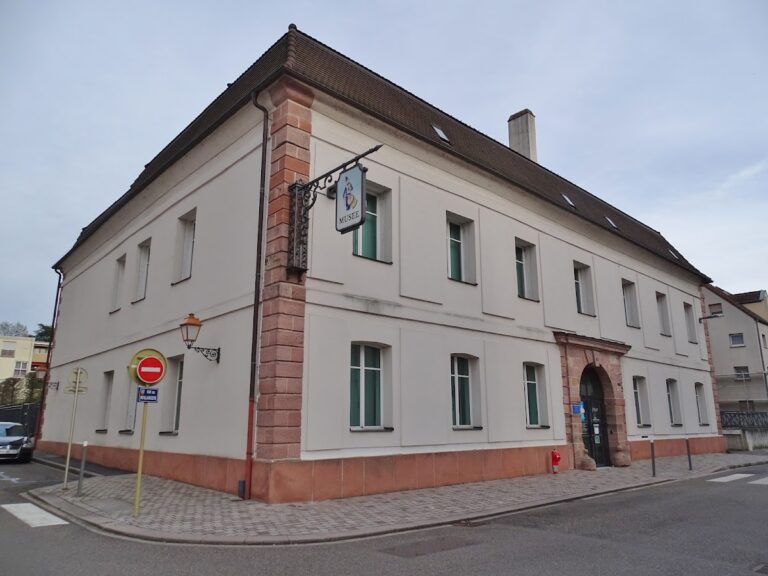
Models held by the Historical Museum of Mulhouse present the site through its principal building phases. They represent the Habsburg mound around 1050, the fortified castle and keep of the twelfth to fourteenth centuries, and the sixteenth-century seigneurial residence associated with the House of Andlau.
Nearby sites