Busséol Castle: A Medieval Fortress in France


Site at a Glance
- Rating
- 4.2
- Popularity
- Low
- Country
- France
- Primary era
- Medieval
- External website
- Open
- Eras represented
- Classical, Medieval
- Civilizations
- Duchy of Aquitaine, Roman
- Site type
- Military
- Remains
- Castle
On this page14 sections
History
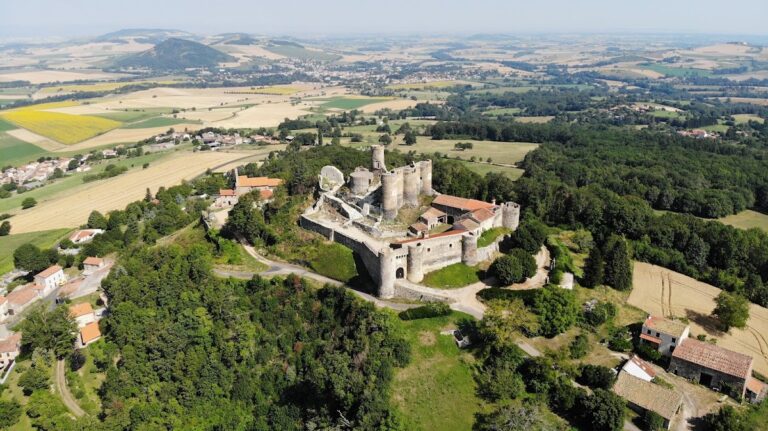
Busséol Castle is a medieval fortress in France, built in 1170 during the Romanesque period, an architectural style known for massive construction and rounded arches. It stands in Busséol, in the historic Auvergne region near Clermont-Ferrand, above the Limagne. The site also preserves remains of a second-century Gallo-Roman military installation, giving the height a history that began before the present castle.
Early Fortification and Foundation
The rocky site held a Gallo-Roman castrum, meaning a fortified settlement or military installation, during the second century. By 833, the castle was associated with a confirmation by Pepin I of Aquitaine, a Carolingian king and grandson of Charlemagne. He confirmed privileges that Charlemagne had granted to Manglieu Abbey.
The present fortress was built in 1170. William VIII of Aquitaine, a duke involved in conflict with the bishop of Clermont, sought the support of Pope Alexander III. In that year, he donated the castle to the pope and the Catholic Church.
Medieval Lords and Royal Connections
During the medieval period, Busséol was connected with the counts of Auvergne and later with Blanche of Clermont, granddaughter of Louis IX of France and wife of Robert VII, Count of Auvergne. The property subsequently passed to Marguerite of Évreux, a member of the French royal family, and from 1332 to Joan of Auvergne, queen consort of France and wife of John II, known as John the Good.
Later owners included Catherine de’ Medici, Margaret of Valois, Countess of Auvergne and Lady of Busséol, John Stuart, Prince of Scotland, Charles of Angoulême, an illegitimate son of Charles IX, and the French kings Louis XIII and Louis XIV. Catherine de’ Medici stayed at Busséol with her son Charles IX during their journey through Auvergne in 1566.
Sieges and Later Seigneurial Ownership
The fortress resisted the siege of Philip Augustus in 1215. It also withstood attacks by soldiers of the Black Prince during the Hundred Years’ War and an assault in 1589 by Jean-Louis de La Rochefoucauld, Count of Randan, a leader of the Catholic League during the French Wars of Religion. Cardinal Richelieu spared the castle, which remained inhabited until the French Revolution.
After a settlement with the Duke of Bouillon in 1643, the castle and its seigneurial rights passed to the de Frédeville family. Louis XIV later ceded the property to Gilbert Simon de Frédeville. In 1789, it became the property of Jean-Baptiste de Mascon.
Decline and Restoration
During the nineteenth century, the castle passed to the family of the Marquis de Vichy. In 1880, ownership went to Ludovic Le Groing de la Romagère, who was married to the marquis’s niece. Interest in the property declined after the sale, and the buildings deteriorated.
The Houlier family acquired the entire property in 1966 and restored it over approximately thirty years. Madame Houlier and her son Thierry carried out the restoration and received the Ministry of Culture’s chef-d’œuvre en péril award in 1970. Busséol Castle entered the French register of historic monuments on 17 July 1926.
Remains
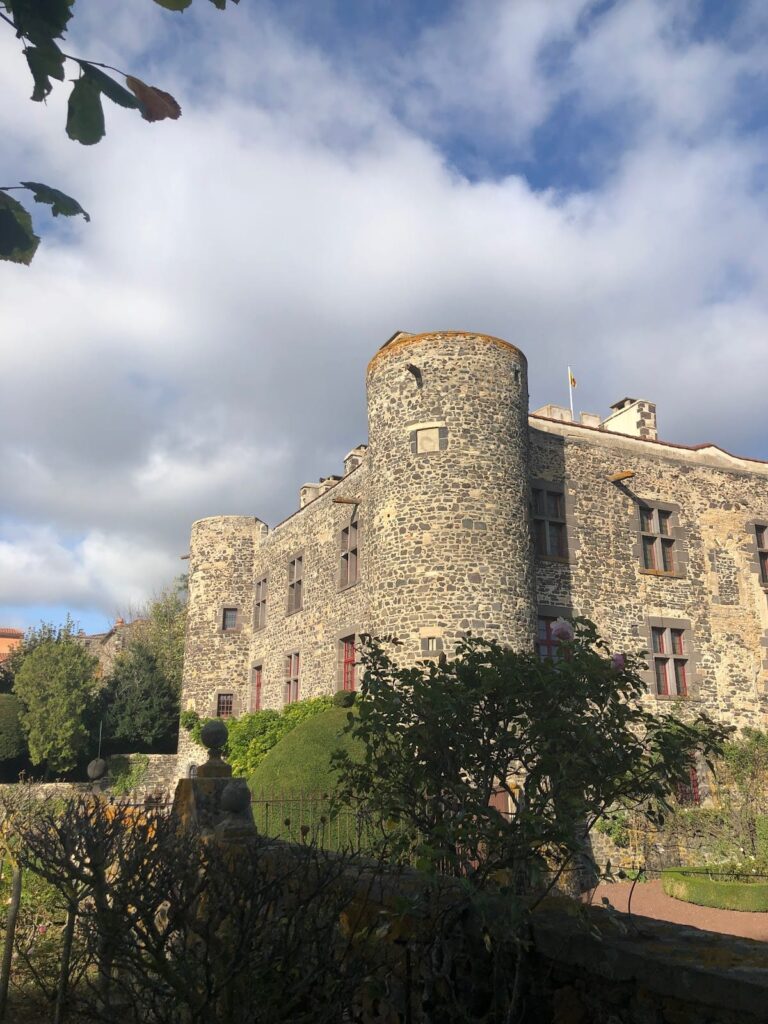
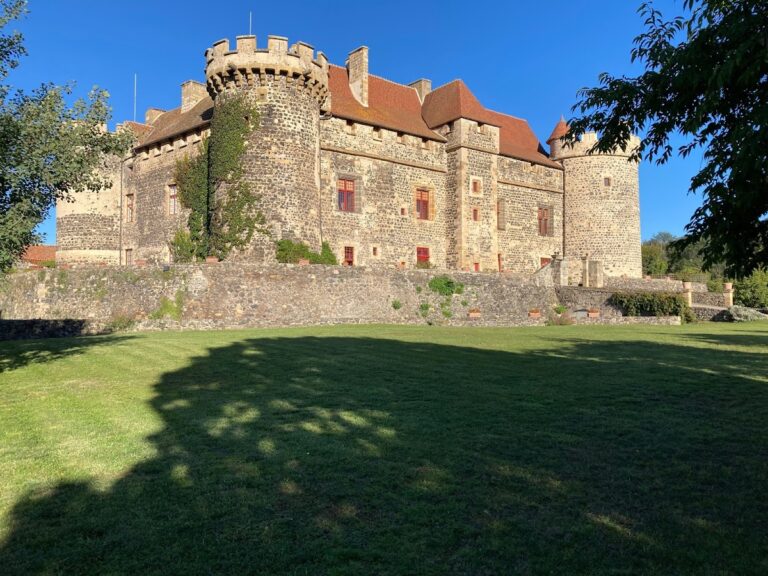
Busséol Castle occupies a volcanic rock about 700 metres above sea level. The rock was formed by a volcanic dyke and rises above the Limagne. Remains of the earlier Gallo-Roman military installation and a feudal fortress were found on the height. The surviving castle combines a main residential block with a principal fortified tower, a crenellated tower, massive walls, a lookout tower, and a steep southern defensive position above the rock face.
Fortifications and Entrance
Walls and Donjon
The main fortified tower, or donjon, has walls approximately three metres thick, an interior diameter of five metres, and a height of 27 metres. Its two storeys include a weapons store and a final refuge. Together with the battlements, lookout tower, and heavy enclosing walls, it preserves the castle’s defensive character.
Western Approach and Portal
Along the western side, a winding stairway passes between the rock and the donjon before reaching a small Romanesque entrance portal. Built from warm-coloured dressed stone, the portal is protected by a projecting bay and a portico. It opens into the gatekeeper’s lodge and then into the castle interior.
Residential and Religious Buildings
Hall of the Order of Saint Lazarus
From the entrance, a colonnade supports a heavy beam ceiling and leads to the hall associated with the Order of Saint Lazarus of Jerusalem, a medieval religious and military order linked with care for people suffering from leprosy and with the Crusading movement. The hall’s name recalls the counts of Auvergne and lords of Busséol, who were regarded as protectors of the order during the Crusades.
Great Hall and Lower Rooms
Two lower rooms lie behind the hall, including a provisions room and a kitchen lit by an arched window. On the residential level, a tall rectangular great hall contains an unusually shaped round Romanesque fireplace. Its conical chimney hood dates from the twelfth century. The hall opens onto four rooms, including bedrooms, and also onto the donjon.
Romanesque Chapel
A Romanesque chapel stands at the foot of the residence, forming a separate religious element within the castle complex.
Gardens and Waterworks
The castle’s elevation and geological setting produced a distinctive microclimate within the walls. Gardens were arranged on several levels in the medieval tradition. They include kitchen gardens, an orchard, an ornamental garden containing Mediterranean plants and flowers, and beds of medicinal and aromatic plants.
The restored grounds include the Garden of the Crusades. Restoration also reconstructed the old water reservoirs and returned them to their former arrangement.
Nearby sites