Château de Brangues: A Historic Residence and Literary Estate in France
Site at a Glance
- Rating
- 4.9
- Popularity
- Very Low
- Country
- France
- Primary era
- Early Modern
- External website
- Open
- Eras represented
- Medieval, Early Modern, Modern
- Civilizations
- French
- Site type
- Domestic
- Remains
- Castle
On this page8 sections
History
Château de Brangues is a historic residence in France that developed from a fourteenth-century fortified house into a pleasure residence shaped by successive owners and alterations. Its history links a powerful Dauphiné family, the French royal court, later aristocratic owners, and the poet and diplomat Paul Claudel.
From fortified house to aristocratic residence
Construction began in the fourteenth century at the initiative of the Rossillon family, a powerful lineage from the historic province of Dauphiné in southeastern France. The original building was a fortified house, a residence equipped with defensive features but smaller in scale than a major medieval castle.
During the fifteenth century, Louis XI, king of France from 1461 to 1483, dispossessed the Rossillon family of its lands and granted them to Imbert de Baternay. Imbert enlarged the original building with an east wing and a pepper-pot turret, a small turret with a rounded, conical roof. Diane de Poitiers, the daughter of Jeanne de Baternay, later held the lands of Brangues and Le Bouchage for a time. She was married to Jean de Poitiers and became a prominent court figure and favored companion of Henry II of France.
In 1609, the Gratet du Bouchage family purchased the château and commissioned its south and west wings. The estate was sold to the marquis de Quinsonnas in 1830, while the Quinsonnas family became its owners in 1856. The family was related to the prominent Virieu family of the former Dauphiné province.
The Claudel estate
Paul Claudel acquired the château and estate in 1927 as a place for his summers. Claudel was a French poet, dramatist, diplomat, and Catholic writer. After ending his diplomatic career in 1936, he settled at Brangues permanently and devoted most of his time to literary work.
During his residence, Château de Brangues received political and literary figures, including President Édouard Herriot and the writer François Mauriac. After Claudel’s death in Paris in 1955, his body was taken to Brangues in accordance with his wishes and buried in the château park. His grave remained visible in 2023. The estate later hosted the Brangues Encounters from 1976 to 2001, followed by new encounters.
On 28 December 1827, the writer Stendhal, the pen name of Henri Beyle, read about the Brangues Berthet affair in the Gazette des Tribunaux. The incident inspired his novel The Red and the Black. Commentators have often associated the château in the novel with Château de Brangues, although that connection is an interpretation rather than an established identification.
Ownership and protection
In 2008, the Isère departmental council considered acquiring the château and estate to create a cultural site, but André Vallini, the council’s president, abandoned the proposal. The Association du Domaine Paul Claudel is identified as the current owner, and Paul Claudel’s descendants continue to live privately at the château.
The château and park were listed as historic monuments by an order dated 11 March 1964. This protection, under French heritage law, was renewed and updated on 6 February 2014.
Remains
Château and courtyard
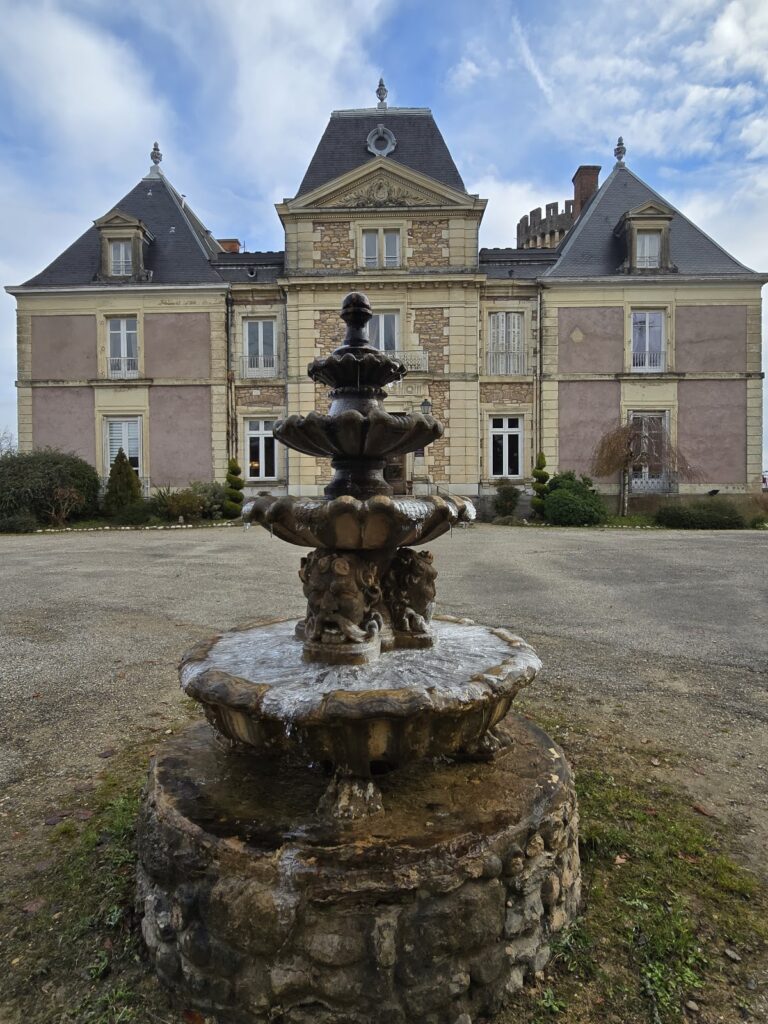
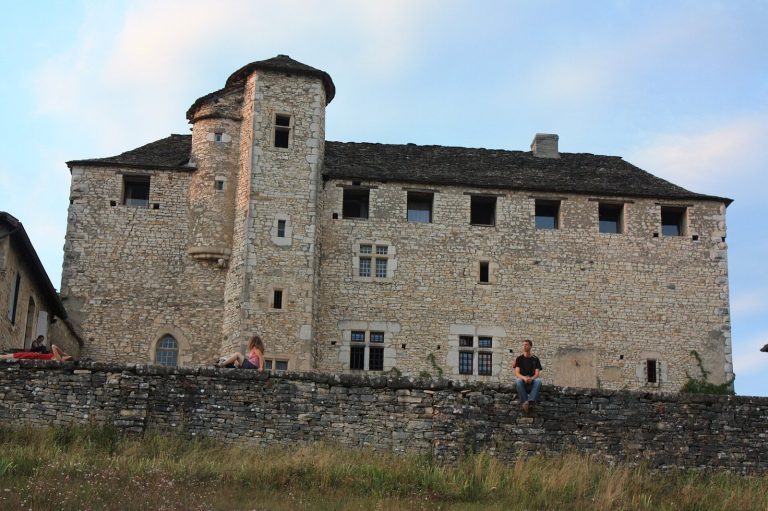
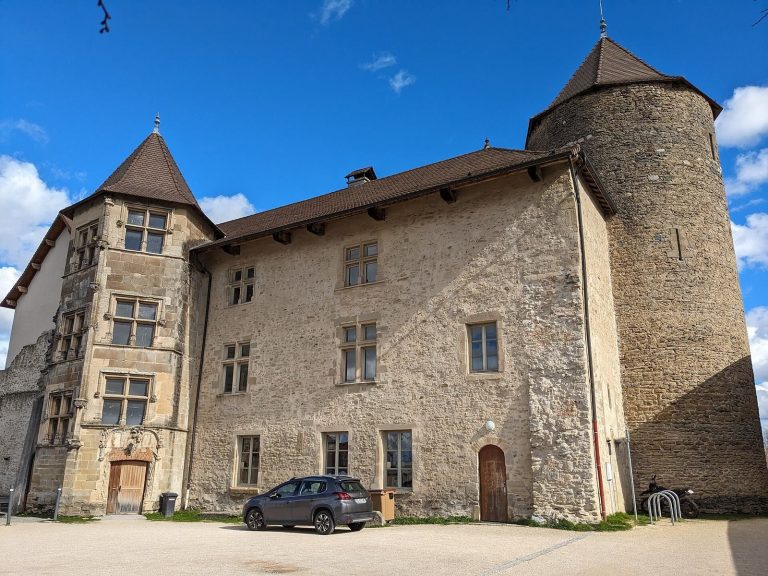
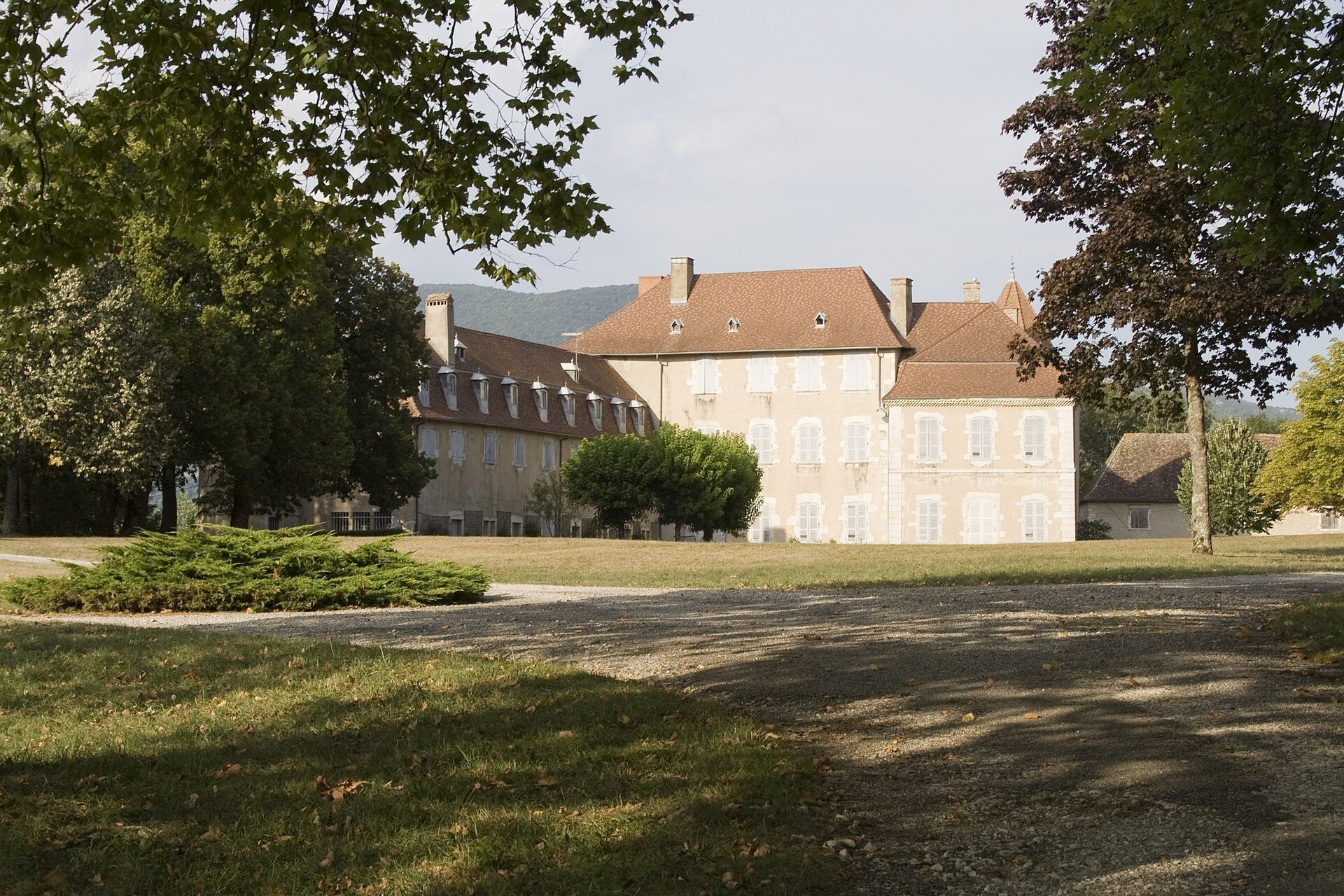
The present building is mainly a seventeenth- and eighteenth-century pleasure residence incorporating the remains of the medieval fortified house. Successive extensions created an atypical P-shaped plan. Three wings form a trapezoidal courtyard, with a large round tower occupying its north-eastern corner.
The fourteenth-century tower survives within the building and has walls approximately two metres thick. Further construction from the fourteenth and fifteenth centuries remains in the northern part of the château. The façade was remodeled in the fourteenth century and faces the park.
Park and service buildings
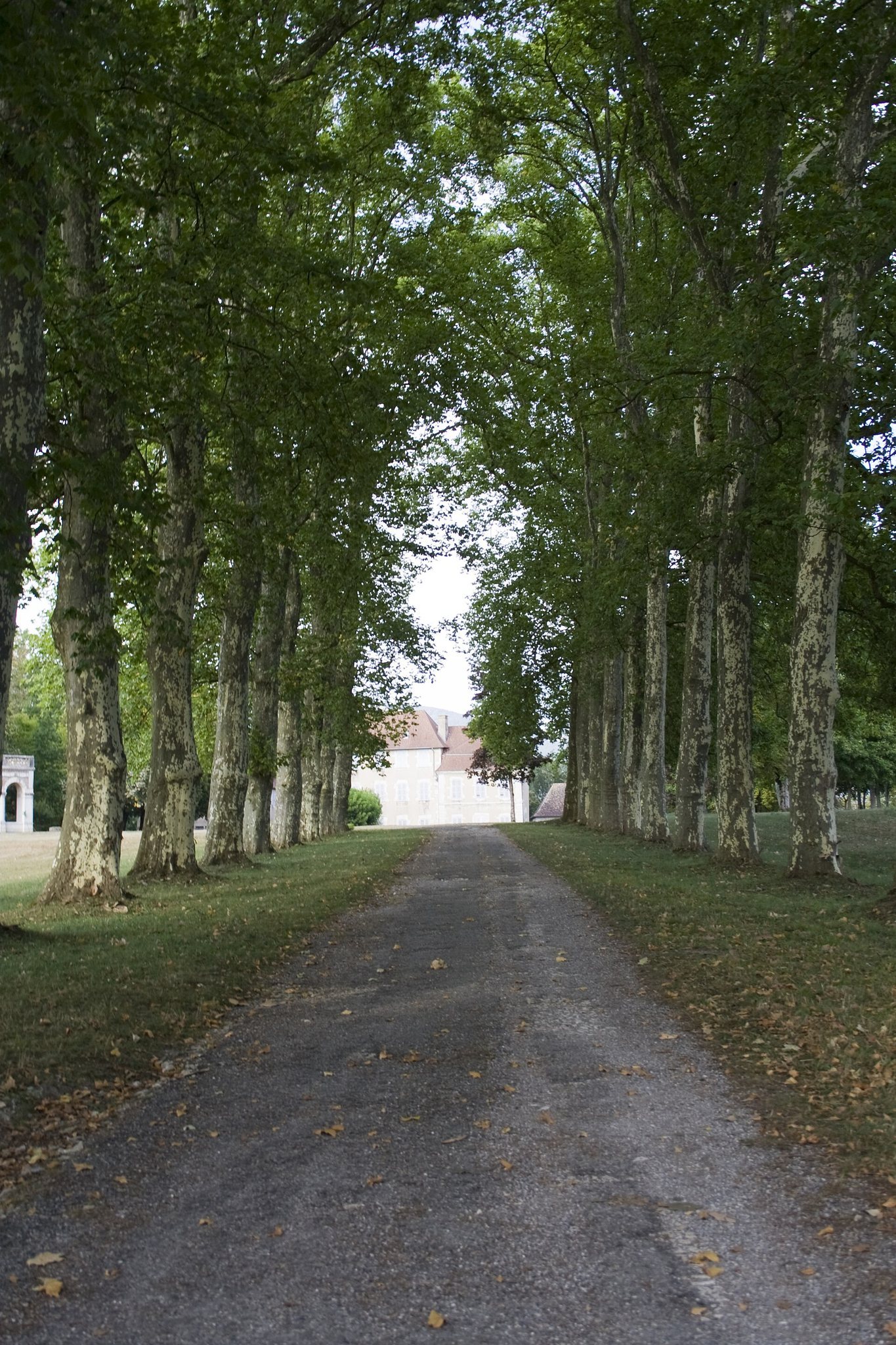
The estate covers seventeen hectares on elevated ground at the edge of Brangues, near the Rhône, at approximately 225 metres above sea level. Its park contains century-old trees, meadows, and an orchard established in the eighteenth century. At the far end of the park, Paul Claudel’s grave lies beneath a poplar planted by the actor Jean-Louis Barrault. The grave bears the epitaph, “Here lie the remains and the seed of Paul Claudel.”
Service buildings include a washhouse, former stables, and a caretaker’s house. An elegant pavilion beside the avenue leading to the château formerly served as an orangery. The entrance grille was made for Baudet de Groslée in 1845. A farm on the estate is used for private events.
Interiors and literary memory
The interior furnishings evoke Claudel’s diplomatic career in China, Prague, and Brussels. His study has been preserved as it was, while books from his library are displayed with a portrait of his friend, the musician Arthur Honegger. These rooms retain the domestic and literary associations formed during Claudel’s residence at Brangues.