Château d’Étoges: A Moated Château in France
Site at a Glance
- Rating
- 4.6
- Popularity
- Low
- Country
- France
- Primary era
- Early Modern
- External website
- Open
- Eras represented
- Medieval, Early Modern
- Civilizations
- County of Champagne, French
- Site type
- Domestic
- Remains
- Castle
On this page12 sections
History
Château d’Étoges is a moated château in France whose origins lie in a twelfth-century fortress established by the lords of Conflans. Its later rebuilding followed the style of Paris’s Place Royale, now known as the Place des Vosges. Built beside a slope and supplied by local springs, the estate developed from a medieval stronghold into an aristocratic residence, an imperial-era property, and eventually a hotel.
The Conflans and d’Anglure lords
The first fortress at Étoges was established in the twelfth century by the lords of Conflans, hereditary marshals of Champagne. Eustache III de Conflans, a marshal of Champagne and adviser to the king, is credited with building a fortification on the edge of the slope. Its position was probably supplied with water by springs rising locally.
After the early deaths of Eustache’s children, his sister Marguerite de Conflans brought Étoges into her marriage with Oger III d’Anglure, a knight serving the Duke of Orléans. The estate passed to the d’Anglure family in 1339. After selling their other domain, about 40 kilometres to the south, the family made Étoges the principal seat of its lineage during the fifteenth century.
From fortress to château
Francis I stayed at Étoges in 1544 during his war with Charles V, accompanied by his lieutenant François d’Anglure. In 1572, Antoinette d’Anglure brought the estate as her dowry to Chrestien de Savigny, Baron of Rosne. Savigny served as chamberlain to the Duke of Anjou, lord of Châlons, and the king’s lieutenant in Champagne. He joined the Catholic League, a Catholic political and military movement opposed to the spread of Protestantism, and died in battle in 1595.
Savigny’s heirs retained the name d’Anglure and demolished the medieval fortress. They replaced it with a château inspired by the architecture of Paris’s Place Royale. Charles Saladin de Savigny continued the family name, while his heir, Antoine Saladin d’Anglure de Savigny, received Louis XIII at Étoges in 1632 and was made a count in 1656. A further redesign on the medieval foundations began in 1661, with the reconstruction also broadly associated with the early seventeenth century.
Royal visits and the Boufflers period
In 1687, Marc Antoine Saladin d’Anglure, Count of Étoges, hosted Louis XIV and his court for dinner. The expense and magnificence attached to the estate helped bring the lords of Étoges to financial ruin. Marc Antoine died the following year at the age of 48, and his son died at 34 without issue. The estate was sold in 1717.
In 1718, the county, together with about 1,500 hectares of land and woodland, passed to Joseph Marie de Boufflers, son of Marshal Louis-François de Boufflers and a companion of the young Louis XV. Boufflers made further changes to the property. He died of smallpox at Genoa in 1747 while defending the city against the Austrians. His only son died four years later, and his granddaughter, Amélie de Gontaut, sold Étoges in 1760.
Late monarchy and Revolution
The next owner, Ambroise-Julien Clément de Feillet, served as a councillor of the Parlement of Paris and strongly supported Jansenism, a Catholic reform movement associated with strict religious discipline and a rigorous understanding of grace and sin. His son established a Rosière festival at Étoges in 1768, a ceremony honoring a young woman chosen for her reputed virtue. In 1782, the estate was sold to Claude Christophe Lorimier de Chamilly, first valet de chambre to Louis XVI, and his wife, Marie-Thérèse Marsollier.
After 1789, revolutionary tensions were sharpened by the Count of Étoges’s position at Versailles and by the influence of the local mayor Lambert, known as the “Shepherd of Étoges.” On 20 June 1791, the royal carriage carrying Louis XVI and his family while fleeing Paris stopped in the village. The king did not pass through the château gate because those present believed that the royal party had been recognized.
Chamilly and his son were arrested in 1792, and the château was placed under sequestration before being sold as national property. At his own request, Chamilly was imprisoned in the Temple with the king and was taken to the scaffold in 1794.
The Guéheneuc family and the Empire
After several changes of ownership, François Scholastique de Guéheneuc acquired the estate in 1802. His daughter Louise de Guéheneuc had married Marshal Jean Lannes in 1800. After Lannes died in 1809, Napoleon supported the Guéheneuc family. François became a Count of the Empire and a senator, and directed the Water and Forests administration. His son Charles Louis Joseph Olivier served as the emperor’s aide-de-camp.
Henriette de Guéheneuc married General François Joseph Kirgener, Baron de Planta, at Étoges. Kirgener died four years later while returning from the Russian campaign, leaving a son. During the French campaign of 1814, when fighting took place nearby at Champaubert and Montmirail, the Russo-Prussian coalition under General Gebhard Leberecht von Blücher established its headquarters at the château.
After the fall of the Empire, Guéheneuc retired to Étoges and created an English-style garden, using a more informal landscape design than the formal French terraces. He became mayor, represented the Marne as a deputy from 1828 to 1831, served as a general councillor of the Marne, supported the July Monarchy, and was appointed a Peer of France. He died in 1840. Étoges then passed to Henriette Kirgener de Planta and her son, Napoléon-Louis-Henri.
Nineteenth-century decline and preservation
Napoléon-Louis-Henri sold the farm buildings in 1859 and parcels of the estate to the local entrepreneur Charles Uriel. He offered the château for sale in 1874, but the deteriorated and isolated building attracted no buyer. A proposal to turn it into an orphanage was abandoned because of the scale of the necessary work, while the expected value of its building materials would not have covered demolition.
Charles Uriel acquired the château in 1877, intending to reduce it to the size of a comfortable house for his daughter Julia. He sold the painted gallery panels by the Reims artist Jean Hélart to Count Werlé, who installed them at his château at Pargny-lès-Reims. That building burned during the First World War. Uriel’s son-in-law, Dominique Neuville, later undertook embellishment work at Étoges. After the war destroyed his dyeing factory, he died in 1916.
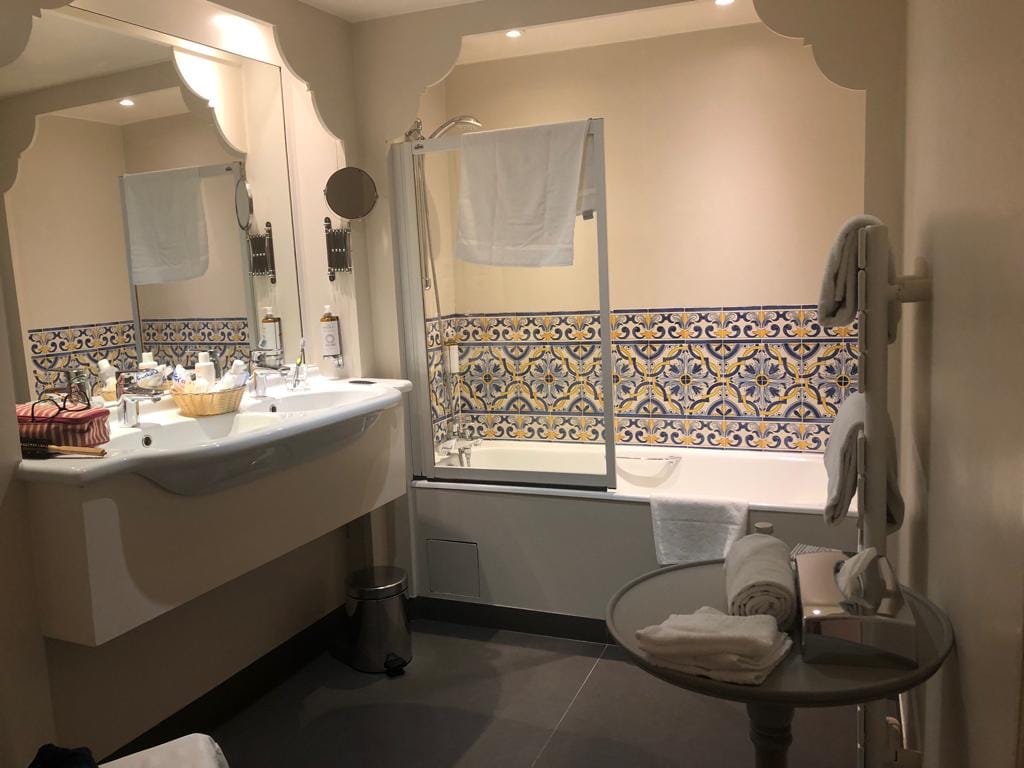
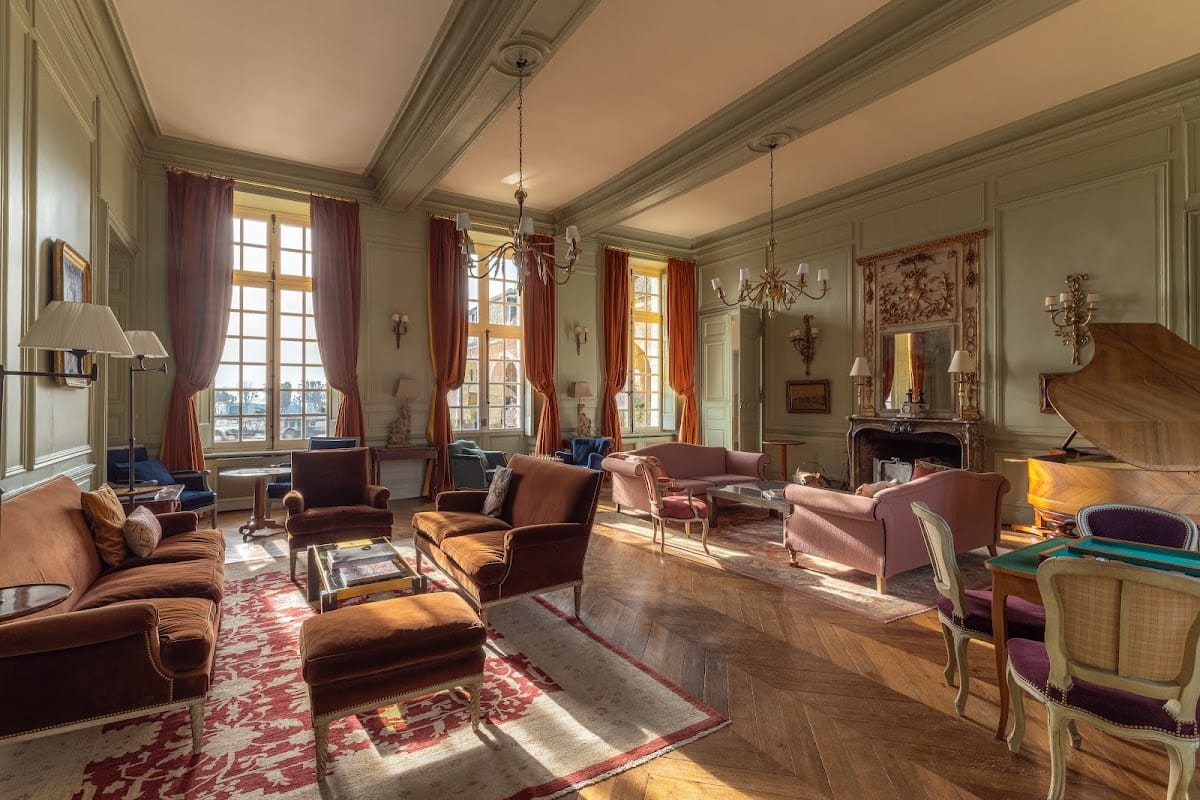
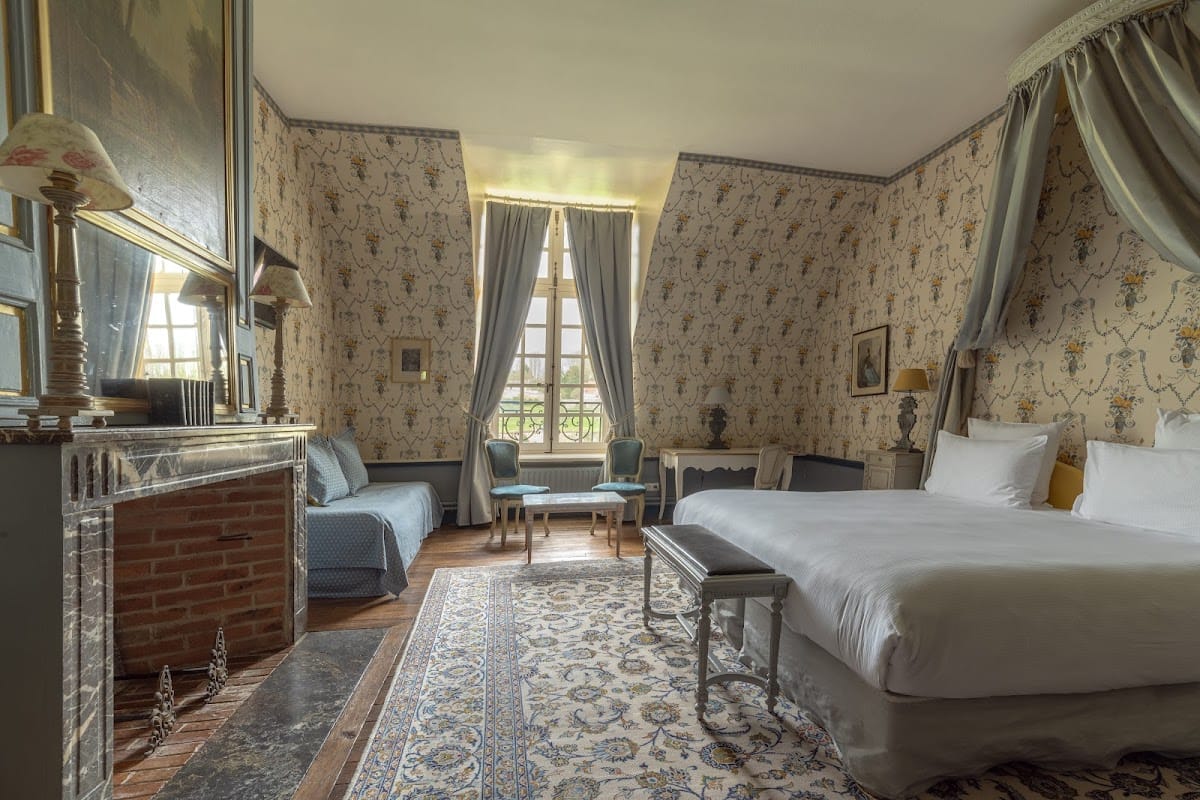
Dominique Neuville’s son Robert researched the history of Étoges, renovated the park’s hydraulic system, and helped with the exhumation of the stone funerary effigies in the village church. The château has been listed as a historic monument in France since 1956. In 1991, Robert Neuville’s granddaughter Anne Filliette-Neuville converted it into a hotel, and a gastronomic restaurant was added in 2006. She sold the property to NAO Collection in October 2023, which continued its hotel use.
Remains
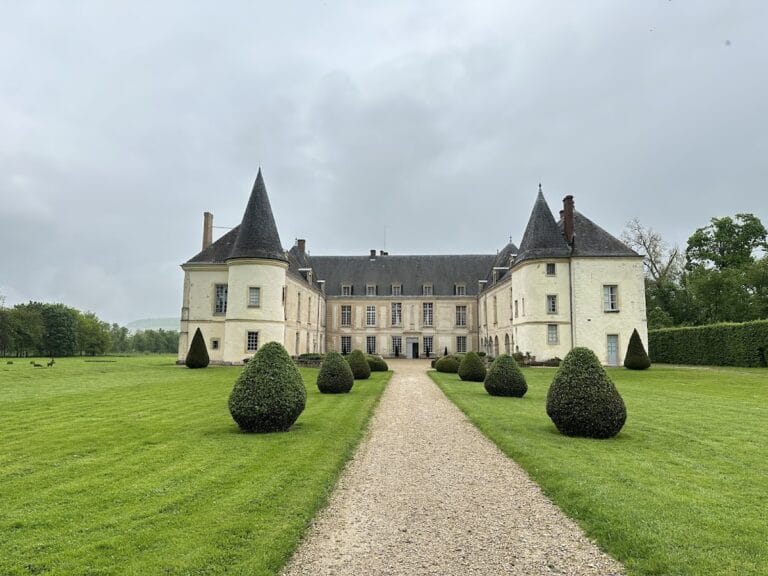
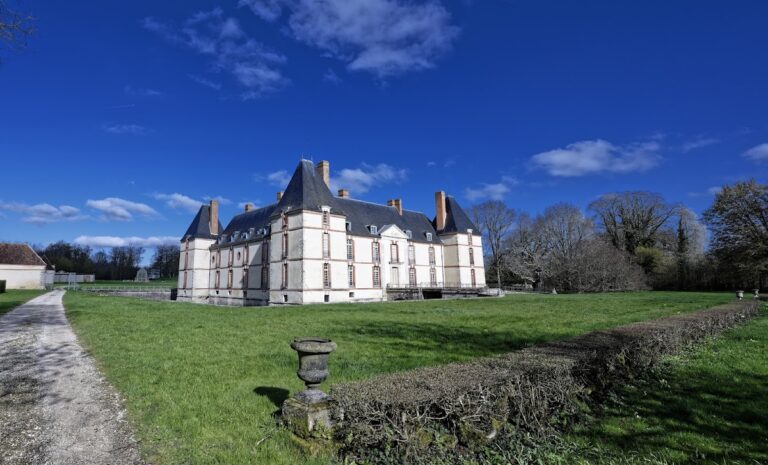
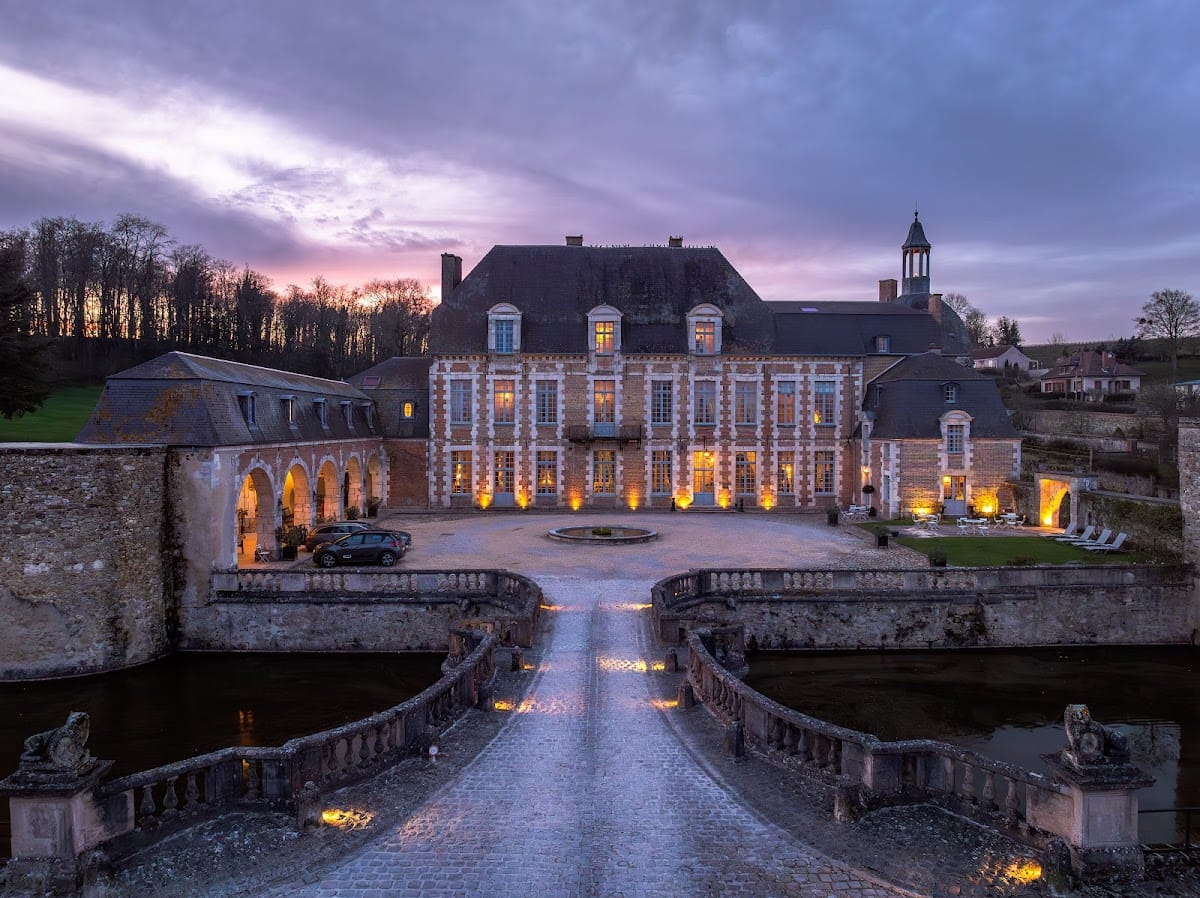
Château d’Étoges occupies the foundations of the twelfth-century fortress and retains the form of a moated château. Broad moats surround the buildings and are fed by springs emerging throughout the park. High masonry walls line the water. Beyond them, formal French-style terraces descend through the grounds, while the park also contains the English-style garden created after the fall of the Empire.
Buildings and courtyard
The main residential block rises into two wings. One wing contains an arcade gallery topped by an interior gallery. Corner towers carry dome-shaped roofs, and the courtyard combines brick and stone in a marked contrast with the more defensive appearance of the outer façades. The present complex therefore preserves both the fortified setting inherited from the medieval foundations and the character of the later residential château.
Water system and entrance bridge
The estate’s springs once produced 24 jets in the parterres, courtyard, and even inside the château, supplying basins and moats. Robert Neuville later renovated the park’s hydraulic system. Boufflers moved the entrance to the south. An earlier drawbridge collapsed in 1725 under the weight of Queen Maria Leszczyńska’s carriage and was replaced by a four-arched stone bridge that remains in use.
Painted gallery and associated objects
The château once contained a painted gallery by Jean Hélart, the Reims painter who lived from 1618 to 1685. Its panels were removed and transferred to the château at Pargny-lès-Reims, which was destroyed by fire during the First World War. Objects associated with Étoges include a portrait of Marc Antoine Saladin d’Anglure, a bas-relief, a work identified as Guy Piedefer, and a plaque commemorating the French campaign of 1814.
Funerary effigies
The village church preserves stone effigies of members of the d’Anglure lineage. These recumbent funerary figures, known as gisants, represent the deceased on their tombs. Their recovery was supported by Robert Neuville and preserves a material connection between the family and Étoges.