Saint-Pierre d’Hautvillers Abbey: A Benedictine Monastery in France
Site at a Glance
- Popularity
- High
- Country
- France
- Primary era
- Early Modern
- Eras represented
- Medieval, Early Modern
- Civilizations
- French
- Site type
- Religious
- Remains
- Monastery
On this page17 sections
History
Saint-Pierre d’Hautvillers Abbey is a former Benedictine monastery in Hautvillers, France. Its foundation is traditionally dated to around 650, though the precise date is uncertain. The abbey became a center of manuscript production during the early medieval period and was also known for religious devotion and wine-making.
Foundation and Early Community
According to tradition, Berchaire returned to Reims around 658, and Archbishop Nivard commissioned him to establish a monastery. Nivard entrusted the estate of Altum Villare, the medieval Latin name for Hautvillers meaning high village or high farmstead, to Berchaire and his fellow monks. They followed the rules associated with Benedict and Columbanus, two traditions of monastic life. A foundation legend says that a dove indicated where the monastery should be built. Berchaire is traditionally considered its first abbot.
Saint Rieul joined the community in 662 and became archbishop of Reims in 669, succeeding Nivard. The monastery’s religious life developed over the centuries. From the seventeenth century, its Benedictine community followed a reform movement that began in Lorraine in 1604, the Congregation of Saint-Vanne and Saint-Hydulphus.
Carolingian Manuscripts and Saint Helena’s Relics
Under the Carolingians, the Frankish ruling dynasty that dominated much of western Europe from the eighth to tenth centuries, the abbey became a center for making manuscripts. Its works included the Ebbo Gospels and, probably, the Utrecht Psalter. Wine-making also formed part of the community’s work.
In 841, a priest from Reims brought relics of Saint Helena from Rome to the abbey, where Abbot Haldouin received them. Saint Helena, the mother of the Roman emperor Constantine I, was venerated as a Christian saint. The relics drew pilgrims, adding to the abbey’s income and enabling it to acquire about 40 hectares of land and vineyards. They remained there until the French Revolution. After the monastery was suppressed, a cellarer, the monk responsible for provisions and cellar management, hid the relics. They were later taken to Paris for public veneration and entrusted to the Knights of the Holy Sepulchre. In 1819 they were placed in the church of Saint-Leu-Saint-Gilles in Paris; some relics were subsequently returned to Hautvillers.
Destruction and Rebuilding
Following Norman incursions in 822, the abbey was restored in 940. English forces set fire to it in 1449. During the abbacy of Dom Royer, dated 1507-1527, the remaining traces of that fire were removed. The abbey was destroyed in 1544 during the conflict between Francis I, king of France, and Charles V, Holy Roman Emperor. In 1562, Huguenots, French Protestants, burned what remained.
The abbey was rebuilt in 1603, reportedly with donations from Catherine de’ Medici. Repairs and changes to the buildings supported the renewed monastic community and its wine production. The number of monks rose from six in 1634 to 24 in 1689. From 1668 until his death in 1715, Pierre Pérignon served as cellarer and administrator. He improved wine blending and vineyard management, helping to build the abbey’s reputation for wine. Although the site is popularly described as the birthplace of Champagne, Pérignon did not invent sparkling Champagne. His successor, Brother Pierre, recorded Pérignon’s methods in a 35-chapter treatise on Champagne vineyard cultivation in 1724, without claiming that he had invented sparkling wine.
Jean-Philippe d’Orléans held the title of commendatory abbot around 1744. A commendatory abbot received an abbey’s title and revenues, often without governing its community. Alphonse de Lateriis was the last abbot before the Revolution.
Revolution and Later Ownership
The monastery was suppressed and dismantled principally between 1791 and 1793, and its monks were expelled. In 1794, the remaining buildings and estate passed to Jean-Remy Moët, a wine merchant from Épernay. His son-in-law, Pierre-Gabriel Chandon, took over in 1823 and rebuilt vineyards and parts of the complex. The estate later became associated with Moët & Chandon, a Champagne producer. The former abbey church became Hautvillers’ parish church and is owned by the municipality, while Moët & Chandon owns the estate.
Modern work has altered and investigated parts of the site. In 2012, the cloister was restored and the vanished Saint Helena Gate reconstructed in collaboration with French historic-monument architects. A separate gate at the southern end of the estate was restored between 2016 and 2019. Archaeological work in 2023, carried out by France’s National Institute for Preventive Archaeological Research with the Champagne Wine Museum, returned to areas partly examined in projects led by Pascale Bousquet-Chevalier in the late 1980s.
In 1983, the church, the surviving cloister-wing facades and roofs, the former abbey grounds, and the Saint Nivard Fountain were classified as French historic monuments. The entrance portal, the former kitchen’s facades and roofs, and two vaulted bays within it were registered. Since 2015, the abbey and Cave Thomas have also formed part of the UNESCO-listed Champagne Hillsides, Houses and Cellars.
Remains
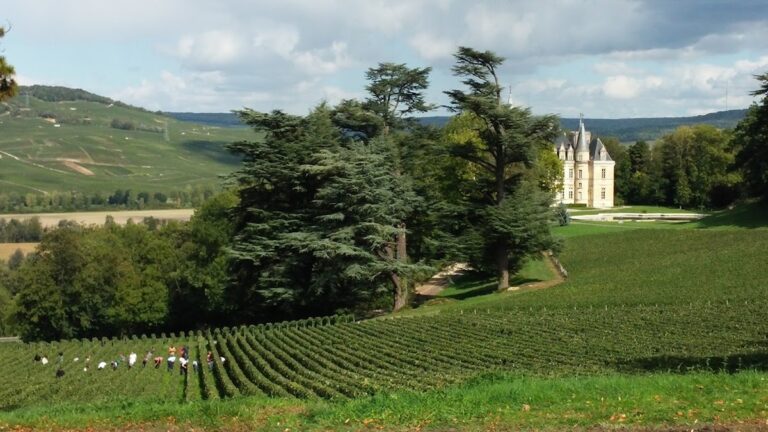
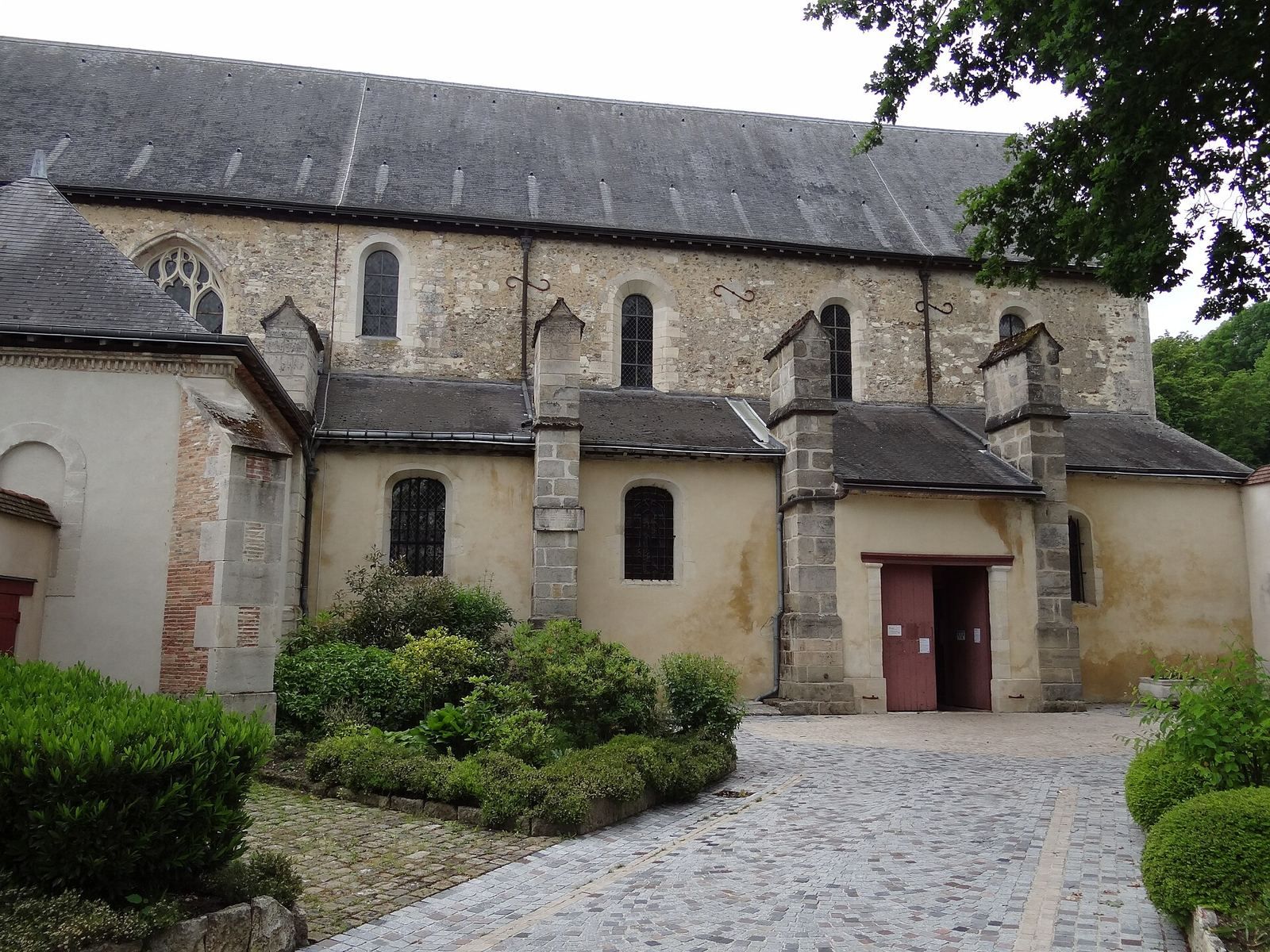
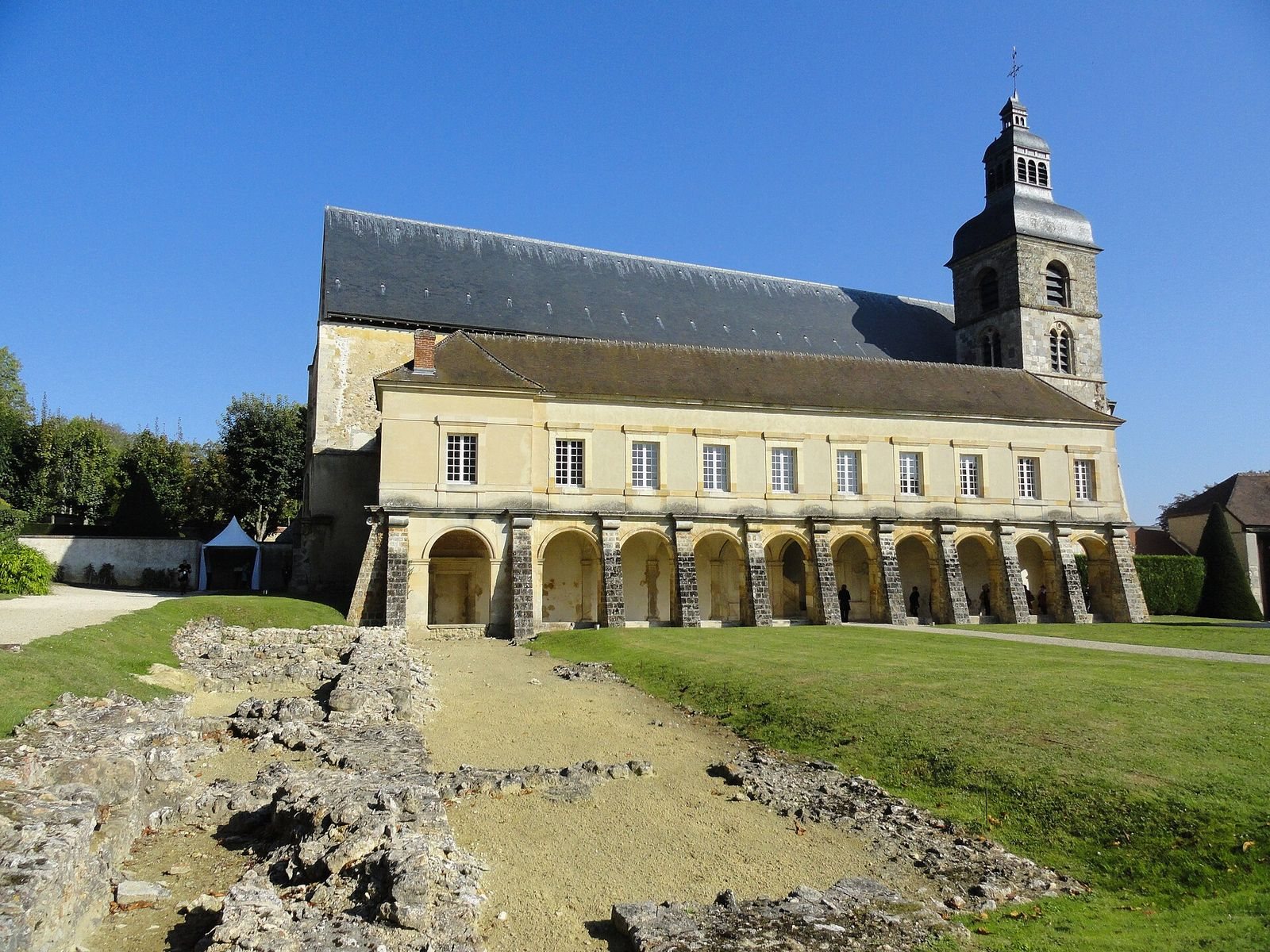
The abbey occupies the southern side of Hautvillers on a hill overlooking Épernay and the Marne. The church is joined to a surviving section of the cloister. Monastic buildings and gardens lie to the east, while the building known as Les Filles de France and the former press building are to the west.
Estate Features
Three entrances serve the grounds: one from Rue de l’Abbaye, the Saint Helena Gate from Rue de Cumières, and another at the estate’s southern end. The Saint Helena Gate was reconstructed in 2012, while the southern entrance was restored between 2016 and 2019. The grounds also contain the Saint Nivard Fountain and the former kitchen, whose two bays have rib vaults, ceilings structured around intersecting ribs.
Church of Saint-Sindulphe
Architecture and Fabric
The three-aisled church combines Romanesque and Gothic forms, two distinct European architectural styles, and most of its structure dates to the sixteenth century. Only the lower portion of the west front and its portal survive from the original Romanesque church. The facade has a Romanesque lower section and a Gothic upper section. The nave has a shallow, basket-handle-shaped ceiling, and the Saint Helena chapel contains Baroque furnishings, in a distinct European artistic style. The rebuilding sequence is uncertain: a third church may have been constructed under Abbot Dom Roger in 1518, and the building may have been rebuilt again after the mid-sixteenth-century destruction.
Choir and Paintings
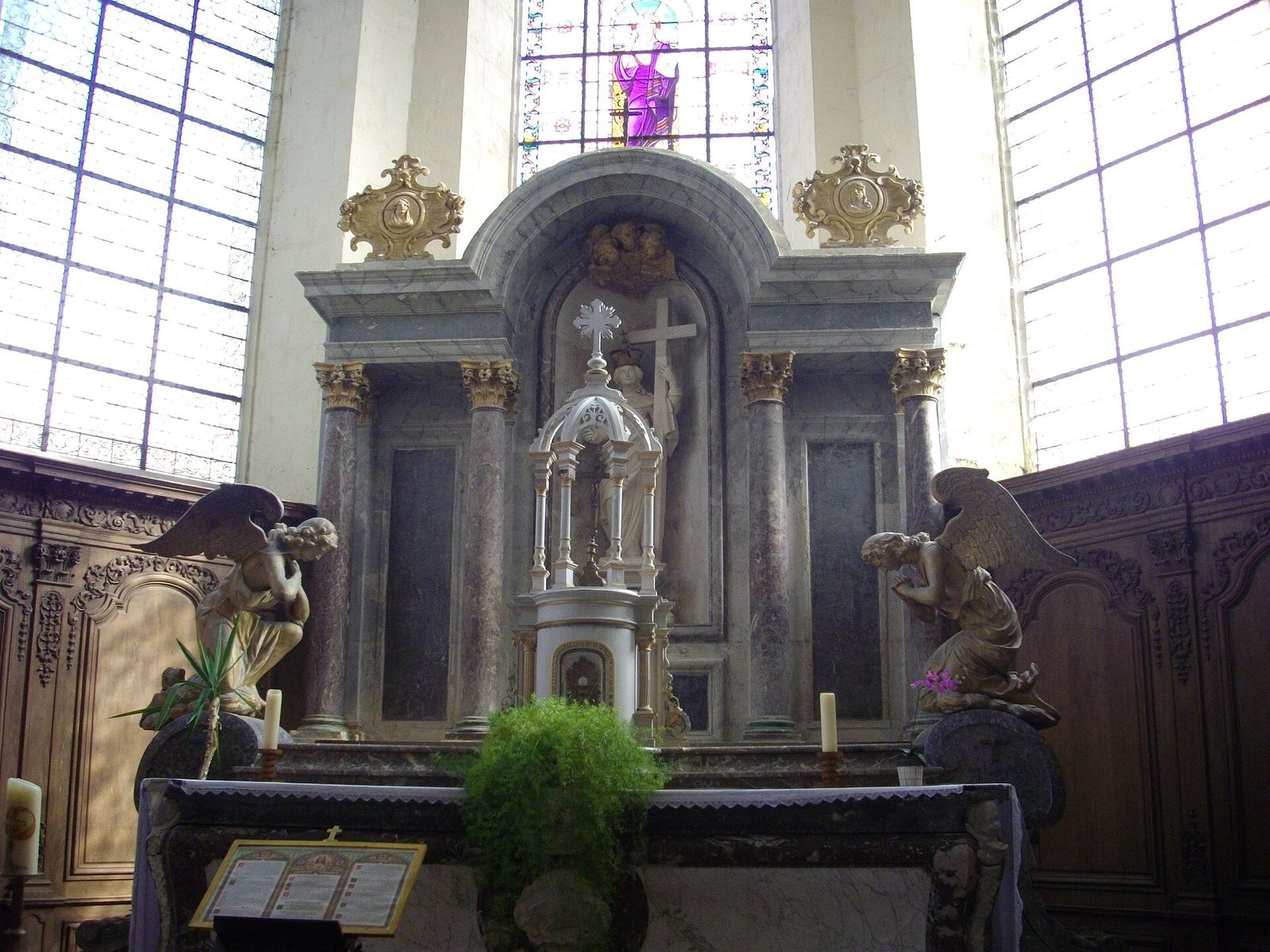
The choir stalls and paneling date to 1780. Their carved decoration includes putti, childlike figures used as ornaments, foliage, and mascarons, carved face masks, as well as the arms of Jean-Philippe d’Orléans. The high altar was built in 1691 under Pérignon’s direction. Above it hangs a large chandelier made from four wheels of a wine press.
Seven paintings hang above the choir stalls, four on one side and three on the other. Three works dated 1715, each measuring 315 by 425 cm, are by the Lorraine painter Claude Charles. They depict Saint Nivard presenting the monastery’s plans, Saint Benedict speaking with his sister Saint Scholastica, and Saint Peter healing a paralytic. Two other paintings come from the workshop of Philippe de Champaigne. Two seventeenth-century works by Langlois, also each measuring 315 by 425 cm, show Christ carrying the cross and Christ crucified between the two thieves.
Burials and Religious Objects
Pierre Pérignon’s tomb lies in the choir. Its marble slab measures 131 cm high by 65 cm wide, and its inscription recalls his 47 years as cellarer, his management of the wine, his care for the poor, and his death in 1715. Dom Royer is buried beside him. A memorial slab for Dom Thierry Ruinart, a Benedictine monk of Saint-Germain-des-Prés who died at the abbey in 1709, lies in the central aisle and measures 67 by 56 cm.
The church contains a pulpit and reliquaries, containers for religious relics, associated with Saint Helena and Saint Nivard. Some of Saint Helena’s surviving relics are also among its religious objects.
Organ
The church’s raised-gallery organ began as an instrument built around 1630 by two German-born organ builders. Louis Gorlidot and Mathieu Wyskirclum rebuilt it around 1769, retaining older pipes. Nicolas-Augustin Hubert modified it in 1847, and Augustin Brisset made further changes later in the nineteenth century. The instrument has three keyboard manuals, each with 56 notes, and a 32-note pedalboard. During the Second World War, 438 pipes were lost.
Manuscripts
Ebbo Gospels
Monks at the abbey produced the Ebbo Gospels between 816 and 823 on commission from Ebbo, archbishop of Reims. This ninth-century illuminated manuscript contains the four Gospels, each beginning with a painted portrait of its evangelist. It is now held at the media library in Épernay.
Utrecht Psalter
The Utrecht Psalter, probably made at the abbey in the 820s, is a book of biblical psalms with additional devotional texts. Its 166 texts each begin with a line drawing on unadorned parchment. Production for Ebbo has been proposed, but his patronage is unproven.
Cave Thomas
Cave Thomas is an underground wine cellar about 800 m south of the abbey, cut into the chalk-rich slopes below the village. Its main gallery measures 34 m long and 6 m wide and could accommodate as many as 500 wine barrels. The cellar was designed to maintain cool, steady storage conditions for wine.
Carved Capital
A fragmentary fourteenth-century capital, the sculpted top of a column, from the abbey is displayed at the Champagne Wine Museum in Épernay. It depicts a figure treading grapes in a vat, surrounded by grapevines; the figure’s feet remain visible.