Burg Grimburg: An Ecclesiastical Spur Castle in Germany
Site at a Glance
- Rating
- 4.6
- Popularity
- Low
- Country
- Germany
- Primary era
- Medieval
- External website
- Open
- Eras represented
- Medieval
- Civilizations
- Holy Roman Empire
- Site type
- Military
- Remains
- Castle
On this page11 sections
History
Burg Grimburg is an ecclesiastical spur castle in Germany whose first known castle was built around 1150, in the medieval period, by the noble lords of Saarbrücken. It stands in the territory of the present-day municipality of Grimburg, in Rhineland-Palatinate. The castle later became one of the territorial strongholds of the Archbishops and Electors of Trier, who used such fortified possessions to administer and defend their lands.
Foundation and rebuilding
The origin of the first castle remains uncertain. It may have been established by the cathedral custodian, a senior cathedral official responsible for aspects of liturgical and material administration, who held manorial rights in Grenderich, Sauscheid, and Gusenburg. Another possibility is that St. Paulin Abbey founded it, since the abbey held lordship rights in and around Wadrill.
The first castle was destroyed during the Trier Schism, a dispute over the succession to the archbishopric of Trier that lasted from 1183 to 1190. After Johann I became Archbishop of Trier in 1190, he rebuilt it, describing the work as de novo construxit, meaning “built anew.” From this period, Grimburg belonged to the seven Trier territorial castles first listed in the Liber annalium, together with Arras, Ehrenbreitstein, Manderscheid, Neuerburg, Saarburg, and Welschbillig.
A ruling of 4 April 1258 records that the cathedral custodian and St. Paulin Abbey each held one quarter of Grimburg. The garrison therefore owed allegiance to the Archbishop of Trier and to both co-owners. Each could call upon the garrison when needed and had to meet associated obligations.
Lordship and administration
Simon of Warsberg held the office of cathedral custodian from 1242 and became cathedral provost, the leading dignitary of the cathedral chapter, in 1252. His efforts to expand and formalize his rights included patronage and tithe rights in 1248, followed by a share in Grimburg in 1258. These developments were connected with his close relationship to the Saarbrücken family. Members of that family served as burgraves of Grimburg for about a century after the castle became a Trier territorial stronghold shortly after 1190.
Boemund of Saarbrücken, Simon of Warsberg’s nephew, was later known as Boemund of Grimburg. Around 1270, he went on to build Dagstuhl Castle and adopted the title “Lord of Dagstuhl.” Grimburg itself served as the administrative seat and court of the Electoral Trier Amt of Grimburg. An Amt was an administrative and judicial district in the Electoral Trier system, and Grimburg’s Amt is first recorded in 1328.
The castle’s name probably does not derive from the Middle High German word grimme, meaning frightening, gloomy, or fierce. It may instead represent a variation of grüene. In connection with a documentary reference from around 1202, the name could therefore mean “green castle” or “castle in the green.”
Late medieval and early modern history
Emperor Maximilian I, the Habsburg ruler of the Holy Roman Empire from 1508 to 1512, visited Grimburg with his retinue in 1512, reportedly for falconry. Ten years later, in 1522, the imperial knight and military leader Franz von Sickingen occupied the castle without a fight.
Elector Johann of Schönberg, the Elector and Archbishop of Trier associated with the castle’s later religious improvements, lived at Grimburg and renewed and enlarged its chapel in 1585. The castle then suffered severe damage during the Thirty Years’ War, the major European conflict of 1618 to 1648. French soldiers set it on fire in 1683 during the Wars of the Reunions, a series of expansionist wars conducted by France under Louis XIV in the late seventeenth century.
Abandonment and reconstruction
Around 1690, administration of the Amt of Grimburg was transferred to the Lascheid estate near Hermeskeil, which had reverted to the archbishopric. Grimburg was abandoned and left to decay. Surrounding communities subsequently used the ruin as a convenient source of building stone, further affecting the surviving complex.
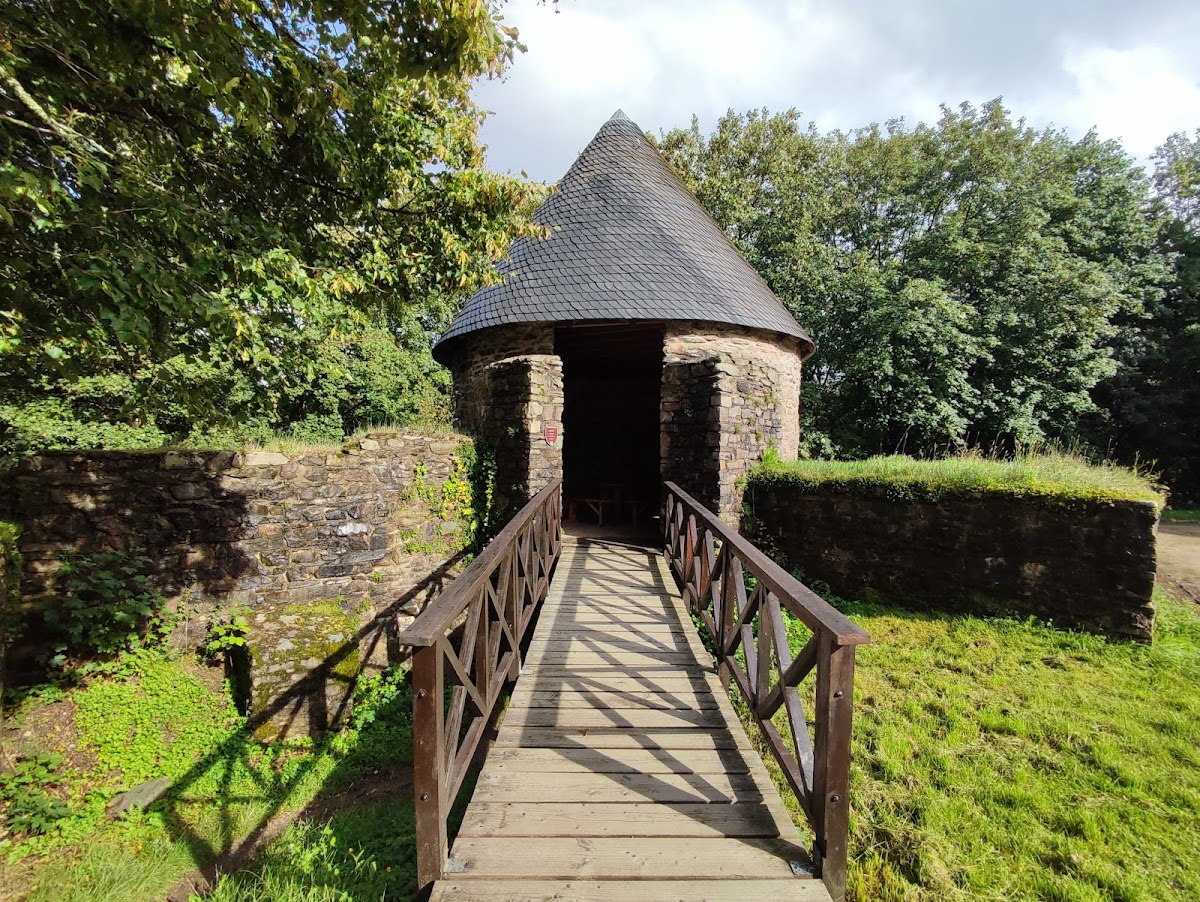
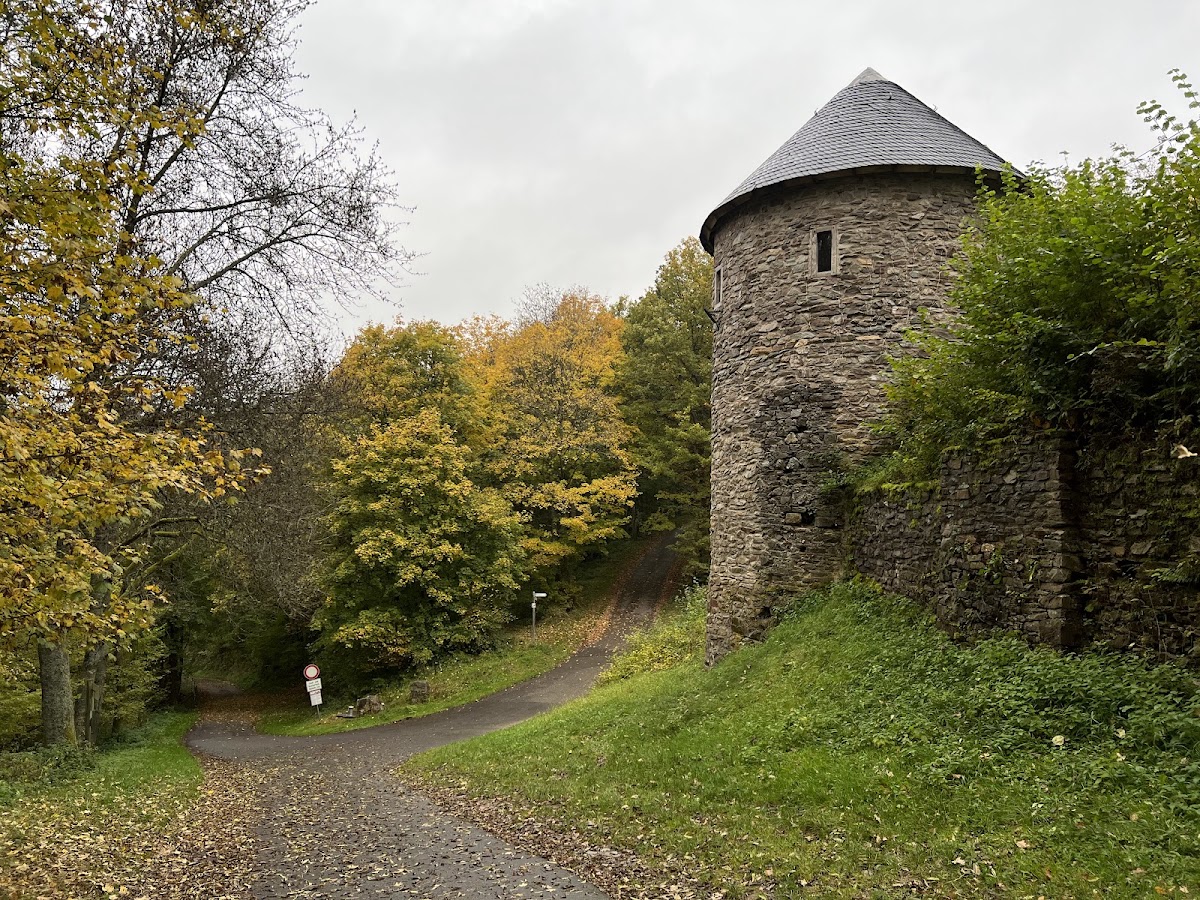
The Förderverein Burg Grimburg was founded in 1978. In cooperation with the collective municipality of Hermeskeil and the municipality of Grimburg, it cleared the site, carried out excavations, stabilized the remains, and undertook partial reconstruction. The castle house was rebuilt from 1978 to 1988, the keep from 1978 to 1990, the Witches’ Tower and Kitchen Tower from 1981 to 1987, and the entrance tower from 1999 to 2000.
Remains
Setting and layout
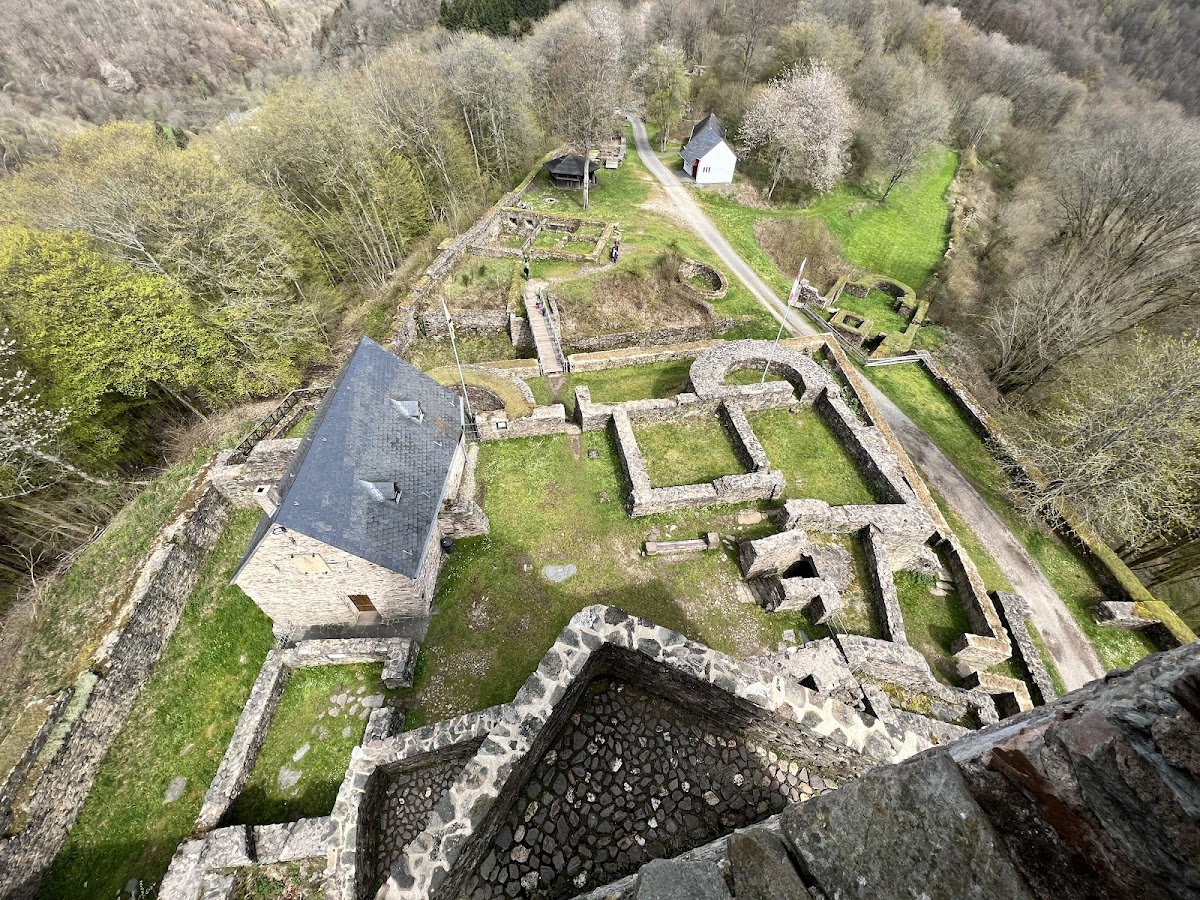
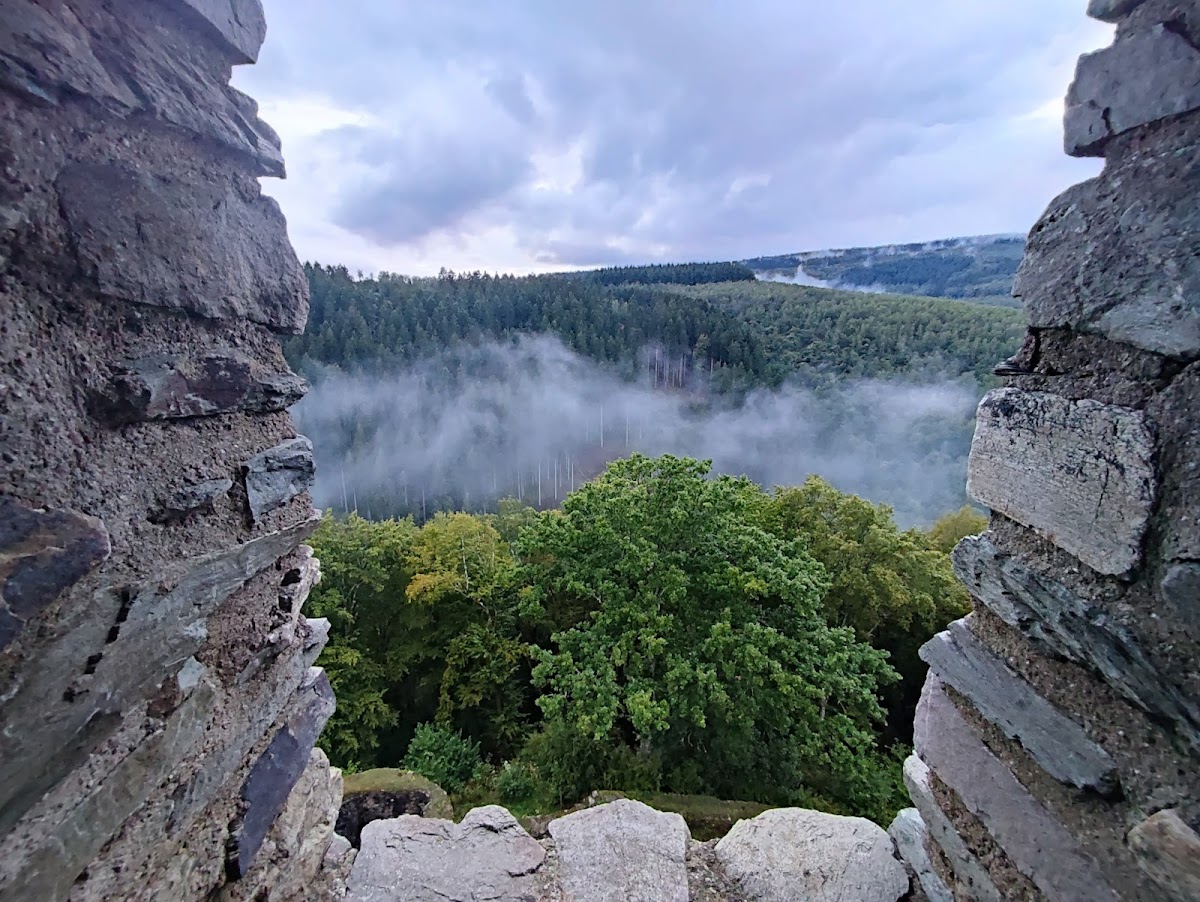
Burg Grimburg occupies a long mountain spur between the Wadrill and Mühlenbach valleys in the Saar-Hunsrück Nature Park. The site lies on Kittelaufberg, a southern spur of Hasenknopf, at an elevation of 448 metres. Kittelaufberg reaches 460.1 metres, while Hasenknopf rises to 497 metres. The Mühlenbach passes east of the spur and joins the Wadrill to its south; the Wadrill passes west of it.
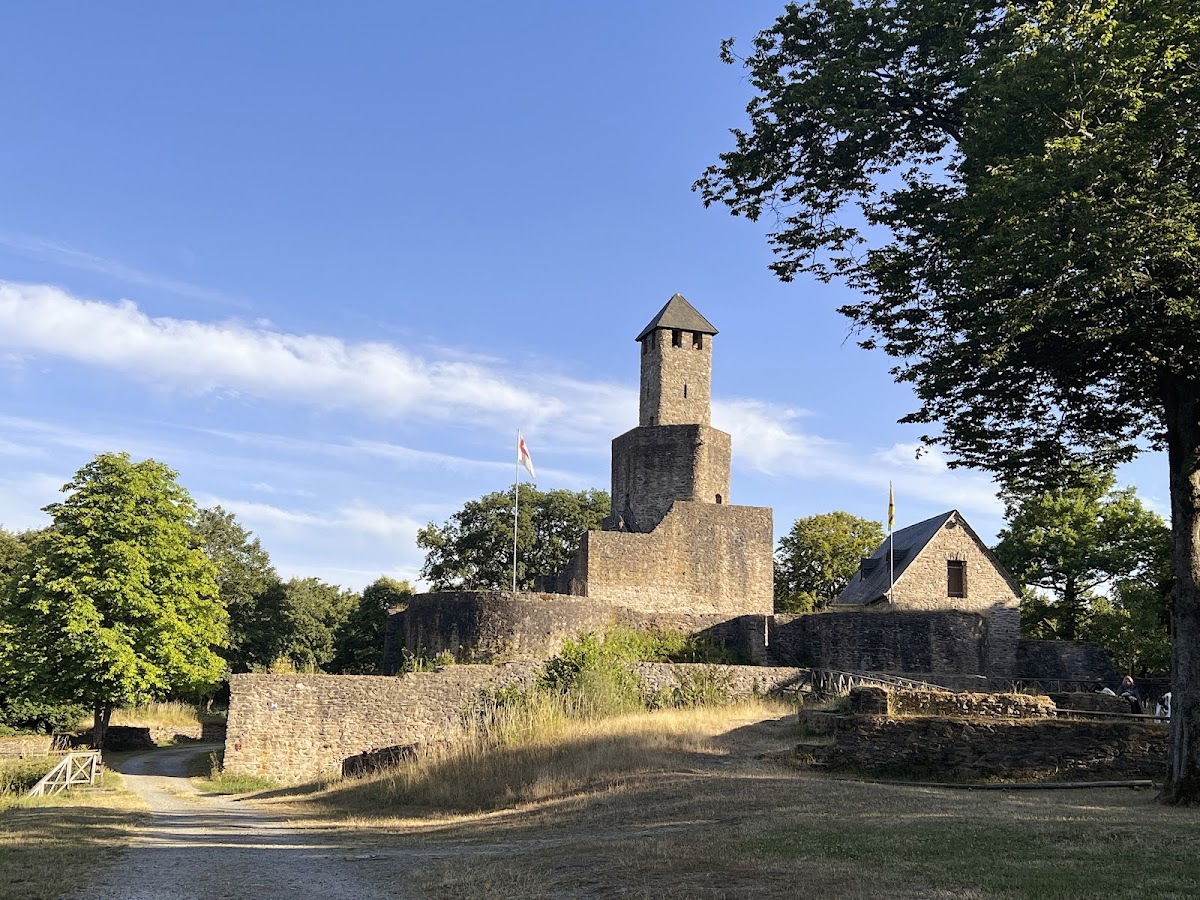
The castle complex extends for approximately 300 metres in length and 90 metres in width. Its principal elements are an outer bailey, a rectangular keep, a palas or residential hall, and a chapel. The keep and castle house form substantial surviving parts of the complex, although several components were partially rebuilt during the modern reconstruction campaigns.
Principal buildings
Keep and castle house
The rectangular keep was the principal fortified tower of the castle. It is one of the substantial surviving parts of the complex and was rebuilt between 1978 and 1990. The castle house, the main residential and representative building, was reconstructed between 1978 and 1988. Together, these buildings form the central architectural remains of the reconstructed stronghold.
Chapel
The chapel was arranged as a lower church and an upper church. The lower church served the inhabitants of the outer bailey. The upper church was designed as a gallery with its own entrance and was reserved for the Archbishop of Trier and his officials. The chapel was renewed and enlarged in 1585 during the residence of Elector Johann of Schönberg.
Outer bailey and towers
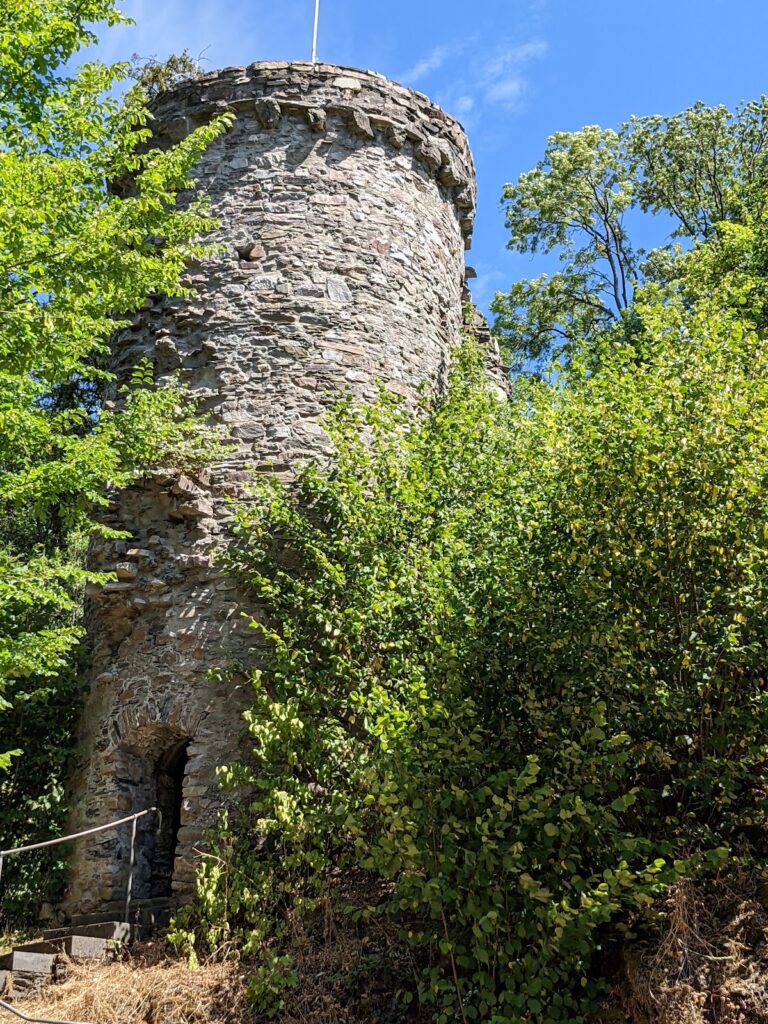
The outer bailey formed part of the castle’s extended layout and was served by the lower church. The Witches’ Tower and Kitchen Tower were reconstructed between 1981 and 1987, while the entrance tower was rebuilt from 1999 to 2000. These towers, together with the keep and castle house, are documented components of the reconstructed complex.
The first castle may have included a residential tower that was later hollowed out and fitted with a new pentagonal tower. The builder of this early arrangement remains uncertain. The surviving complex therefore combines evidence of an earlier castle plan with buildings and towers restored or partly reconstructed during the campaigns carried out from 1978 to 2000.