Château d’Heudicourt: A Historic Residence in Normandy


Site at a Glance
- Rating
- 4.4
- Popularity
- Very Low
- Country
- France
- Primary era
- Early Modern
- External website
- Open
- Eras represented
- Early Modern, Modern
- Civilizations
- French
- Site type
- Domestic
- Remains
- Castle
On this page7 sections
History
Château d’Heudicourt is a sixteenth-century residence in Heudicourt, France, built by the Sublet family in the architectural tradition later described as the Louis XIII style, which combined late Renaissance and early Baroque features. Tradition holds that a hunting rendezvous stood on the site during the reign of Dagobert, the seventh-century Merovingian king of the Franks. The estate’s documented history begins in 1574, when it was acquired by the father of Michel (I) Sublet, an administrator serving Marshal Joyeuse.
The Sublet family
Michel (I) Sublet built the château. After his death, his son Michel (II), a lieutenant general and governor of Landrecies, completed the residence around 1660. Michel III, the next generation, became Marquis d’Heudicourt and served in the armies until 1684. He died at the château in 1720. In 1666 he married Bonne de Pons, niece of Marshal d’Albret and a close friend of Madame de Maintenon, the prominent court figure and morganatic wife of Louis XIV. A painting by Mignard preserved at the château shows Michel III and Bonne de Pons together.
From royal office to private estate
The property later passed to Pons Auguste Sublet, Grand Wolfcatcher of France, a senior royal officer responsible for the king’s hunting establishment, especially wolf hunting. He transferred the office to his son-in-law Belsunce while retaining its income. Pons Auguste was remembered for his wit, sharp remarks, malicious humour, and extreme drunkenness.
His only daughter, Alexandrine Sublet (1721–1803), inherited the estate. At fifteen she became Madame de Belzunce, Marquise de Castelmoron. Widowed at twenty, she later served as a lady-in-waiting to Madame Adélaïde, daughter of Louis XV. She was reputedly noticed by both the king and the dauphin, the heir apparent to the French throne.
Revolution and Estève restoration
During the French Revolution, the château was converted into a prison. In 1798, Madame de Belzunce transferred the estate to four Parisian notables, who sold it in 1804 to Martin-Roch-Xavier Estève, Treasurer of the Government and a native of Languedoc.
Estève restored the property by raising the moats and the entrance bridge. He also levelled the lateral wings, which were falling into ruin. After becoming Treasurer-General of the Crown, he was made a Count of the Empire by Napoleon in 1809. Following a quarrel with the emperor, Estève resigned in 1811 and retired to Heudicourt. The Estève family remains the owner of the estate, whose current owner is identified as Yves Estève. The château is privately used as a residence.
Château d’Heudicourt, its main courtyard, moats, and gardens were classified as historic monuments by an order of 17 October 1966. In France, this status places a building or site under state heritage protection because of its architectural or historical importance.
Remains
The château and courtyard
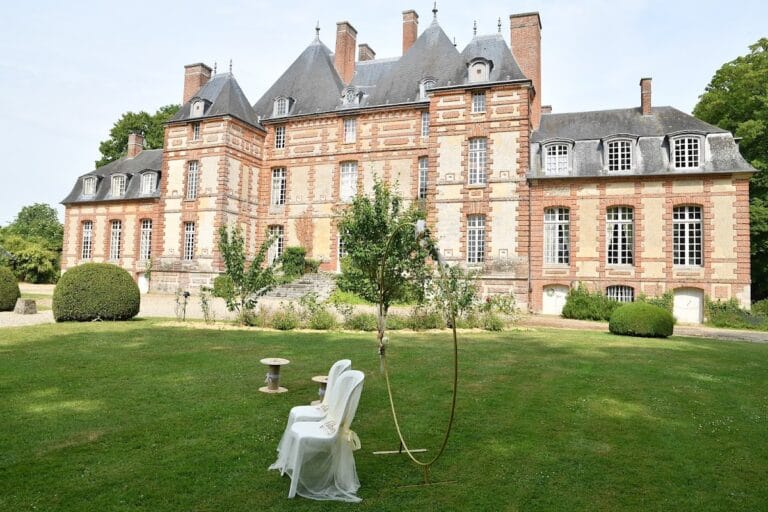
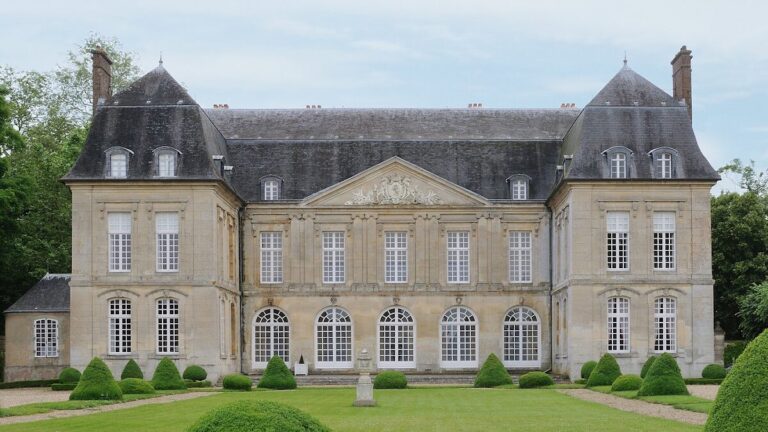
Built of brick and stone beneath slate roofs, the château formed part of a four-building complex arranged around the present main courtyard. Square pavilions stood at the corners, while deep dry moats separated the complex from its surroundings. The entrance is reached by a bridge over the moats. Only the principal residential building survives from the original arrangement. It was rebuilt in the eighteenth century and later given a Neoclassical avant-corps, a projecting section of a building’s façade, by Martin-Roch-Xavier Estève. The lateral wings were levelled during his restoration because they had fallen into ruin.
The park and gardens
The park covers 14 hectares and was laid out in a classical manner at the end of the seventeenth century. Its surviving design includes groves, star-shaped avenues, an open-air theatre, and views toward the surrounding countryside framed by ha-ha walls. A ha-ha is a sunken boundary that preserves an uninterrupted landscape view while restricting movement. In the nineteenth century, a medicinal-plant garden supplied the château pharmacy with herbs.
The storm of 1999 brought down old rows of trees and large cedars near the château. The plantings were later reconstituted with several hundred trees representing various species.
Nearby sites