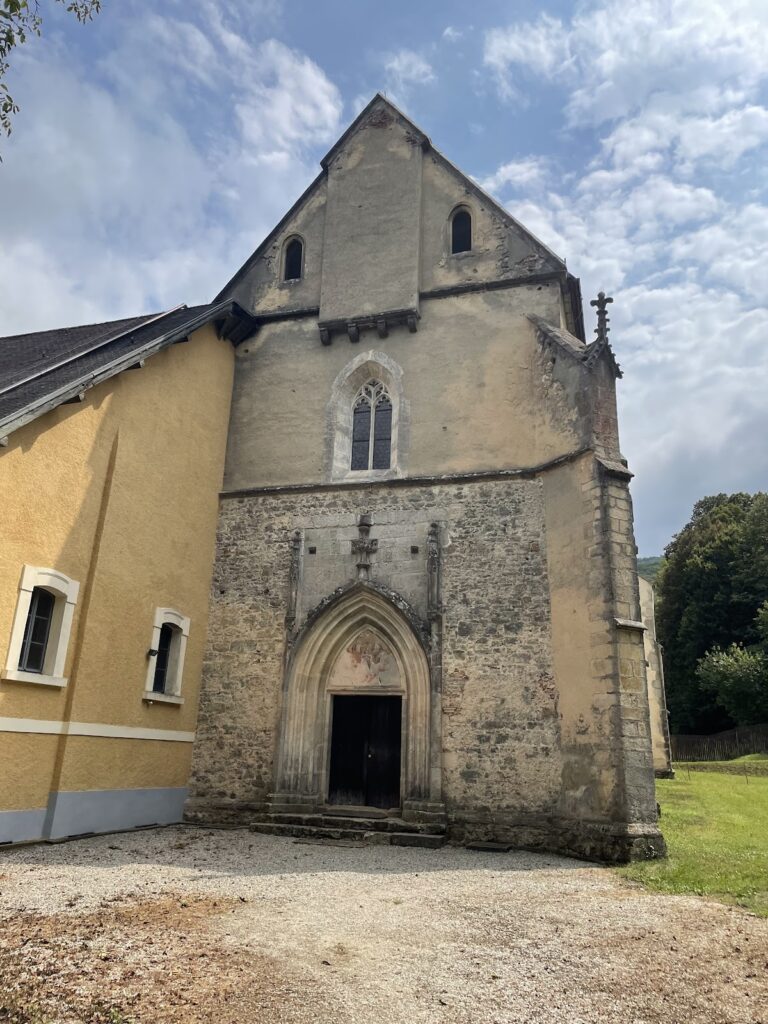
Castle Gradac: A Water Castle and Historic Estate in Slovenia


Site at a Glance
- Rating
- 3.5
- Popularity
- Very Low
- Country
- Slovenia
- Primary era
- Medieval
- Eras represented
- Medieval, Early Modern, Modern
- Civilizations
- Habsburg, Holy Roman Empire
- Site type
- Military
- Remains
- Castle
On this page12 sections
History
Castle Gradac is a medieval water castle in Gradac, Slovenia, whose origins reach back to the thirteenth century. Built as a fortified residence beside the Lahinja, it developed from a defensive stronghold into an aristocratic estate, an industrial centre, a wartime medical facility, and a residential complex.
Medieval fortress and aristocratic estate
The castle first appears in written records in 1228 under the name Graecz, when it was described as a fortress. Other historical forms include Gretz, Gradez, Gradecz, castrum Gretz, castrum Graecz, Schloss Grecz, and gschloss Graecz. The name may have come from its owner Herbort, who is also identified uncertainly as Herbert of Graecz or Herward of Auersperg and Grätz.
Its early purpose was probably military. The fortress helped protect the surrounding area during Ottoman attacks and offered shelter to local peasants. In the fifteenth century, the complex included a tabor, a fortified refuge used for defense and shelter. This structure was later demolished when the castle park was laid out.
The von Grez family line ended in 1475, after which the castle passed to the Auersperg family of Turjak. Erasmus Minndorfer held it in 1488, followed later by Peter Čavič. Ownership during the seventeenth century included Jurij Lell, the Thurn-Valsassina counts, and the Purgstall counts. Janez Baltazar Purgstall was the owner in 1629, while his son Janez Jurij Purgstall of Khrupp, Freyenthurn, and Gradez held it in 1632. The owner between 1625 and 1629 remains unidentified.
Janez Vajkard Valvasor, a seventeenth-century Carniolan nobleman and writer, referred to the castle as Gradez, Gradec, or Grätz in his historical and geographical work. The local pronunciation Gradetz preserves this older form. The Slovenian word gradec means a small fortress or small castle.
Earthquake, rebuilding, and industrial change
An earthquake in 1640 destroyed half of the castle. The Gusič counts acquired the estate in 1661 and remodeled the damaged complex. They retained ownership until 1846. The castle later passed through several hands, including the Ottenfels-Gschwind family, which bought it in 1881. In 1882 it went to Baron Friedau and the Austrian Alpine Mining Company, and in 1891 to the entrepreneur Robert Schlesinger of Opatija. Gabriela Goriany of Ruperč vrh purchased half the castle in 1916 and sold her share that same year to the Croatian Escompte Bank in Zagreb. The last owner was the Zagreb businessman Šutej.
Industrial development brought a major change to the estate and its surroundings. After the Revolution of 1848, Franz Ritter von Friedau established the first ironworks in the Bela krajina region at Gradac. He already owned ironworks in Donawitz near Leoben and in Vordernberg in Upper Styria. Rising demand for iron and steel for railway construction, together with the removal of restrictions on industrial activity after 1848, encouraged the project. Local coal, iron ore, and forests that could supply charcoal also favored Gradac as its location.
The ironworks operated from 1858 to 1881. It directly employed about 50 workers, while coal extraction and forestry suppliers brought the wider workforce to roughly 300 people, in addition to around 20 to 30 carters. Economic crises, competition from larger consolidated ironworks, and weak transport links contributed to bankruptcy. Iron was carried by horse-drawn wagons to the nearest railway station at Zidani Most.
War, social reuse, and conservation
After Italy’s capitulation, an ambulance was established in the castle under Dr. Zvezdana Mervin. It treated approximately 48 patients each day. In autumn 1944, further medical stations operated in the Macele House and the Potočnik family house, while Pancetova Gostilna served as a soup kitchen.
After the Second World War, the castle housed a school for young people described at the time as difficult to educate. The buildings were later converted into social housing. The former school building still had eight tenants in 2025, and rooms in the castle buildings continued to serve as apartments until well into the 1990s.
The estate also preserves an important episode in the history of written administration. A Slovenian-language urbar, a lordship register of property, rights, and dependent inhabitants’ obligations, belonged to the lords of Gradac. It was valued as an economic and legal record of medieval and early-modern feudal society and was regarded as the only urbar written in Slovenian. Janez Jurif Baron Purgstall, also known as Johan Georg Purgstall, listed it in his testament of 29 March 1640. It was not included in the 1693 inventory of Serena Magdalena Gusić, née Marenzi, although Janez Sigmund Baron Gusić’s testament of 1720 mentioned an old urbar of the Gradac castle and estate. The document was later lost.
Castle Gradac and its park are protected as a Slovenian cultural monument of national importance. Interest in repairing and reusing the complex grew especially after Slovenia became independent, although practical progress was slow for many years. The Municipality of Metlika installed a new roof on the Visoki grad to slow deterioration. Proposals involving investors from Italy and Ireland did not result in leases.
Public discussion about the castle’s future intensified in 2006 during debate over a regional development programme and Slovenian municipal elections. Since summer that year, residents of Gradac have led a revitalization initiative. Later proposals included a hotel and facilities for riding, tennis, golf, and canoeing. A public tender in early 2009 sought a long-term tenant and placed the castle in the “Invest in Slovene Tourism” programme. In 2022, SPIRIT Slovenija issued another call to attract investors.
Remains
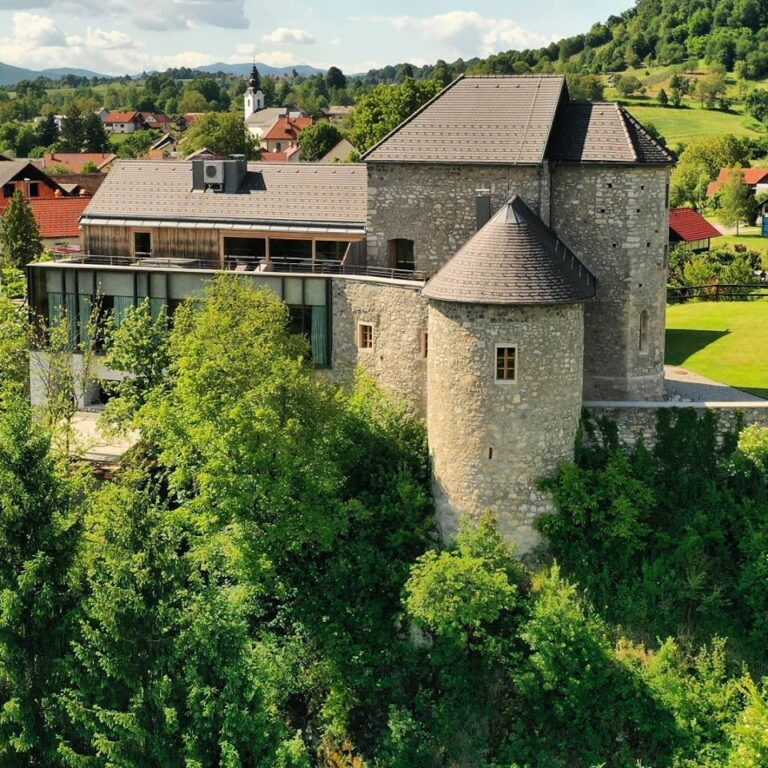
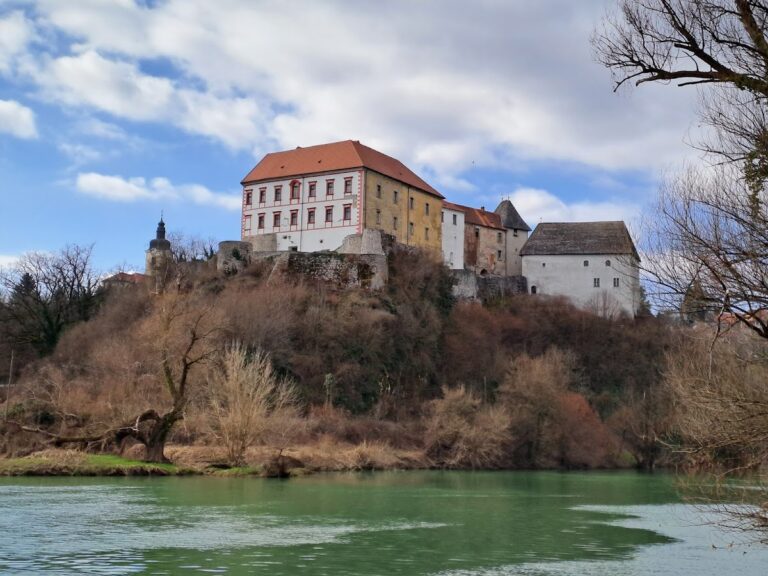
Castle Gradac stands in the centre of Gradac on a bend of the Lahinja, with the river surrounding it on three sides. The surviving complex combines the principal Visoki grad, or High Castle, the elongated nineteenth-century Nizki grad, or Low Castle, a residential building, a stable, and a park with gardens and a mausoleum. Its water-protected setting reflects the castle’s original defensive function.
Castle buildings and approach
High Castle
The Visoki grad forms the principal castle building. Its origins belong to the thirteenth-century water castle, which was enlarged and altered over time. The earthquake of 1640 destroyed half of the complex, and the Gusič counts remodeled it after acquiring the estate in 1661. A new roof was later installed on the building as a measure to slow its deterioration.
Low Castle and residential building
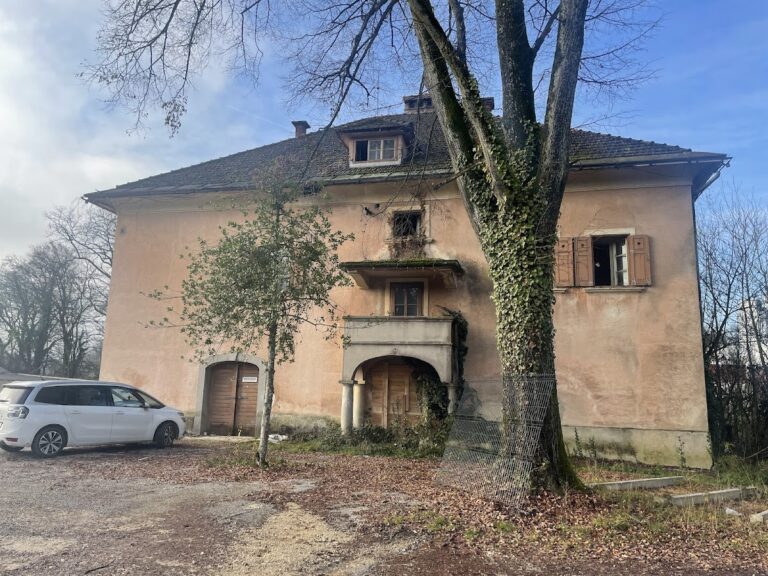
The elongated Nizki grad is a nineteenth-century service building within the castle complex. Nearby, the present residential building preserves the later social history of the estate. It first served as the school established after the Second World War and subsequently formed part of the social-housing accommodation.
Bridges, moat, and stable
The former entrance crossed the moat by a wooden drawbridge. The part of the moat beneath that approach was later filled. A wooden bridge now provides the approach, having been rebuilt in 2024 to replace an older bridge that had become structurally unsafe. In the courtyard, the remains of the burned stables survive. A second small wooden bridge once linked the castle with properties across the Lahinja in the area known as Tropinek.
Park and ironworks landscape
Park, gardens, and mausoleum
The former estate included a landscaped park, gardens, and an avenue about 100 metres long planted with large plane trees and spruces. The avenue was illegally felled during the 1990s, after Slovenia’s independence from Yugoslavia, and its timber was sold illicitly. The surviving tree stumps mark its former line. The park is regarded as an important example of garden architecture in Slovenia. Ivan Stopar provisionally placed its creation in the seventeenth century, when the Gusič family acquired the castle, although the precise history of its formation remains uncertain. A mausoleum of the former owner Ivan Gusič is also part of the estate.
Ironworks at Tropinek
Across the Lahinja at Tropinek stood the region’s first blast furnace and iron foundry. The associated ironworks operated from 1858 to 1881 and formed part of the industrial transformation connected with Castle Gradac during the nineteenth century.