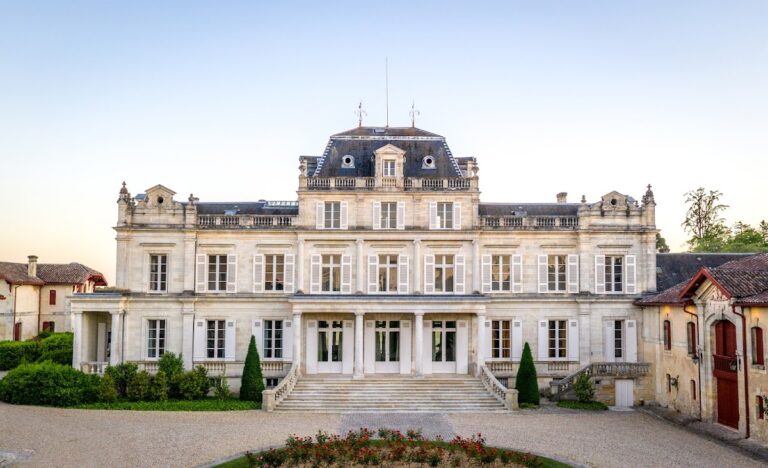
Château Rauzan-Ségla: A Historic Margaux Wine Estate in France


Site at a Glance
- Rating
- 4.6
- Popularity
- Very Low
- Country
- France
- Primary era
- Early Modern
- External website
- Open
- Eras represented
- Early Modern, Modern
- Civilizations
- French
- Site type
- Economic
- Remains
- Production Complex
On this page11 sections
History
Château Rauzan-Ségla is a historic wine estate in Margaux-Cantenac, France, within the Margaux appellation on the left bank of the Garonne in the Haut-Médoc. Its origins date to 1661, when the Bordeaux merchant Pierre des Mesures de Rauzan acquired the Gassies noble house and its vineyard. The estate produces the red wine Château Rauzan-Ségla and the second wine Ségla, and its history is closely connected with the formation of several other celebrated Bordeaux properties.
Origins and division of the Rauzan estate
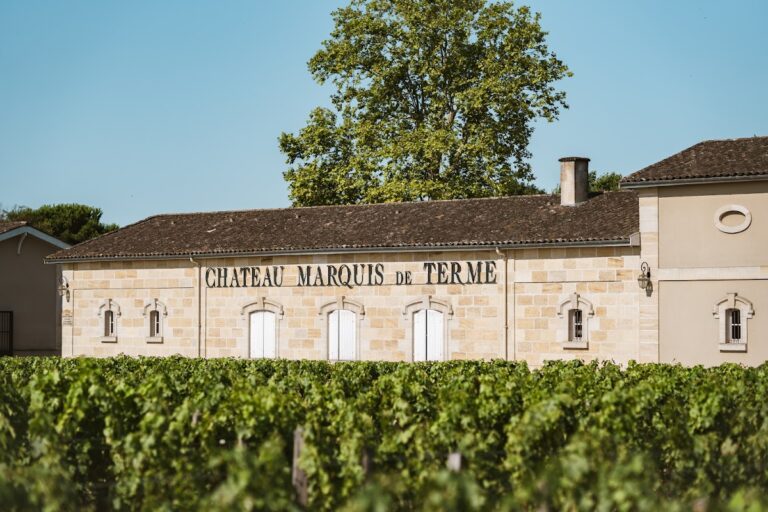
On 7 September 1661, Pierre des Mesures de Rauzan purchased the Gassies property. The surviving wine cellar dates from this period. Rauzan also leased Château Margaux from 1661 and Château Latour from 1679, extending his influence among the leading estates of Bordeaux. After his death in 1692, members of his family continued to administer the Rauzan holdings in Margaux, while marriage and inheritance transferred other parts of the original estate into separate properties, including the later Château Rauzan-Gassies, Château Desmirail, and Château Marquis de Terme.
Marie-Anne de Briet, who had married Philippe-Simon de Rauzan, took control of the Ségla share in 1778 with help from her former parents-in-law. The Rauzan property was formally divided into the Rauzan-Ségla and Rauzan-Gassies shares on 24 April 1763. The name Ségla came from Catherine, who married Baron Pierre-Louis de Ségla in 1785. The share later passed through the Count de Colper and Baron d’Adèle.
Eighteenth-century reputation
During the eighteenth century, Rauzan wines were considered among the best produced in Bordeaux. Thomas Jefferson, then the United States minister to France and later president, visited the estate in Bordeaux in 1787. He described it as “Rozan” and placed it in the second category of Bordeaux wines. In 1790, while returning to the United States, he bought 120 bottles. The wines may also have been supplied to George Washington’s cellars.
Ownership and changing fortunes
Eugène Durand-Dassier, a minister of the Reformed Church, purchased the estate in 1866. In the final quarter of the nineteenth century, annual production varied with the harvest from 24 to 105 barrels, averaging about 50 barrels. Durand-Dassier received an honorary diploma at the 1895 International Exhibition of the Philomatic Society of Bordeaux.
In 1903, the property passed by inheritance to Durand-Dassier’s only daughter, who was married to Frédéric Cruse. The Cruse family owned several Bordeaux vineyards and placed Rauzan-Ségla under the management of Charles Skawinski of Château Pontet-Canet. The vineyard then covered 35 hectares, and the wine sometimes sold for prices closer to those of a first growth than a second growth.
A severe frost in 1956 led to the replanting of much of the vineyard with Merlot, which harmed wine quality. John Holt, an English company, bought the estate in 1960 for three times the amount paid in 1956. In 1988, John Holt, the Eschenauer trading house, and their associated châteaux became part of the English corporation Brent Walker. Spring frosts in 1991 reduced the harvest to one-third of its usual level. During Brent Walker’s financial crisis, the company’s bankers placed the estate on the market.
Renewal under Chanel
French entrepreneur Jacques Wertheimer, the owner of Chanel, acquired the winery in 1994. The property is held through the Wertheimer family and Chanel, and the original spelling Rauzan-Ségla was restored after the acquisition. Following Jacques Wertheimer’s death in 1996, ownership of Chanel and the winery passed to his sons Alain and Gérard.
The new management bottled the 1993 wines. David Orr and John Kolasa joined the estate after working at Château Latour, and a distribution company associated with Latour was also acquired. After a quality crisis in the 1960s, Rauzan-Ségla regained an elite position among Bordeaux wineries during the 1980s through new cellar equipment, improved vines, stricter grape selection, and a new management team.
Since 1973, Château Rauzan-Ségla has held the first position among the Deuxième Crus Classés, or classified second growths, in the official 1855 Classification of Bordeaux wines. This classification places leading Bordeaux estates into formal growth categories, with second growths below the first-growth category. The estate marked its 350th anniversary in 2011, when the German fashion designer Karl Lagerfeld created the label for the 2009 vintage.
Nicolas Audebert assumed operational responsibility for Château Rauzan-Ségla and Château Canon in May 2014. He had previously worked for the Champagne house Krug and for Cheval des Andes in Argentina, and he oversaw his first Bordeaux harvest in September 2015. In 2024, both estates received certification for organic winegrowing.
Remains
The estate covers 66 hectares, including approximately 49 to 52 hectares of vines. Its physical character combines a historic country house, a surviving wine cellar, operating buildings, an observatory tower, and a vineyard planted on gravel and clay-limestone soils. The buildings and production areas have been altered over time, while the vineyard and cellar continue to define the estate’s organization as a working wine property.
Château and estate buildings
The mansion
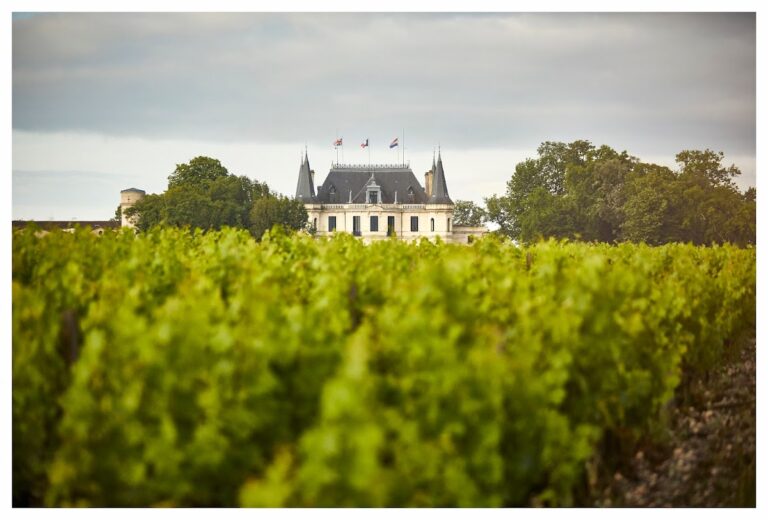
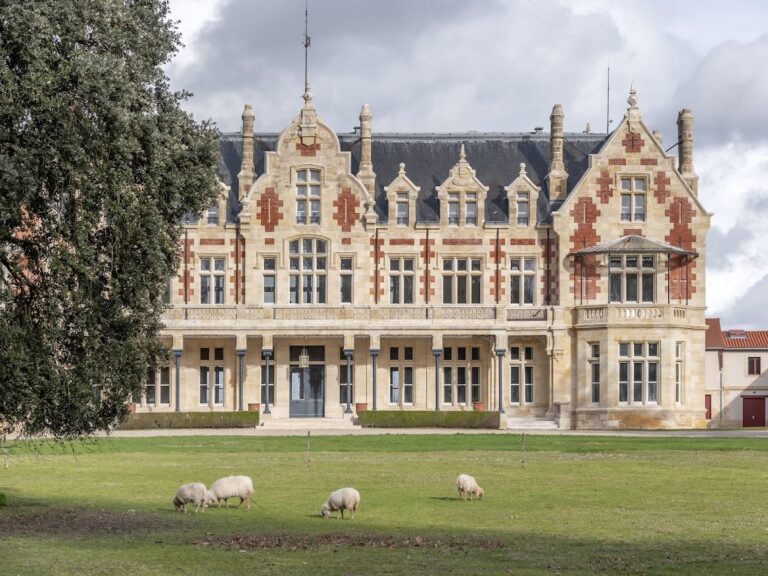
The original house was a modest, single-storey rural chartreuse, a low and elongated country house associated especially with the Bordeaux region. Frédéric Cruse commissioned Louis Garros to transform it into the present two-storey mansion, which has sloping roofs and a turret. The château was restored between 1904 and 1905, and its operating buildings were renovated from 1905 to 1906.
The rooms were once richly furnished with furniture and objects acquired from Bordeaux châteaux that were being demolished. Later furnishings became more uniform and include English furniture from the eighteenth and nineteenth centuries. The interiors were renewed at the beginning of the twenty-first century by the American architect Peter Marino.
The observatory tower
Between 1919 and 1920, Alexandre Garros added an observatory tower to a shed. He was the son of Louis Garros, who had reshaped the mansion. The tower forms part of the estate’s later architectural development alongside the earlier château and operating buildings.
The wine cellar and winery
The surviving wine cellar dates from the estate’s seventeenth-century origins. At the beginning of the twenty-first century, older steel vats were replaced by larger temperature-controlled stainless-steel vats. These vats regulate fermentation temperatures without imparting oak flavor. Extensive vineyard work and strict selection at every stage of production accompanied the modernization.
The wines mature for approximately 18 months, or in some descriptions 18 to 20 months, in barriques, small oak barrels traditionally holding about 225 litres. Annual barrel renewal is approximately 50 to 60 percent, while the proportion of new barrels reached 70 percent during the early twenty-first-century modernization. Average yield is about 45 hectolitres per hectare, with annual production of roughly 100,000 to 120,000 bottles each of the grand vin, the estate’s principal wine, and Ségla.
Vineyard
The vineyard occupies fine, deep gravel, including deep gravel over clay and limestone, together with clay-limestone soils. Planting density is approximately 8,000 vines per hectare, and the vines use double Guyot pruning, a system that retains two fruiting canes, generally one on each side of the vine. Plantings were recorded as 54 percent Cabernet Sauvignon, 41 percent Merlot, 1 percent Cabernet Franc, and 4 percent Petit Verdot in 2008. In the early twenty-first century they comprised 61 percent Cabernet Sauvignon, 35 percent Merlot, 2 percent Petit Verdot, and 2 percent Cabernet Franc. The 2025 composition was 62 percent Cabernet Sauvignon, 36 percent Merlot, 1 percent Petit Verdot, and 1 percent Cabernet Franc. Average vine age was approximately 27 years in 2008 and approximately 35 years in another period.